Short answer
Some metal roofs need them and some do not. You need snow guards wherever snow sliding off the slope can land on a walkway, a driveway, a lower roof, a gutter or an entry door, and you can skip them where the eave discharges over lawn or planting beds. Standing seam sheds snow in slabs, so the decision is about what sits below the eave rather than about the panel itself.
On this page
Some metal roofs need snow guards and some do not. The test is simple: stand at the bottom of each slope and look at what is directly below the eave. If it is a walkway, a driveway, a set of steps, an entry door, a deck, a lower roof, a gas meter or a parked car, that slope needs snow retention. If it drains over lawn or shrubs, it usually does not.
This matters more on metal than on asphalt. A standing-seam pan is smooth and continuous, so once the sun warms the panel and a thin film of meltwater forms underneath the snowpack, the whole slab lets go at once. Several inches of wet New Jersey snow across a wide slope is a lot of weight arriving on the ground in about two seconds. Asphalt shingles hold snow with friction and shed it in pieces. Metal does not.
What snow guards actually do
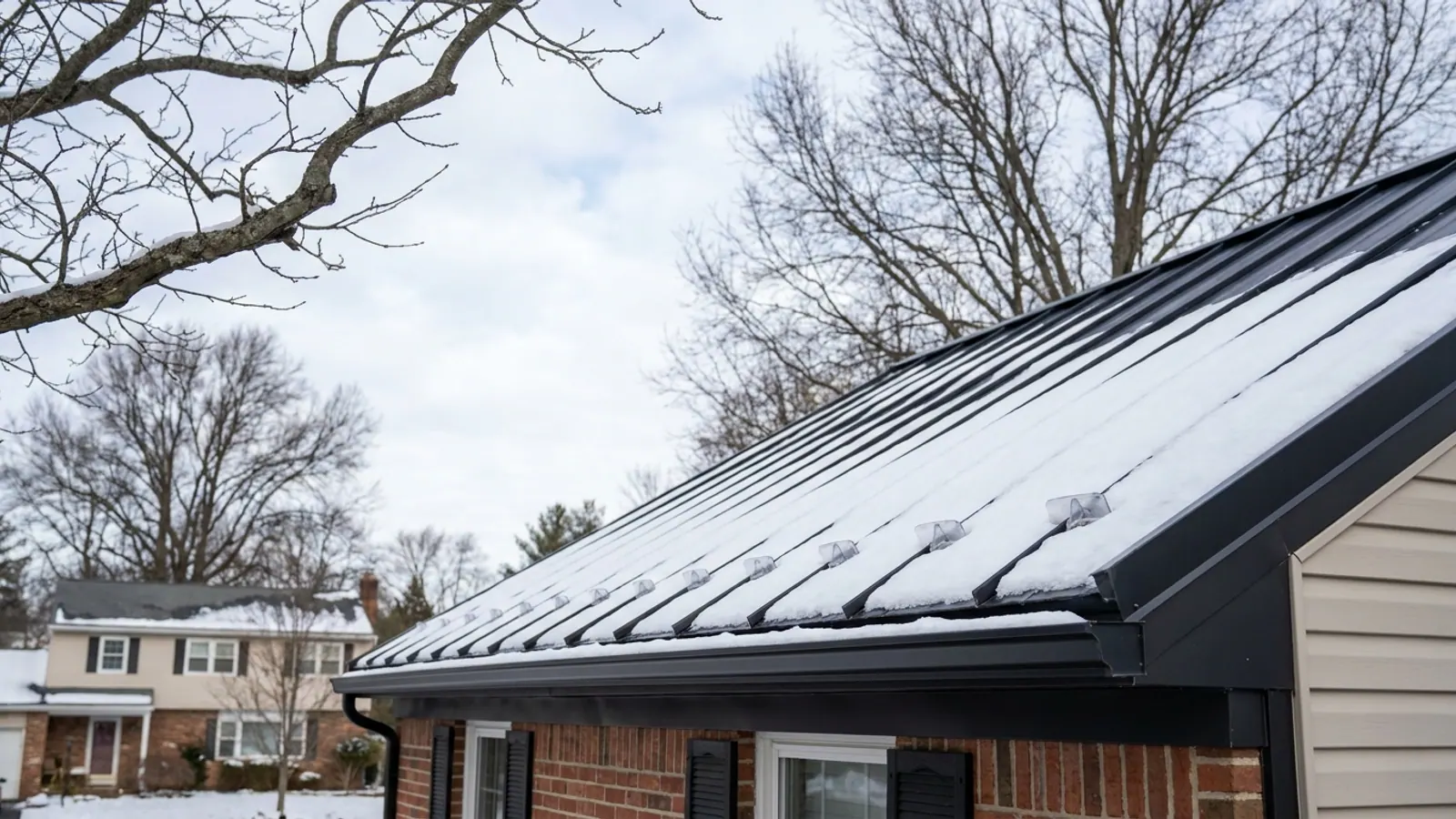
They break the sheet up and hold it on the roof so it melts and drains instead of releasing in one slab. That is the whole function. Guards do not stop snow from ever leaving the roof, they change how it leaves: as water down the gutter over a day or two, or as small amounts falling from between the guards, rather than as a single avalanche off the eave.
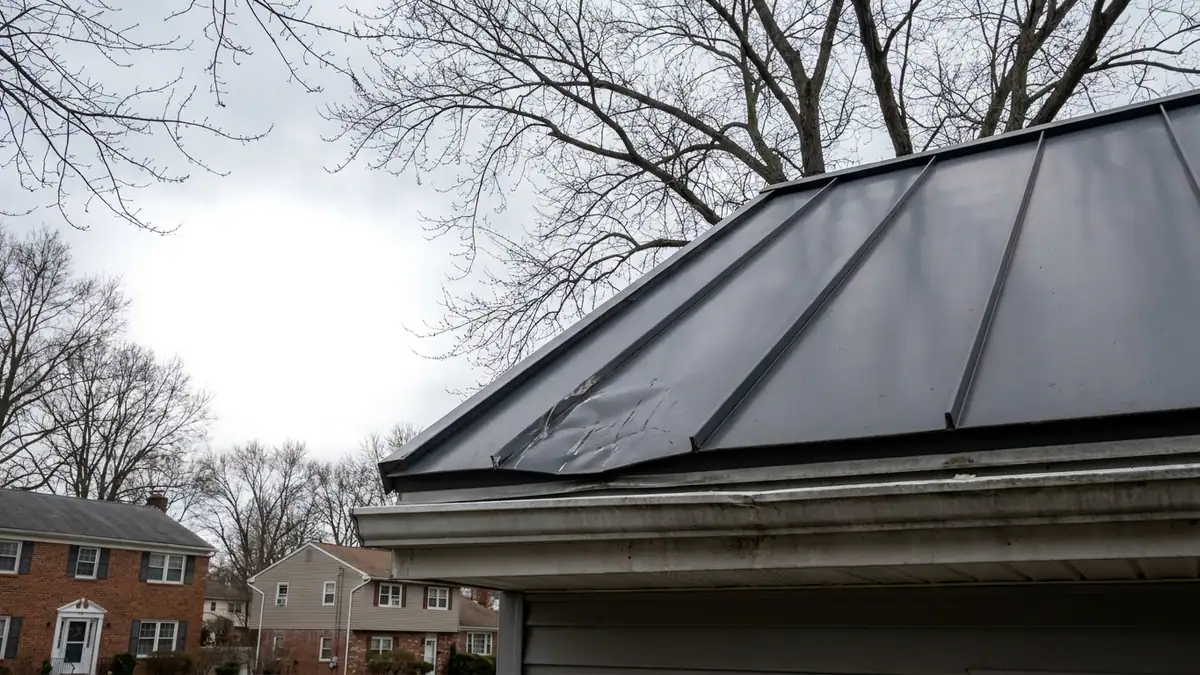
The damage a slide causes is predictable. Gutters get torn off the fascia, because the leading edge of the slab catches the front lip and pulls the whole run down with it. Lower roof sections take impact damage. Downspouts, railings, lighting and outdoor units below the eave get flattened. And the safety issue is the one people underestimate: a slide off a second-story slope onto a front walk is dangerous, and if that walk is a public sidewalk, it is a liability question too.
When a New Jersey metal roof needs snow guards
Work through the roof one slope at a time.
- Any slope above an entry door, a stoop, a set of steps or the path people actually use to reach the front door.
- Any slope above a driveway or a parking area, especially where a car sits under the eave.
- Any slope that discharges onto a lower roof, a porch roof, a bay window roof or an attached garage.
- Any slope above a deck, patio, hot tub, air conditioning condenser, generator, gas meter or utility feed.
- Any slope whose eave sits close to a property line or a sidewalk.
- Slopes steeper than roughly 6:12, where snow releases sooner and travels farther once it does.
Slopes that shed over open lawn, planting beds or the back of the lot generally do not need guards, and adding them there is money that buys nothing.
Snow load is the other half of the decision, and New Jersey is not uniform. The New Jersey DCA Bulletin 19-1 ground snow loads run 50 psf in Sussex County, 40 psf in Passaic County, 35 psf in Warren, Hunterdon and Morris counties and 30 psf in Somerset County, with other counties generating site-specific values. A roof in the northwest counties holds substantially more weight in a February storm than one near the shore, and the guard layout has to reflect that.
Types of snow retention, compared
| System | What it is | Best for |
|---|---|---|
| SystemIndividual pad or cleat guards | What it isSmall guards set in a staggered pattern across the field of the slope | Best forShorter slopes, moderate snow, lower-cost retention where full holding is not critical |
| SystemContinuous bar system | What it isOne or two round or rectangular tubes running the length of the eave on seam clamps | Best forMost standing-seam roofs above walkways and driveways; the standard choice |
| SystemSnow fence | What it isTwo or three rails on taller brackets, sometimes with a lower plate | Best forSteep slopes, long runs and higher snow load counties |
| SystemClear polycarbonate guards | What it isSmall guards that read as nearly invisible from the ground | Best forFront elevations where the homeowner does not want hardware in the sightline |
On a long slope, one row at the eave is often not enough. Snow above the row keeps loading it, so a second row partway up the slope may be specified. That is a calculation, not a preference: pitch, slope length and ground snow load produce a required holding capacity, and the manufacturer's layout tells the installer how many rows and what spacing meets it. Ask for that layout with your estimate.
How snow guards attach, and the mistake that causes leaks
On standing seam, they clamp to the seam. Clamp-on brackets tighten onto the raised seam with setscrews and put no holes in the panel, which is the entire point of standing seam in the first place. A snow guard screwed down through the flat of the panel creates a fastener penetration in a system designed to have none, blocks the panel from expanding and contracting with temperature, and is the kind of detail that shows up as a stain on a bedroom ceiling three winters later.
Adhesive-mounted guards exist and have a place on exposed-fastener panels and small roofs, but the bond depends on surface prep, temperature and the paint finish. For anything holding real snow load above a walkway, seam-clamped hardware is the right call.
Two more details worth checking. The guard base metal should match or be compatible with the roof panel so the two do not corrode at the contact point, and the guard finish should match the panel color if you care what the roof looks like from the street. The standing-seam metal roofing guide covers how the panel and clip system goes together, which is the assembly the guards are clamping to.
Snow guards and ice dams are not the same problem
Holding snow at the eave does not create an ice dam, and removing snow guards does not prevent one. Ice dams come from heat leaking out of the house into the attic, melting the snowpack from below, and that water refreezing when it reaches the cold overhang. The fix is air sealing, insulation and intake and exhaust ventilation that keeps the deck close to the outdoor temperature. The ice dam guide walks through the causes and what actually stops them.
What is true is that a roof with snow retention keeps its snow longer, so a house with poor attic ventilation will get its ice problems on display rather than sliding them off the edge. Fix the attic, then add the guards. Do not use sliding snow as a ventilation strategy.
What to have in the estimate before you sign
Snow retention is a line item, and it should be written down like one. Get all of this on paper:
- Which slopes get guards, named by elevation, and which do not.
- The system type and manufacturer, the number of rows and the spacing.
- The attachment method, stated as seam clamp, adhesive or mechanically fastened.
- The finish or color of the guards.
- Confirmation that the layout was calculated for your pitch, slope length and county snow load.
Gutters are part of this conversation too. If your existing gutters were torn loose by a slide, or the metal roof is going on above hangers that are already pulling out of the fascia, the gutter work should be scoped at the same time rather than after the roof is finished.
Getting a straight answer on your own roof
Standing-seam installation runs two to four days, and snow retention is specified before the first panel goes up because the seam spacing and the guard layout have to agree. That is the point to decide, not the following January.
Lightning Construction is veteran-owned and family-operated, GAF Certified, and licensed and insured under New Jersey Home Improvement Contractor registration 13VH12437000, and it works in all 21 New Jersey counties. There is no deposit on any job and no change orders: the written estimate is the final price, and the conditions that normally trigger extras are found at the free inspection and priced into the quote. Lightning pulls the permit from your municipality's construction office under the New Jersey Uniform Construction Code and attends the inspection, so you file nothing.
If you are pricing a metal roof and want the snow retention specified properly for your slopes and your county, book a free estimate. It costs nothing, there is no obligation, and a salesperson does come to the house.