Short answer
Salt air rarely kills the panels first. It attacks the small parts — fasteners, clips, cut panel edges, trim, drip edge and the flashing screws — because those are where the protective coating is thinnest, cut through, or missing entirely. On a shore house the specification that matters is the fastener and trim metallurgy, not the panel color.
On this page
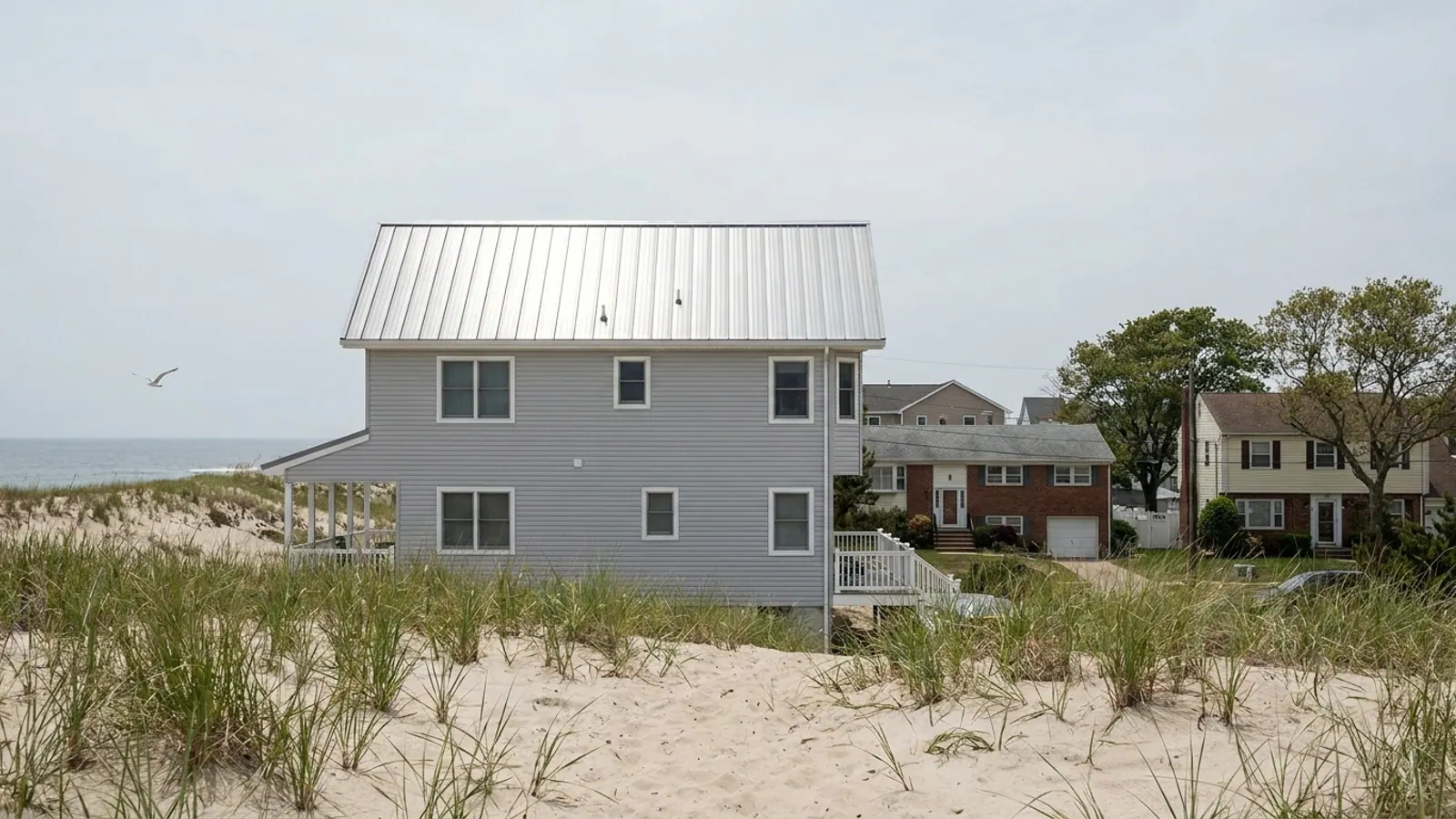
Salt air does not usually eat the panels. It eats the hardware. On a New Jersey shore house, the first things to fail on a metal roof are the fasteners, the clips, the exposed cut edges of panels, and the trim and flashing at the perimeter — because those are the places where the factory coating is thinnest, sheared through, or absent. The panel field, with its full paint system on both faces, is the most protected part of the assembly.
That changes what you should be asking a contractor for. The color and the seam profile get all the attention in the showroom. The metallurgy of the screws and the trim is what decides whether the roof looks the same in twenty years.
What salt air actually does to metal
Airborne chloride lands on every surface facing the ocean and stays there. Rain washes some of it off the open roof. Everything sheltered from direct rainfall — soffit undersides, the back side of trim returns, the tuck under a drip edge, the underside of a gutter lip — holds the salt and stays damp longer. Chloride breaks down the passive oxide layer that normally protects metal, and keeps the surface conductive, so corrosion that would stall out inland keeps going.
Three specific mechanisms matter on a roof:
- Coating consumption. Galvanized and Galvalume steel rely on a zinc or zinc-aluminum layer that corrodes in place of the steel. Salt accelerates that sacrifice. Once the coating is used up locally, the steel underneath goes.
- Cut-edge corrosion. Every panel end, every hole drilled for a pipe, every trim miter exposes bare steel. Coatings self-heal across a thin cut inland. In heavy chloride they often do not.
- Galvanic corrosion. Two dissimilar metals in contact with salt water between them form a battery, and the less noble metal corrodes fast. A carbon steel screw in an aluminum panel is the classic version of this on a roof.
The parts that fail first
Fasteners and clips
Screws are the highest-risk item on a coastal metal roof. An exposed-fastener panel puts hundreds of screw heads and neoprene washers into direct salt spray. Even on a standing seam roof, the clips, the clip screws, and the fasteners holding trim and flashing are steel in a salty environment. Specify stainless on a shore house — typically 304 or 316 grade — rather than coated carbon steel. A painted carbon steel screw head looks identical on install day and tells you nothing.
Streaking rust below screw heads is the visible tell. By the time it stains the panel, the fastener shank is further along than the head suggests.
Cut edges and panel ends
Panels get cut on site at hips, valleys, rakes and around penetrations. Those edges should be deburred and, where a coated steel product is used, treated. Ask what the crew does with cut edges and swarf — the fine metal filings left by a saw or a drill. Filings left lying on a panel rust in place and pit the finish under them. A crew that brooms and wipes panels at the end of each day is doing real corrosion control, not housekeeping.
Trim, flashing and drip edge
The perimeter is where the roof meets the weather hardest and where most contractors economize. Drip edge, rake trim, valley metal, chimney and sidewall flashing, and the gutter behind it all need to be the same family of metal as the panel and fastened with compatible hardware. A beautiful aluminum roof with galvanized steel valley metal is a corrosion problem built in on day one. The standing-seam metal roofing guide covers how the system components fit together; what the shore adds is that every one of them has to agree metallurgically.
Which metals can touch and which cannot
| Panel metal | Compatible fasteners and trim | Keep away from |
|---|---|---|
| Panel metalAluminum | Compatible fasteners and trimStainless steel fasteners, aluminum trim, aluminum gutters | Keep away fromBare carbon steel, copper, lead, pressure-treated lumber in direct contact |
| Panel metalGalvalume or galvanized steel | Compatible fasteners and trimStainless or matched coated steel fasteners, same-coating steel trim | Keep away fromCopper, graphite-containing materials, standing contact with aluminum |
| Panel metalCopper | Compatible fasteners and trimCopper or stainless fasteners, copper trim | Keep away fromAluminum and galvanized steel anywhere downstream of copper runoff |
Direction matters as well as contact. Water running off a copper flashing onto an aluminum gutter will corrode the gutter even though the two never touch. Check what is uphill of what.
How close to the water does this matter
There is no clean line, and anyone who gives you one in feet is guessing. What is reliable is the gradient: an oceanfront or bayfront house with unobstructed exposure is in a far harsher environment than a house a mile back behind tree cover and other buildings. Houses in Ocean, Monmouth, Atlantic and Cape May counties that face open water, a bay or a tidal river should be specified as coastal. If your siding hardware stains, if your outdoor light fixtures pit, if your car shows salt film in summer, treat the roof the same way.
Wind matters alongside salt. Shore roofs take nor'easters every winter, and panel gauge, clip spacing and fastener pullout values are all part of the same specification conversation. The Jersey Shore roofing guide goes through the wind and storm side in depth.
What to put in the written estimate
Do not accept "coastal grade" as a line item. Ask for these in writing:
- The panel metal and, if steel, the coating designation and paint system.
- The fastener grade, by name, for panels, clips, trim and flashing.
- The metal of every trim and flashing piece, including valley metal, drip edge and the gutter.
- Whether the system is concealed-clip or exposed-fastener, and why that choice was made for your roof.
- What happens at cut edges and how panel swarf is cleaned up.
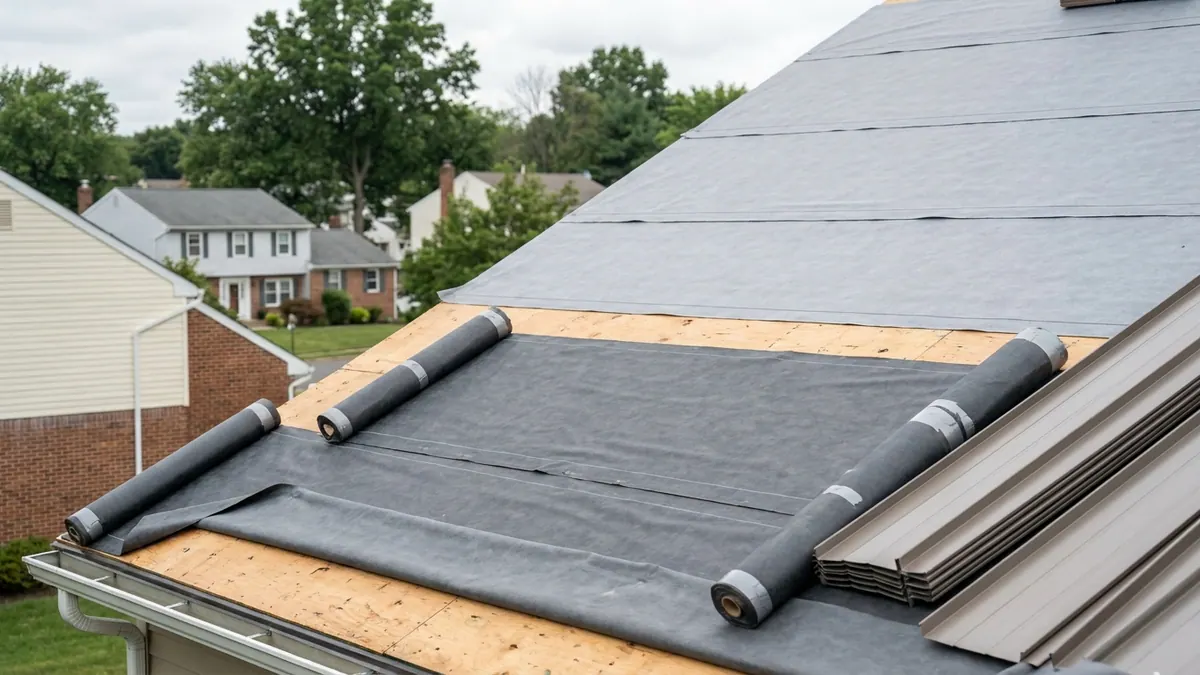
- The underlayment, since salt-laden moisture reaching the deck is a separate problem from panel corrosion.
At Lightning Construction the inspection and the written estimate are free, with no obligation, and a salesperson comes to the house. The written number is the final price — there are no change orders, and nothing is due until the work is finished and you have inspected it. Lightning pulls the permit and attends the municipal inspection under the New Jersey Uniform Construction Code, which on barrier island and flood-zone addresses is not always a short conversation.
Maintenance that actually extends a coastal metal roof
Rinsing works, and it is the single most useful thing a shore homeowner can do. Twice a year, hose down the areas rain never reaches: soffit undersides, the back faces of trim, sheltered wall flashing, and anywhere an overhang shields the metal. Plain fresh water is enough. No pressure washer, no abrasives, no harsh cleaners that strip the finish.
At the same time, walk the perimeter from the ground with binoculars and look for rust streaking below fasteners, white powdery blooming on aluminum, lifted trim, and debris packed into valleys. Clear the gutters, because standing water and wet leaf litter against the roof edge hold chloride right where the metal is most vulnerable.
Cost and what to do next
Metal roofing in New Jersey runs $18,000 to $35,000 in standard-value towns, $28,000 to $55,000 in higher-value towns, and $45,000 to $120,000 for large or luxury homes. The band is set by the municipality's median home value from ACS 2024 five-year estimates, not by how close the house is to the water. Stainless fasteners and matched trim are a small share of that total and the wrong place to save. A standing-seam installation takes two to four days.
If you own a shore house and you are weighing metal, start with the metal roofing page for how the systems are built, then book the free inspection and have the conversation about fasteners and trim on site, where someone can see your exposure.