Short answer
Oil canning is visible waviness in the flat part of a metal panel, and on most standing seam roofs it is cosmetic rather than a failure. It becomes an install problem when it comes from an uneven deck, panels pinned so they cannot move, or fasteners driven too tight. The way to tell the difference is where the waves are, whether they change shape through the day, and whether the seams and clips were installed to the panel maker's instructions.
On this page
- What oil canning actually is
- Why metal shows it and asphalt never does
- Cosmetic waviness versus an install problem
- Table of causes
- What changes how much oil canning you see
- What the crew does on the day to keep panels flat
- What to put in writing before you sign
- What to do if your new metal roof is waving
- Getting a straight answer on your own roof
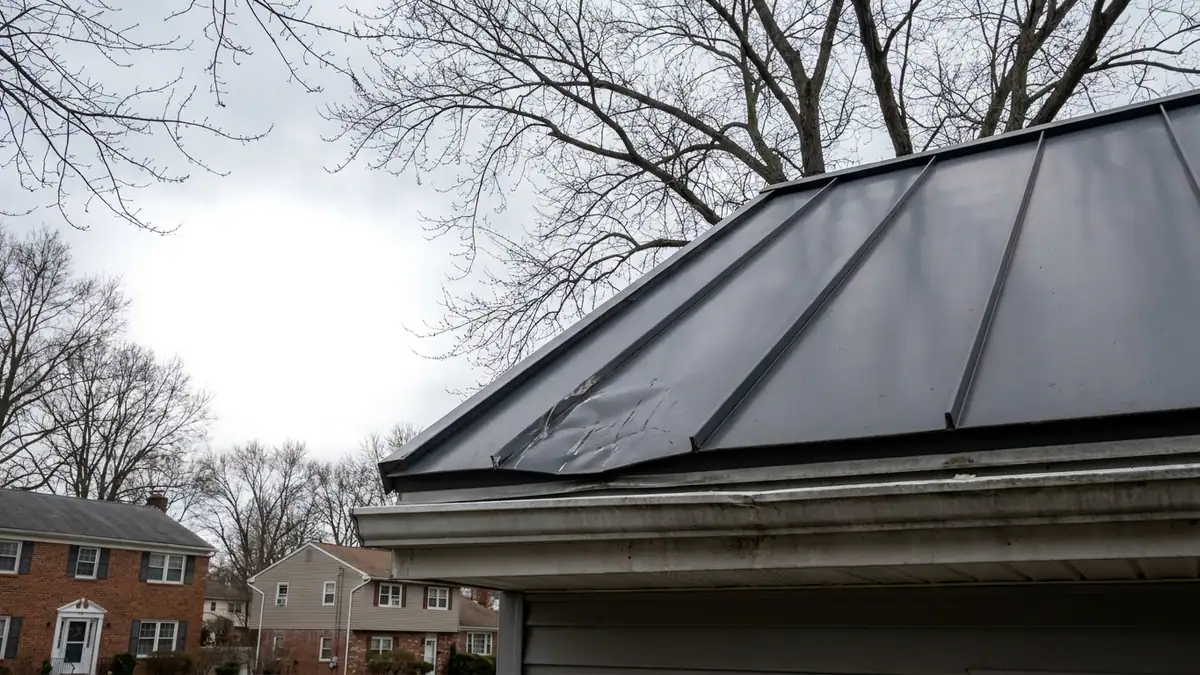
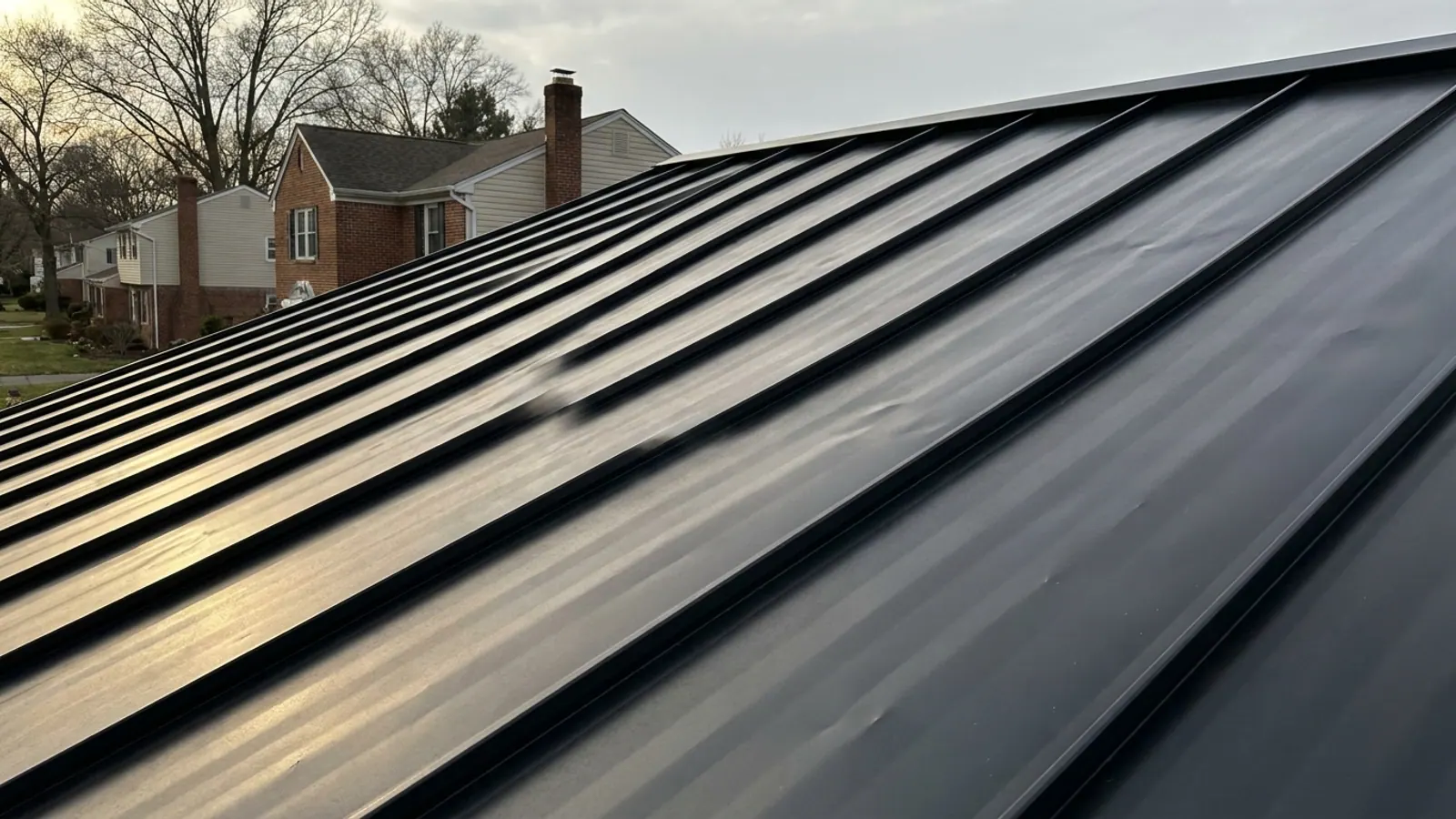
Oil canning is the visible waviness you see in the flat part of a metal panel, between the seams or ribs. On most standing seam roofs it is cosmetic. It shows up because a wide, flat piece of light-gauge metal is never perfectly flat, and low sun across the slope reveals every small change in the plane.
It becomes an installation problem in a narrower set of cases: an uneven deck telegraphing through, panels fastened so they cannot expand and contract, clips spaced wrong, or screws driven too tight. Those have a cause you can point at and a fix. General waviness across the field does not.
What oil canning actually is
Metal comes to the roll-former as a coil. Coil is made with internal stresses that are never perfectly even across its width, and the roll-forming process adds more. When that metal is stretched flat over a roof plane and then heated and cooled every day, the stress finds somewhere to go, and the widest, least supported part of the panel is the flat area between the seams.
That flat area is called the pan. Oil canning lives in the pan. The seams themselves, the clips underneath and the flashings at the edges are the parts that keep water out, and none of them is affected by a wave in the pan. That is the core reason the industry treats mild oil canning as an appearance issue instead of a performance one.
It also moves. A panel that looks smooth at noon can show a soft ripple at six in the evening when the sun comes in at a low angle, and the same slope can look flat again in overcast light. If the waviness appears and disappears with the light and the temperature, you are looking at normal behavior of the material.
Why metal shows it and asphalt never does
An asphalt shingle is small, thick relative to its span, and laid in broken courses. Nothing about it reflects a long unbroken line of light. A standing seam pan can be twenty feet long and more than a foot wide with nothing interrupting it, and it reflects the sky. Any deviation from dead flat becomes a visible band.
This is one of the real trade-offs of the material, and it is worth understanding before you choose. The asphalt versus metal comparison covers the rest of them. Metal buys you 50-plus year material life and a roof that does not lose tabs in a nor'easter. It also buys you a surface that shows its own geometry in a way shingles do not.
Cosmetic waviness versus an install problem
The difference is usually in the pattern.
Signs it is cosmetic
- The waves are broad, soft and spread across the pans on several panels.
- They change with the light and with the time of day.
- They are strongest on the sun-facing slopes in the late afternoon.
- The seams are straight, the panel edges are parallel, and the ridge and eave lines are true.
Signs it is an install problem
- The wave follows a straight line across several panels at the same point, which usually means a high or low spot in the decking under it, or a lap in the underlayment.
- There is a hard crease or a dimple at a fastener location, which means a screw was overdriven.
- A panel looks stretched and tight near the ridge and buckled near the eave, which points to a panel pinned at both ends so it cannot move with temperature.
- The seams are not parallel to each other, or a panel visibly grew or shrank in width across the run.
- The waving appeared suddenly after the first hot stretch of the summer rather than on day one.
Table of causes
| What you see | Likely cause | Cosmetic or install |
|---|---|---|
| What you seeSoft ripple in the pan, changes with light | Likely causeCoil stress and normal thermal movement | Cosmetic or installCosmetic |
| What you seeStraight wave line crossing several panels | Likely causeUneven decking or an underlayment lap under the panels | Cosmetic or installInstall |
| What you seeDimple or crease at one point | Likely causeFastener driven too tight | Cosmetic or installInstall |
| What you seeBuckling near the eave in hot weather | Likely causePanel fixed at both ends, no room to expand | Cosmetic or installInstall |
| What you seeWaviness only on the south and west slopes | Likely causeHeat load and low-angle sun | Cosmetic or installCosmetic |
| What you seeWave over an old roof left in place | Likely causeUneven substrate telegraphing through | Cosmetic or installInstall decision made earlier |
What changes how much oil canning you see
Five things move the needle, and all five get decided before the panels arrive.
- Panel width. A narrower pan has less unsupported flat area, so it resists waving. A wide panel looks cleaner to some people and shows more movement.
- Gauge. Heavier metal is stiffer and holds its plane better than thin metal over the same span.
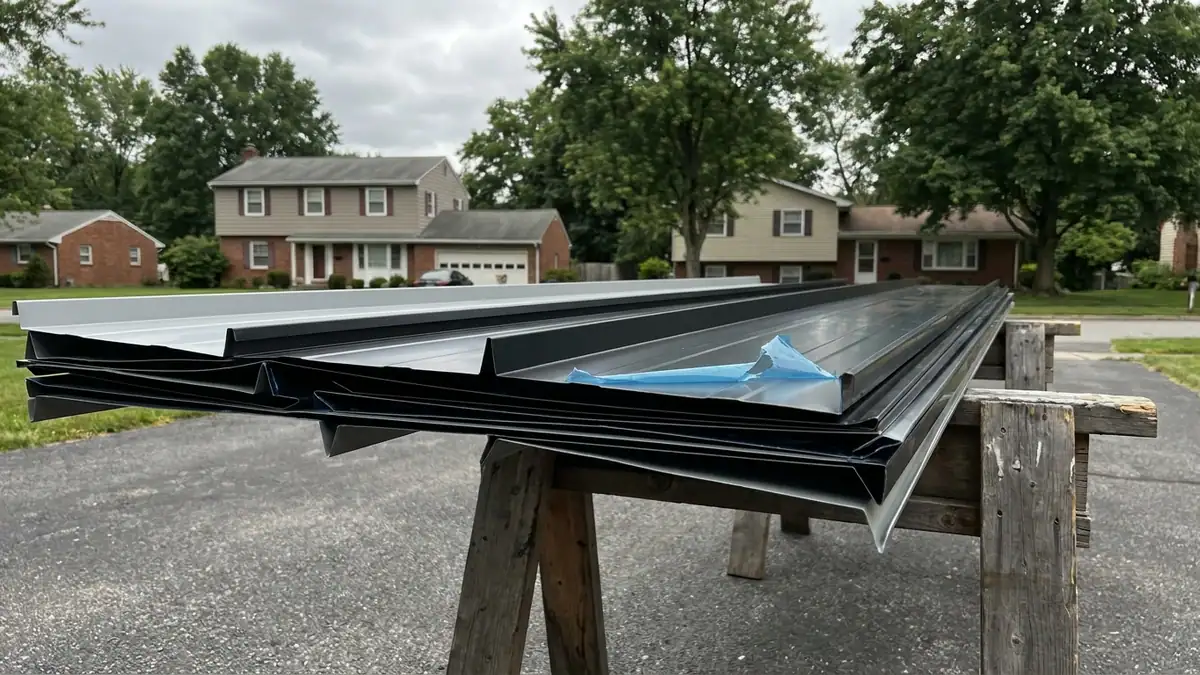
- Striations or a center rib. Light ribs rolled into the pan stiffen it and break the reflection so small waves stop reading as one continuous ripple. This is the single most effective thing you can specify.
- Color and gloss. Dark, glossy, smooth finishes show every deviation. Lighter colors and low-gloss finishes hide the same amount of movement.
- The substrate. Panels are only as flat as what is under them. A stripped deck with rotted sheathing replaced and a flat underlayment gives the panels a fair chance. Panels run over an existing shingle roof do not get that chance.
What the crew does on the day to keep panels flat
Standing seam is not a one-day job. It takes two to four days, and a fair share of that time is deck work and layout before any metal goes down.
The crew strips to the decking and replaces anything soft, delaminated or broken. Then they check the plane. High nails get set, humped sheets get corrected, and the underlayment goes down without wrinkles or stacked laps under the pan area. Clips are set at the spacing the panel manufacturer specifies for that panel width and that wind exposure, and floating clips are used where the panel length requires them so the metal can move. Panels are fixed at one point, usually at the ridge or eave depending on the system, and left free to expand everywhere else. Nothing gets forced into place.
The full sequence, including the underlayment and seam details, is in the standing-seam metal roofing guide.
What to put in writing before you sign
Ask for the panel profile, the pan width, the gauge, the metal type, the finish system, and whether the pan is striated or flat. Ask whether the price includes a full tear-off to the deck and what happens to any bad sheathing. Ask the contractor to state, in the estimate, that oil canning is an appearance characteristic of the material and to show you the manufacturer's own language on it.
That last point matters, because most panel warranties exclude oil canning. If nobody tells you that until after the roof is on, the conversation gets unpleasant.
Lightning Construction writes no change orders. Decking condition, extra layers and flashing are found at the free inspection and priced into the quote, so the substrate work that keeps panels flat is not a surprise item discovered on day two. There is also no deposit — nothing is due until the work is finished and you have inspected it. Lightning pulls the permit from your municipality's construction office and attends the inspection under the New Jersey Uniform Construction Code.
What to do if your new metal roof is waving
- Photograph it at three different times of day, from the same spot, so you can show whether it changes.
- Look along the slope from the eave, not straight at it. A wave that follows a straight line across panels is a deck issue; a wave that wanders is coil stress.
- Check for creases at fastener points and for buckling near the eave in hot weather.
- Call the installer and ask for the clip spacing and the fixed-point location used on your roof, in writing.
- If the cause is a fastener or a pinned panel, it can often be corrected. If it is the deck, the affected panels come off, the deck is corrected, and they go back on.
Metal already stretched does not flatten out again. That is why the decisions listed above are worth making before the order goes in rather than after.
Getting a straight answer on your own roof
Metal roofing runs $18,000 to $35,000 in standard-value New Jersey towns, $28,000 to $55,000 in higher-value towns, and $45,000 to $120,000 on large or luxury homes, with the band set by the municipality's median home value from ACS 2024 five-year estimates. At that number you should know exactly which panel, which gauge and which finish you are buying, and what the flat area is going to look like in late-afternoon sun.
See the panel options and systems on the metal roofing page, then book a free estimate. The inspection and the written estimate are free with no obligation, and a salesperson does come to the house. Bring up oil canning at that visit and ask to see a large sample outdoors, not a chip on a kitchen table.