Short answer
Most residential standing-seam metal roofs in New Jersey are installed in two to four days on site. Asphalt is faster, with most replacements torn off and finished in a single day, because metal panels have to be measured, fabricated to length and set one at a time. The bigger part of the calendar is usually what happens before the crew arrives, since panels are made for your specific roof rather than pulled off a shelf.
On this page
Most residential standing-seam metal roofs in New Jersey take two to four days on site. Compare that with asphalt, where most replacements are torn off and completed in a single day, and you have the honest trade-off: metal costs more time on the roof and gives you a material life measured in decades rather than years.
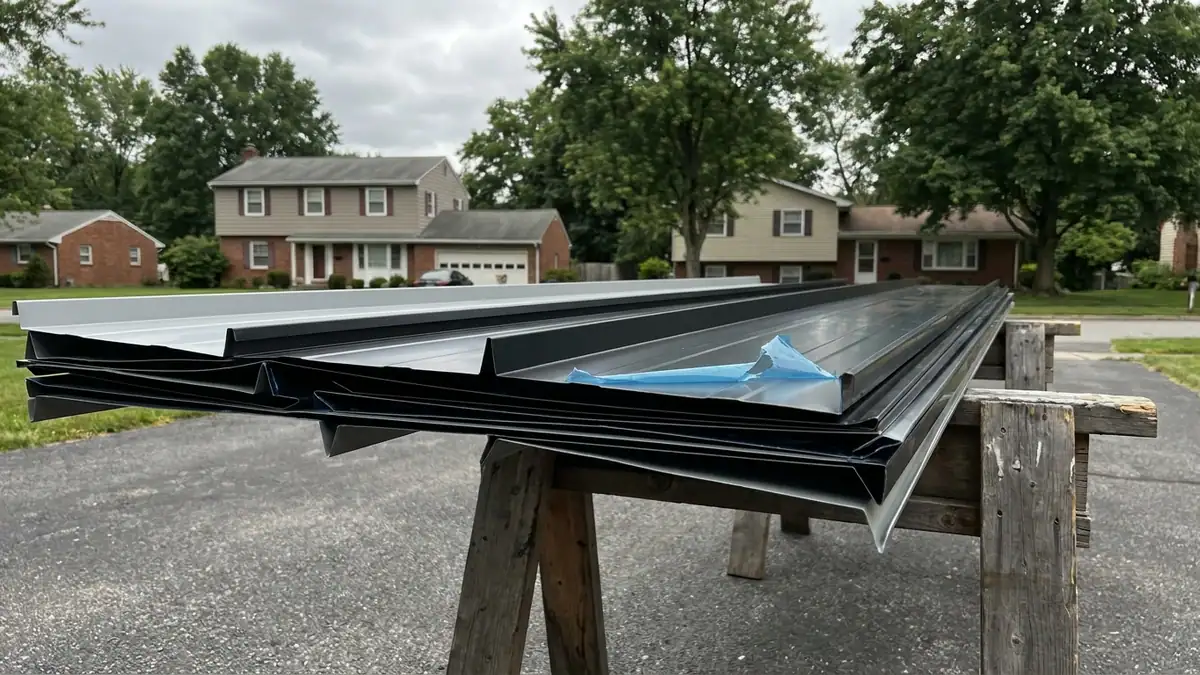
The number that surprises people is not the install window. It is the calendar before the crew shows up. Metal panels are not stacked in a warehouse waiting for you. They are ordered or roll-formed to the exact length of your roof planes, in your color and finish, and that step happens after the contract is signed and before anyone climbs a ladder.
The two to four day window, day by day
A typical standing-seam job on a two-story New Jersey house with a couple of gables and one chimney runs like this.
- Day one is protection and tear-off. Tarps and plywood go over the landscaping, walkways and any AC unit, magnetic sweeps get staged, and the old roof comes off down to the decking. Anything soft or delaminated in the sheathing is cut out and replaced. High-temperature synthetic underlayment goes down over everything that was opened, so the house is dry before the crew leaves.
- Day two is layout and the first panels. This is the slowest-looking day and the one that decides how the roof reads from the street. The crew squares the eave, sets the starter and the first panel dead straight, then works across the plane clipping and seaming. A panel that starts an eighth of an inch off multiplies across thirty feet.
- Day three is the remaining planes, valleys, hips and the hand-formed flashing at the chimney, sidewalls and vent pipes. Trim, ridge cap and closures go on.
- Day four, when there is one, is the detail work: cleanup, gutter reconnection, a full magnetic sweep of the property, and a walk-around with you before anything is paid.
Simple ranch roofs with long uninterrupted runs and no dormers can finish inside two days. Cut-up roofs with multiple dormers, several valleys and a couple of skylights are the ones that reach four.
What actually stretches the schedule
The roof itself is the main variable, not the crew.
| Condition | Effect on the schedule |
|---|---|
| ConditionLong, simple planes with few penetrations | Effect on the scheduleFastest. Fewer cuts, fewer flashings |
| ConditionMultiple dormers, valleys and hips | Effect on the scheduleAdds time. Every intersection is cut and flashed by hand |
| ConditionSteep pitch | Effect on the scheduleSlower. Staging and fall protection take longer to move |
| ConditionExisting decking in poor shape | Effect on the scheduleAdds hours to a day for sheathing replacement |
| ConditionTwo existing layers of shingles | Effect on the scheduleMore tear-off, more debris handling |
| ConditionChimney, skylights, satellite mounts | Effect on the scheduleEach one is a custom flashing detail |
| ConditionMetal shingles instead of standing seam | Effect on the scheduleDifferent rhythm, more individual pieces to set |
Those conditions are also the ones that turn into surprise charges with other contractors. Lightning Construction finds them at the free inspection and prices them into the written estimate, so there are no change orders once the roof is open, and no deposit is due before the work is finished and you have inspected it.
Ordering, permits and the weeks before the crew arrives
The on-roof days are the short part. Here is the rest of the sequence.
Measurement and fabrication
After you sign, the roof gets measured for real, not from an aerial estimate. Panel lengths, trim profiles and flashing details are specified, then the material is ordered in your chosen color and finish. Ask for the expected lead time in writing when you sign, because it varies by product and by finish and it is the single biggest driver of when the job actually happens. Custom colors take longer than stocked ones.
The permit
A reroof in New Jersey is permitted work under the Uniform Construction Code, and the municipal construction office sets its own turnaround. Lightning pulls the permit from your town's office and attends the inspection. You file nothing and schedule nothing. If you want the detail on how that process works town by town, the roof permit guide covers it.
Scheduling around weather
Metal is less weather-sensitive than asphalt in the cold, since it does not rely on a sealant strip warming up to bond. It is more weather-sensitive in wind. A twenty-foot panel is awkward and dangerous to carry up in a gust, so a windy day gets postponed even under clear skies. Rain stops work at the same point it would on any roof.
Metal versus asphalt, on time alone
| Asphalt shingle | Standing-seam metal | |
|---|---|---|
| Typical days on site | Asphalt shingleOne | Standing-seam metalTwo to four |
| Material availability | Asphalt shingleGenerally stocked | Standing-seam metalFabricated for your roof |
| House exposed overnight | Asphalt shingleRarely | Standing-seam metalOnly under underlayment, never bare decking |
| Price range, standard-value towns | Asphalt shingle$9,000-$22,000 | Standing-seam metal$18,000-$35,000 |
Price bands are set by the median home value of your municipality, and the higher-value and luxury bands run above those figures. If you are still deciding between the two materials rather than scheduling one, the asphalt versus metal comparison is the place to start, and the standing-seam guide goes deep on the system itself.
How to prepare so the days do not slip
There is not much for you to do, and what there is matters.
- Clear the driveway the night before. Panels, brakes and the debris trailer all need close access, and carrying material an extra hundred feet costs real time.
- Move vehicles, grills and patio furniture away from the drip line on every side being worked.
- Take fragile items off walls on the top floor. Fastening and seaming carries vibration through the framing.
- Keep pets inside and away from the work area for the full run of the job, not just day one.
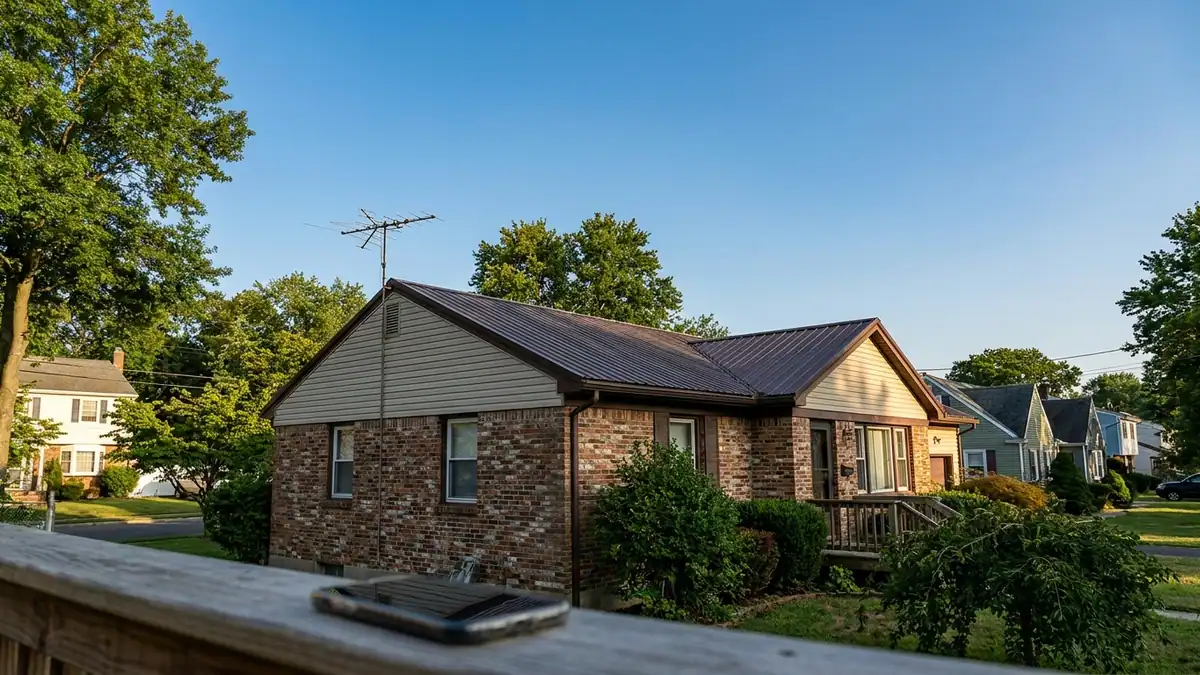
- Tell your contractor about anything mounted on the roof or attached to the fascia, including satellite dishes, antennas and holiday light clips.
What to ask before you sign
Get four things in writing: the expected material lead time, the number of working days planned on site, what happens to the schedule if it rains, and the price for decking replacement if any is needed. A contractor who will commit to those on paper is telling you the schedule is real. One who will not is leaving room to move.
When you are ready for numbers on your own roof, the metal roofing page lays out the systems Lightning installs, and a free inspection and written estimate costs nothing and carries no obligation. A salesperson does come to the house; that is a straight sales appointment, and the estimate you get is the final price.