Short answer
Sometimes. Some New Jersey carriers give a credit for a metal roof because of its fire and wind ratings, and others price it no differently than a new asphalt roof. The bigger effect is usually on the claim side, where a metal roof raises your replacement cost and can bring a cosmetic damage exclusion into the policy.
On this page
- Why insurers care about your roof material at all
- The ratings a carrier may ask about
- The clause that surprises metal roof owners
- What to ask your carrier before you sign the roofing contract
- Higher replacement cost is real, and it cuts both ways
- What to send your insurer after the roof is finished
- What a metal roof will not do to your policy
- What to do next
Sometimes, and not always in the direction homeowners expect. Some New Jersey carriers give a credit when you put a metal roof on the house, because metal panels carry strong fire and wind ratings and a long service life. Others rate almost entirely on roof age and condition and will treat your new standing seam roof exactly the way they would treat a new architectural shingle roof. The material is one input, not the whole calculation.
The part that gets less attention, and matters more at claim time, is what a metal roof does to your coverage rather than your premium. Here is what actually changes on the policy, what to ask before you buy, and what to send your carrier after the job is done.
Why insurers care about your roof material at all
Roof claims drive a large share of what carriers pay out on a homeowners policy in New Jersey. Wind, hail, nor'easters and falling limbs all hit the roof first. So underwriters look at three things: how old the roof is, what it is made of, and whether it is still in serviceable condition.
A new roof of any material improves all three at once. That is often where the premium change comes from. When a homeowner tells us their bill dropped after a metal roof went on, the credit was frequently for roof age, not for the metal itself. Both are worth having. You just want to know which one you are getting, because a roof-age credit erodes every year and a material credit does not.
The ratings a carrier may ask about
If your carrier does rate on material, these are the specifics an underwriter or agent will ask for. Get them from the product data sheet for the exact panel on your estimate, not from a general claim about metal.
- Fire classification. Steel and aluminum roof assemblies commonly carry a Class A fire rating, the highest classification, when installed over the tested underlayment assembly. The assembly matters, not just the panel.
- Wind rating. Panel systems are tested for uplift, and standing seam with concealed clips generally performs well because there are no exposed fasteners on the field of the roof. Coastal New Jersey homeowners should pay close attention to this one, and the Jersey Shore roofing guide covers what salt air and sustained wind do to a roof at the barrier islands.
- Impact rating. Some products are tested under UL 2218 for impact resistance and rated Class 1 through Class 4. A handful of carriers offer a credit tied specifically to a Class 4 product. Many do not offer it at all in New Jersey.
Ask your agent which of the three, if any, actually maps to a credit on their rating plan. "Metal roofs get a discount" is not an answer you can bank on.
The clause that surprises metal roof owners
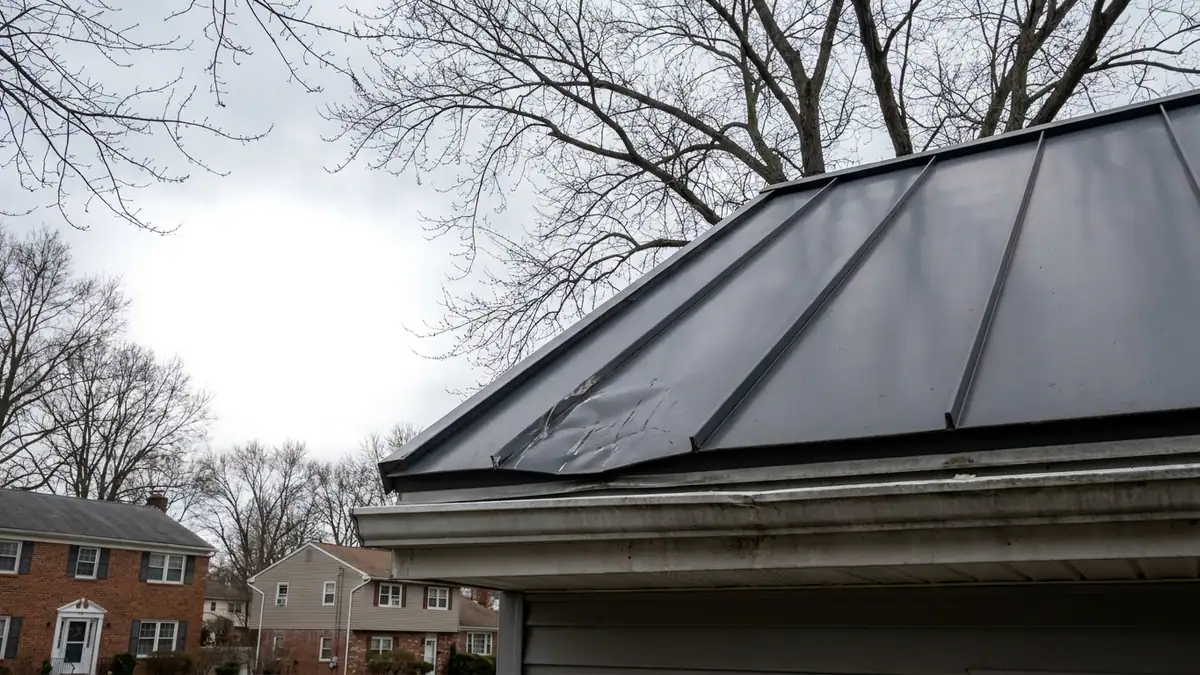
Cosmetic damage. Hail can dent a metal panel without breaching it. The roof still sheds water, still holds its finish, still performs, and looks dimpled from certain angles in certain light.
Some carriers exclude that. A cosmetic damage exclusion or a cosmetic damage endorsement says the policy pays for damage that affects the roof's function, not for dents and marring that do not. Sometimes the exclusion is the trade for a lower premium on a metal roof. Sometimes it is applied automatically to metal and you never see it unless you read the declarations.
This is not a reason to avoid metal. It is a reason to read your renewal packet and ask two direct questions: is there a cosmetic damage exclusion on this policy, and is the roof deductible the same as the rest of the dwelling deductible or is it a separate percentage.
What to ask your carrier before you sign the roofing contract
Call your agent while you still have the estimate in hand. Fifteen minutes now beats a surprise at renewal.
| Question to ask | Why it matters |
|---|---|
| Question to askDo you credit roof material, roof age, or both? | Why it mattersTells you whether the savings shrink each year or hold |
| Question to askIs there a specific credit for a Class 4 impact-rated product? | Why it mattersOnly some carriers have one, and it may change which panel you pick |
| Question to askWill a cosmetic damage exclusion be added to a metal roof? | Why it mattersDecides whether hail dents are covered |
| Question to askIs my roof deductible flat or a percentage of dwelling coverage? | Why it mattersA percentage deductible on a higher dwelling amount costs you more at claim time |
| Question to askWill my dwelling coverage amount go up to reflect the new roof? | Why it mattersA metal roof costs more to rebuild than asphalt, and coverage should track that |
| Question to askIs this a replacement cost or actual cash value settlement on the roof? | Why it mattersAn older policy may have been moved to depreciated roof coverage without you noticing |
Get the answers in writing, even if it is just an email from the agent summarizing the call.
Higher replacement cost is real, and it cuts both ways
Metal costs more than asphalt to install in New Jersey. Metal roofing runs $18,000 to $35,000 in standard-value towns, $28,000 to $55,000 in higher-value towns, and $45,000 to $120,000 for large or luxury homes. The band is set by the municipality's median home value from ACS 2024 five-year estimates, not by your street or your square footage.
Your dwelling coverage is supposed to reflect what it costs to rebuild your house today, roof included. So the same roof that earns you a material credit can also nudge your coverage amount up. Those two can partly cancel each other out. That is not a bad outcome. Underinsuring the roof is far worse than paying a few dollars more to insure it correctly, and a homeowner who discovers the gap after a storm has no way to fix it retroactively.
If you are weighing the systems side by side, the asphalt vs. metal comparison lays out service life, appearance and cost without the insurance layer.
What to send your insurer after the roof is finished
Do this within a week of the final inspection, while everything is still on your phone and in your inbox.
- Email your agent the signed contract or paid invoice showing the date, the address and the roof system installed.
- Include the manufacturer's product data sheet with the fire, wind and impact ratings for the panel that went on your house.
- Send the closed permit and the municipal inspection record. Lightning pulls the permit and attends the inspection in every New Jersey municipality, so you should have this without chasing anyone.
- Attach photos of the finished roof from two or three angles at ground level, plus any tear-off photos the crew took.
- Ask the agent to confirm in writing that the roof age, roof material and dwelling coverage on the policy have all been updated.
That file is also the file you want if you ever have to open a claim. The New Jersey roof insurance claim guide walks through what an adjuster looks for and how the process runs here.
What a metal roof will not do to your policy
It will not make your house uninsurable, and it will not force a carrier to drop you. It does not exempt you from a wind or hurricane deductible in coastal counties. And a metal roof over an unvented, moisture-loaded attic is still a roof over a problem, which is why the deck and the ventilation get addressed during the replacement, not after.
Nobody should buy a metal roof primarily for an insurance credit. Buy it for the 50-plus year material life, the wind performance and the way it looks on your house. Treat any premium change as a bonus you confirmed in advance rather than a number a contractor promised you.
What to do next
Call your agent, ask the six questions in the table above, and get the answers by email. Then get a real number for your house. Lightning Construction's inspection and written estimate are free with no obligation, and a salesperson does come out to the house. There is no deposit on any job, nothing is due until the work is finished and you have inspected it, and the written estimate is the final price because the conditions that normally trigger a change order are found at the inspection and priced in.
Standing-seam metal takes two to four days on a typical New Jersey home. See the metal roofing page for the systems installed, or request the free estimate and bring your policy declarations page to the appointment.