Short answer
A metal roof is unlikely to change cell service or WiFi inside your house, because those signals reach you through walls and windows rather than down through the roof. What it does affect is anything depending on a signal from the sky or sitting in the attic: an attic TV antenna, a satellite dish, and an existing roof-mounted antenna that has to come off and go back on. Sort those three out before install day.
On this page
- What actually changes, device by device
- Why your phone does not care about the roof
- WiFi is an inside problem, not a roof problem
- Attic antennas are the one that stops working
- Satellite dishes and anything else screwed to the roof
- Cell boosters, and the right way to run one
- What to say at the estimate
- What to do next
A metal roof will not take away your cell bars or your WiFi inside the house. Those signals do not come down through your roof. They come in sideways through windows, doors and walls, which is why a brick house with low-E glass is already doing more to your reception than a steel or aluminum roof ever will.
What a metal roof does affect is narrow and predictable: anything that needs a clear path to the sky from inside or under the roof. That means an attic-mounted TV antenna, a satellite dish that has to be remounted, and a cell booster with its outside antenna in the wrong place. Deal with those three and there is nothing else to worry about.
What actually changes, device by device
| Device | Does a metal roof affect it? | What to do |
|---|---|---|
| DeviceCell phone inside the house | Does a metal roof affect it?Rarely noticeable | What to doTest signal in each room before the job so you have a baseline |
| DeviceHome WiFi router and devices | Does a metal roof affect it?No | What to doNothing |
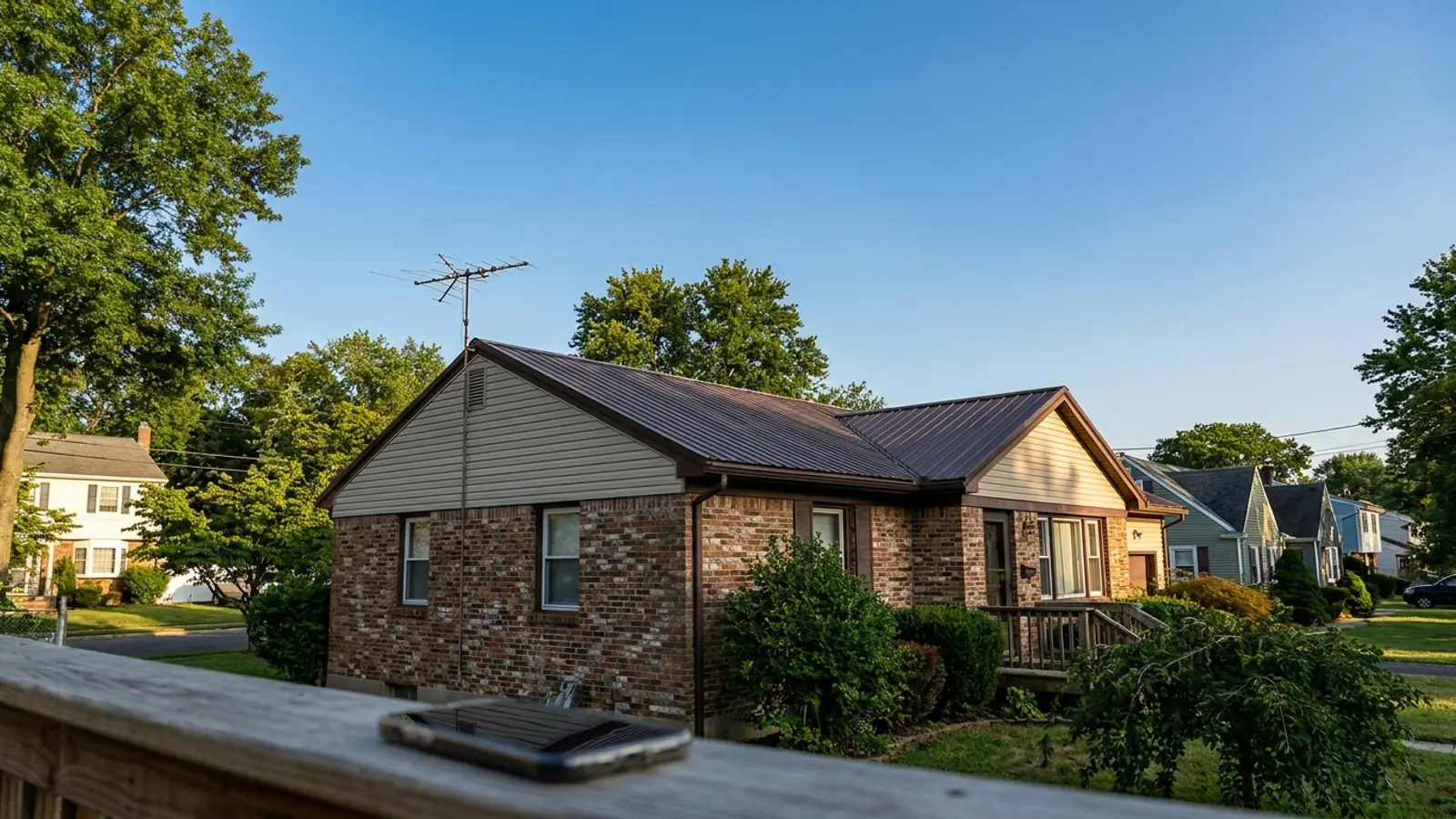
| DeviceOutdoor TV antenna on a mast, chimney or gable | Does a metal roof affect it?No | What to doRemount after install, off the panel field |
| DeviceTV antenna in the attic | Does a metal roof affect it?Yes, this is the real one | What to doMove it outside and above the roofline |
| DeviceSatellite dish | Does a metal roof affect it?Mounting method changes | What to doUse a seam clamp, a gable mount or a ground post |
| DeviceCell signal booster | Does a metal roof affect it?Only if the outside antenna is wrong | What to doKeep the outside antenna outside, high and clear |
| DeviceGarage door opener, car remote, doorbell camera | Does a metal roof affect it?No | What to doNothing |
Why your phone does not care about the roof
Cell towers sit on monopoles, water tanks and building parapets. From your living room, the tower is not overhead, it is out there on the horizon at a shallow angle. The signal reaching your phone has already passed through exterior walls, window glass and whatever is in the yard. Your roof is not in that path for most of the house.
Metal does reflect radio waves. That part is true, and it is why people ask the question. It just does not matter much when the metal is on a plane the signal was never crossing.
There are two honest exceptions. A second-floor room directly under a low attic, in a house where the nearest tower happens to be on high ground above you, can read slightly differently after a metal roof goes on. And a house that is already at one bar, in a dead pocket, has no margin left, so any change at all is noticeable. If that describes your house, take ten minutes before the job and write down the real signal number from your phone's status or field test screen in the rooms you care about. Bars are a cartoon. The number is data, and it keeps the conversation factual later.
WiFi is an inside problem, not a roof problem
Your router is inside. Your laptop is inside. The roof is not between them, so it cannot block anything. If your WiFi is weak in the back bedroom, that is drywall, distance, plaster with wire lath, a brick chimney mass, or an old router, and a new roof changes none of it.
The one real case is a mesh node or access point you are trying to reach through the roof plane, usually in an attic, a detached garage or a third-floor finished space. Run a cable or add a node on the same side of the metal instead of trying to shoot a signal through it.
Attic antennas are the one that stops working
If your over-the-air TV antenna is in the attic, expect it to lose reception under a metal roof. An attic antenna works by receiving broadcast signals through the shingles and decking. Put a continuous conductive surface over it and you have effectively built a shield above the antenna.
There is no workaround that keeps it in the attic. The fix is to relocate:
- Decide the mount location before install day: gable end wall, chimney with a strap mount, or a mast above the ridge.
- Have the antenna taken down and stored before tear-off, not pulled off in a hurry mid-job.
- Reinstall after the panels and trim are finished so nothing gets scuffed and no mount is set in the wrong place.
- Rescan channels once it is back up and aimed. Outside and higher usually beats what you had in the attic.
Satellite dishes and anything else screwed to the roof
A dish can go back up. The method has to change. Standing seam panels move as they expand and contract, and the whole point of the system is that the fasteners are concealed and the panel field has no holes in it. A dish foot lag-bolted through a panel puts a hole in the exact place you paid to not have one, and it can bind the panel as well.
Better options, in order: a clamp that grips the raised seam with no penetration, a mount relocated to a gable wall or fascia, or a ground post with a buried cable run. Ask which one is being used and get it in writing. The standing-seam metal roofing guide explains how the panel and clip system is meant to move, which is the reason penetrations get treated so carefully.
Cell boosters, and the right way to run one
A cellular booster has three parts: an outside antenna, an amplifier, and an inside antenna. The outside antenna belongs outside, mounted high on a gable, a chimney or a short mast, with a clear shot toward the tower. The inside antenna goes in the room with the worst service.
A metal roof does not interfere with that setup. It can actually help a little, because the metal gives some separation between the outside and inside antennas, and separation is what keeps a booster from feeding back on itself. If a contractor tells you a metal roof rules out a booster, they are wrong.
What to say at the estimate
Point at every piece of rooftop equipment during the free inspection: dish, antenna, mast, weather station, anything bolted down. Removal and remounting is labor, and labor that is not in the written estimate is where other contractors find a change order later.
Lightning Construction prices that at the inspection and writes it into the quote. There are no change orders, the written estimate is the final price, and there is no deposit, so nothing is due until the work is finished and you have inspected it. Lightning also pulls the permit from your municipality's construction office under the New Jersey Uniform Construction Code and attends the inspection, so you file nothing.
On timing, a standing seam roof takes two to four days, which is worth knowing if you watch broadcast TV off an antenna and the mast is coming down for the duration. Metal roofing runs $18,000 to $35,000 in standard-value towns, $28,000 to $55,000 in higher-value towns, and $45,000 to $120,000 for large or luxury homes, with the band set by the municipality's median home value from ACS 2024 five-year estimates.
What to do next
If reception is the only thing holding you back from metal, it should not be. Check your phone's signal number room by room this week, find out whether your TV antenna is in the attic or outside, and note how your dish is mounted. Bring all three to the estimate.
If you are still deciding between materials at all, the asphalt versus metal comparison lays out the cost, lifespan and installation differences side by side. When you are ready to price the job on your own house, see the metal roofing page or book a free estimate. The inspection and the written estimate are free with no obligation, and a salesperson does come to the house.