Short answer
Vinyl siding melts or warps when something concentrates heat on one part of the wall, most often sunlight reflecting off a neighboring window, a grill or fire pit parked too close, or hot air from a dryer or appliance vent. The panels are rarely defective; vinyl softens and distorts at temperatures a strong reflection can easily produce. Fix the heat source or block the reflection first, then replace the damaged panels, because new vinyl in the same spot warps again.
On this page
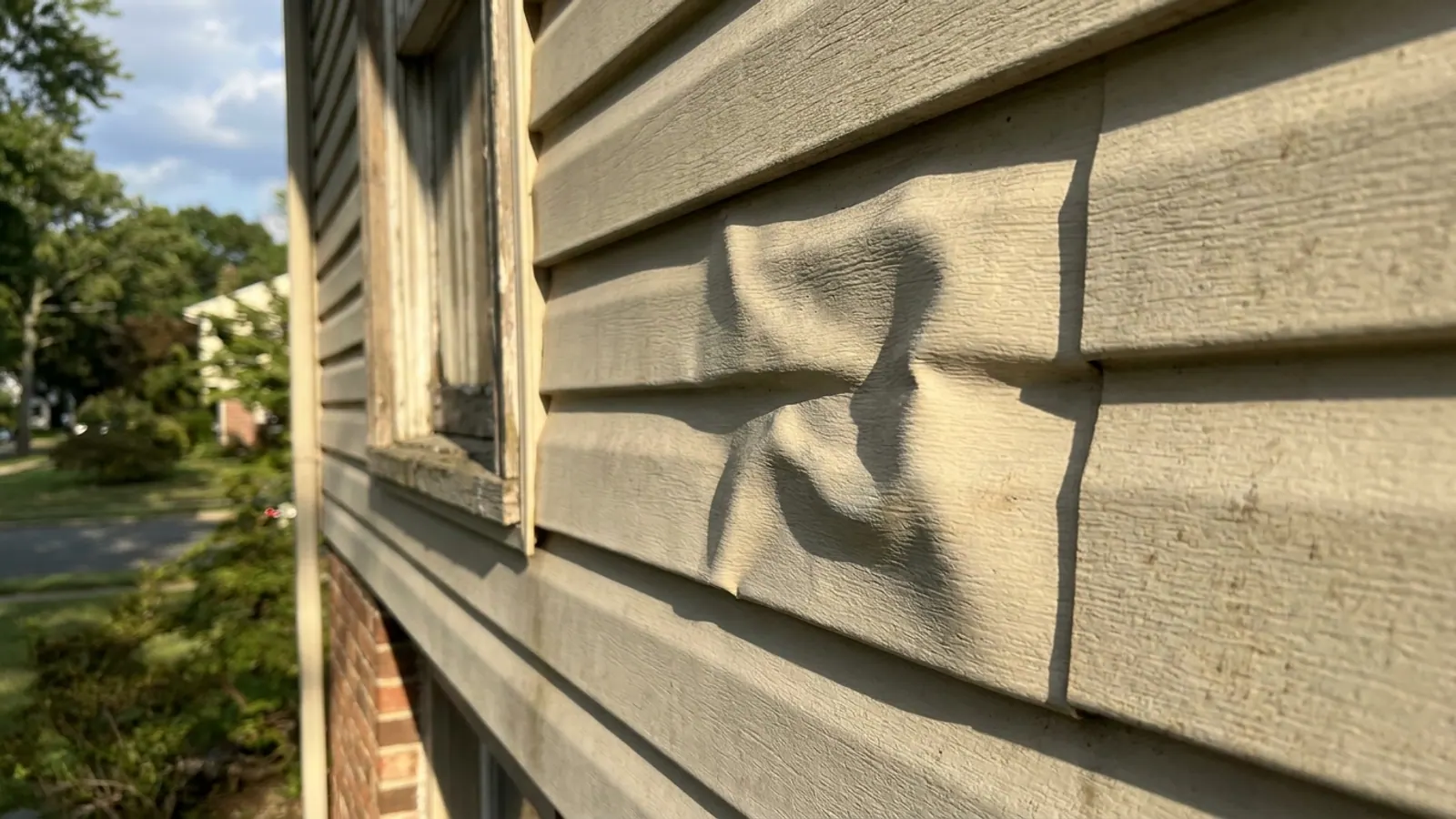
Vinyl siding that has gone wavy, rippled, drooped or bubbled in one localized spot did not fail on its own. Something heated that section of wall past the temperature vinyl can hold its shape at, and the panels moved. Vinyl starts to soften in the range of 160 to 165 degrees Fahrenheit, and a concentrated reflection off glass can push a wall surface well past that on a clear day. The rest of the wall stays perfectly flat, which is the giveaway.
So the question is never really "is my siding bad." It is "what is heating this one area," because until that answer is found, replacement panels in the same spot will distort on the same schedule.
Reflected sunlight from a neighbor's window is the most common cause
Modern insulated glass with a low-emissivity coating is designed to bounce heat back outside. When the outer pane bows slightly inward, which happens with normal pressure and temperature changes in a sealed unit, the flat mirror becomes a concave one and focuses that reflected energy on whatever is across from it. That target is often the side wall of the house next door.
The damage pattern is distinctive. You get a band or a rough oval of warped panels, usually a few feet tall, sitting several feet off the ground, with sharp boundaries and undamaged siding all around it. The distortion tends to be worst on one side of the band. Watch the area over the course of a day and you will often see the bright reflection cross the wall and stop exactly where the damage stops.
The direction matters too. Reflection damage almost always shows up on the wall facing a neighboring house, an addition with a lot of glass, or a sunroom, and it appears in the season when the sun angle lines up. A wall that has been fine for eight years can start warping the summer after a neighbor replaces old glass.
Grills, fire pits and vent exhaust
Radiant heat at ground level does the same thing from closer range. A gas grill used with the lid up against a wall, a propane fire pit on a patio, a chiminea, or a smoker that sits under a soffit will all cook the panels above them. The damage sits low on the wall, is roughly the width of the appliance, and often has a scorched or glossy look rather than a clean ripple.
Dryer vents and high-efficiency appliance exhausts are the quieter version of the same problem. Hot, wet air blowing sideways along a wall softens the panel it runs across and stains it. On a dryer vent the fix is a hood that directs the exhaust away from the wall, not a new panel. Turn the appliance on and put your hand on the siding a foot away; if it is warm, you found it.
A few other heat sources worth ruling out before anyone quotes work: an exterior light fixture with an oversized incandescent bulb mounted tight to the wall, a black asphalt driveway or a light-colored concrete patio reflecting up onto a low course, and a metal roof or awning on a porch below that bounces sun back at the wall above it.
Distortion that is not heat at all
Not every wavy wall is a heat problem. Vinyl expands and contracts noticeably with temperature, and the entire system is designed to float. Panels hang from nails driven in the center of the slot, left about a sixteenth of an inch loose, with gaps at the J-channel and corner posts so the panel can move end to end. Nail a panel tight, drive the nail through the face of the panel, or butt the ends hard into the trim, and the panel has nowhere to go on the first hot afternoon. It buckles.
That damage looks different: long, gentle waves running the full length of a wall or several full courses, showing up in summer and partly relaxing in winter. It is an installation problem, not a heat-source problem, and it is one of the reasons the fastener pattern is worth asking about before you hire anybody.
Water is the third possibility. Panels that look bowed near the bottom of a wall, with soft trim or staining, are usually reacting to rot in the sheathing behind them rather than sun.
How to tell which cause you have
| What you see | Likely cause | What fixes it |
|---|---|---|
| What you seeSharp-edged oval or band of ripples, mid-wall, one elevation only | Likely causeReflected sunlight off nearby glass | What fixes itBlock or diffuse the reflection, then replace panels |
| What you seeLow warping and glossing directly above a patio or deck | Likely causeGrill, fire pit or smoker too close | What fixes itMove the appliance, then replace panels |
| What you seeSoftened, stained panels around a vent hood | Likely causeHot exhaust running along the wall | What fixes itRedirect the exhaust, then replace panels |
| What you seeLong gentle waves over whole courses, worse in summer | Likely causePanels nailed too tight or butted with no expansion gap | What fixes itRe-hang or replace the affected wall |
| What you seeBulging near grade with soft trim or dark staining | Likely causeMoisture in the sheathing behind the siding | What fixes itOpen the wall and repair the substrate first |
Fixing it in the right order
- Identify and remove the heat source. Move the grill, cap and redirect the vent, or work with the neighbor on a screen, awning or exterior shade for the window that is reflecting. Nothing else you do lasts if the wall keeps getting cooked.
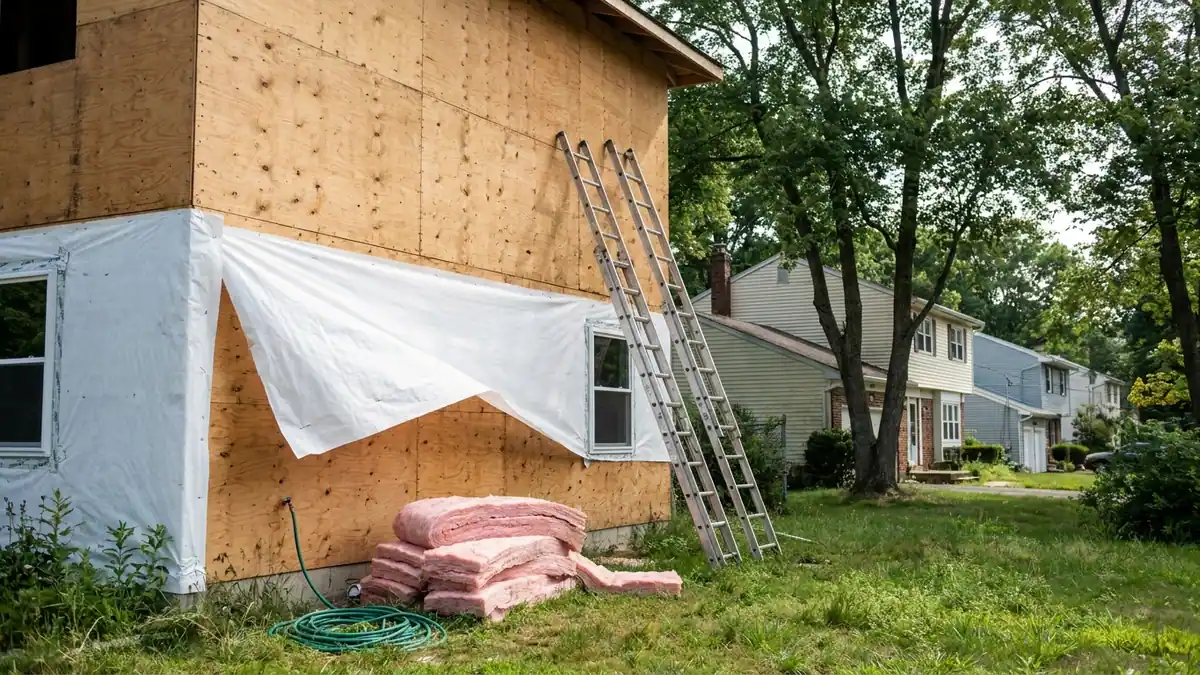
- Have the wall opened where the worst damage is, so someone can confirm the sheathing and house wrap behind it are dry and sound.
- Match the panel. Profile, exposure and color all have to line up, and vinyl fades, so an exact match to a fifteen-year-old wall is often not possible.
- Replace the affected panels, or the full elevation if the match is poor. A patch that reads as a patch from the street is not a fix.
- If the reflection cannot be eliminated, change the material in that spot. Fiber cement does not distort under radiant heat, and it can be run on the exposed elevation while vinyl stays on the rest of the house. The siding options guide covers how the two materials compare on cost, appearance and maintenance.
When it is worth re-siding the whole house instead
If the damage is confined to one band on one wall and the siding line is still available, panel replacement is the sensible call. Re-siding gets to be the better answer when the panels are old enough that no current color matches, when there are multiple damaged areas on different elevations, or when opening the wall turns up moisture problems that were already there.
Full siding replacement in New Jersey runs $10,000 to $22,000 in standard-value towns and $16,000 to $38,000 in higher-value towns, with large or luxury homes at $30,000 to $70,000. The band depends on the municipality's median home value. Those are ranges, not quotes, and the only way to know which end of the range your house sits at is to have someone measure it. You can see how siding work is scoped and what the estimate includes.
What to ask for in writing
Get the cause named in the estimate, not just the repair. A written scope that says "replace 14 damaged panels, north elevation" without a word about the reflection or the vent is a scope that will bring you back in two years.
Ask what happens if the sheathing behind the damage turns out to be wet. At Lightning Construction that condition gets found at the free inspection and priced into the estimate, because there are no change orders. The written number is the number, and there is no deposit, so nothing is due until the work is finished and you have looked at it. When a siding job needs a permit, Lightning pulls it from the municipality's own construction office and attends the inspection, in any of the 21 counties and 544 municipalities served.
The inspection and the written estimate are free with no obligation, and a salesperson does come to the house. If a section of your wall has gone soft and wavy while everything around it looks new, book the estimate and have someone stand in the yard and find the heat before you buy a single panel.