Short answer
You can usually match the profile and the panel size, but almost never the exact color, because the siding on your house has been fading in the sun for years and the new panel has not. A patch is the right call when the damage is small, the color is close, and the wall is somewhere people do not stand and stare. When the color break lands on a front elevation, most homeowners end up redoing that whole wall instead.
On this page
You can match the profile. You usually cannot match the color. Vinyl siding fades from the day it goes up, and a new panel off the shelf in the same named color is a panel that has not spent ten New Jersey summers in the sun. Hold them side by side and you will see it.
That single fact drives every decision on this page. A patch is about whether the color break lands somewhere you will look at every day, and whether the panel you need is still made at all.
Why new vinyl siding never matches old vinyl exactly
Three things move the color, and they all work in the same direction.
Ultraviolet light breaks down the pigment in the surface of the panel. South- and west-facing walls take the most of it, so the same house can be two slightly different shades from one elevation to the next before anyone touches it. Darker colors show the drift more than white and light beige, which is why a white house is far easier to patch than a clay or hunter green one.
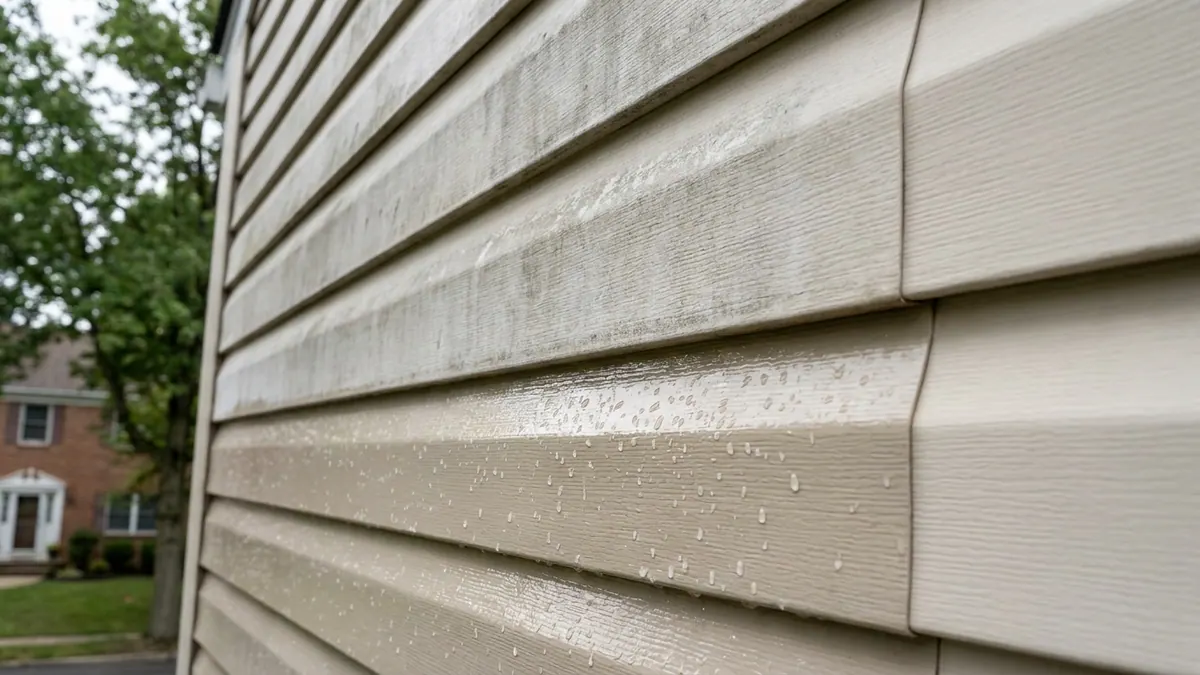
Chalking is the second one. As the vinyl surface weathers it releases a fine powder that dulls the color and lightens it. Rinse a wall with a hose and the top few feet often come back closer to original while the lower courses stay dull, because rain has been washing them differently for years.
The third is the manufacturer. Color names get retired, formulas get reblended, and profiles get discontinued. A double 4-inch clapboard from 2004 is not automatically the same as a double 4-inch clapboard sold today, even from the same brand. Panel height, butt thickness and the shape of the lock all shift between product lines, and a panel that does not lock into the course below it is not a repair.
How to identify the siding you already have
Before anyone quotes you anything, find out what is on the wall.
- Look in the garage, the crawl space and the shed. Original installers frequently leave a bundle of extras, and those panels have been in the dark, which means they still hold the original color.
- Unlock one panel with a zip tool and look at the back and at the nailing hem. Most manufacturers stamp a brand, a product line and a color or code there.
- Measure the exposure. Note whether it is a single 8-inch, double 4-inch, double 5-inch or Dutch lap profile, and measure the butt of the panel where it laps.
- Photograph a corner, a J-channel and a window surround. The trim system matters as much as the panel when you are trying to blend a repair.
- Bring a cut-off piece to the supplier rather than a color name. Names repeat across brands and mean nothing on their own.
If the siding is old enough that the line is gone, a supplier can often point you at the closest current profile. Close on profile plus close on color is sometimes good enough on a side wall. It is rarely good enough on the front.
When a vinyl siding patch is the right call
Patch when the damage is local, the wall is sound behind it, and the visual cost of a slightly off panel is low.
| Situation | Patch or replace |
|---|---|
| SituationOne or two cracked panels on a back or side wall | Patch or replacePatch |
| SituationHail or debris damage in a tight cluster, rest of the wall sound | Patch or replacePatch, or reside that one wall |
| SituationPanels loose or blown off after a storm, siding otherwise tight | Patch or replaceRe-secure and patch |
| SituationDamage on the front elevation, dark color, siding over 10 years old | Patch or replaceReside that elevation |
| SituationCracking showing up in several unrelated places | Patch or replaceWhole-house replacement, the vinyl is brittle |
| SituationSoft or stained sheathing behind the damage | Patch or replaceOpen it up, fix the wall, then reside that section at minimum |
| SituationProfile discontinued and no donor panels available | Patch or replaceReside at least the full elevation |
The donor trick is the one most homeowners have never heard. If you need four panels on a front wall, do not buy four new panels and put them there. Pull four sound panels off the back of the garage, install those on the front where the color already matches, and put the new panels in the hidden spot. It costs a little more labor and it solves the problem completely.
How a single vinyl panel actually gets replaced
Vinyl hangs. It is not fastened tight, and it is not caulked to the wall. A panel locks into the one below it and floats on nails driven in the center of the slots so it can expand and contract with temperature.
The sequence is: unlock the course above the damaged panel with a zip tool, pull the nails, slide the bad panel out, slide the new one in, nail it in the center of each slot with about a nickel's thickness of play under the head, then re-lock the course above. Nobody should be face-nailing a panel, driving a nail tight, or running a bead of caulk along the bottom lock. All three lock the panel in place, and a panel that cannot move buckles in July or splits in January.
A cracked panel matters more than it looks. Vinyl is a rain screen, not a waterproof layer. The house wrap behind it is what keeps water out, and a split panel lets wind-driven rain hit that wrap directly and repeatedly at one spot. Over a few seasons that is how sheathing gets soft.
When patching stops making sense
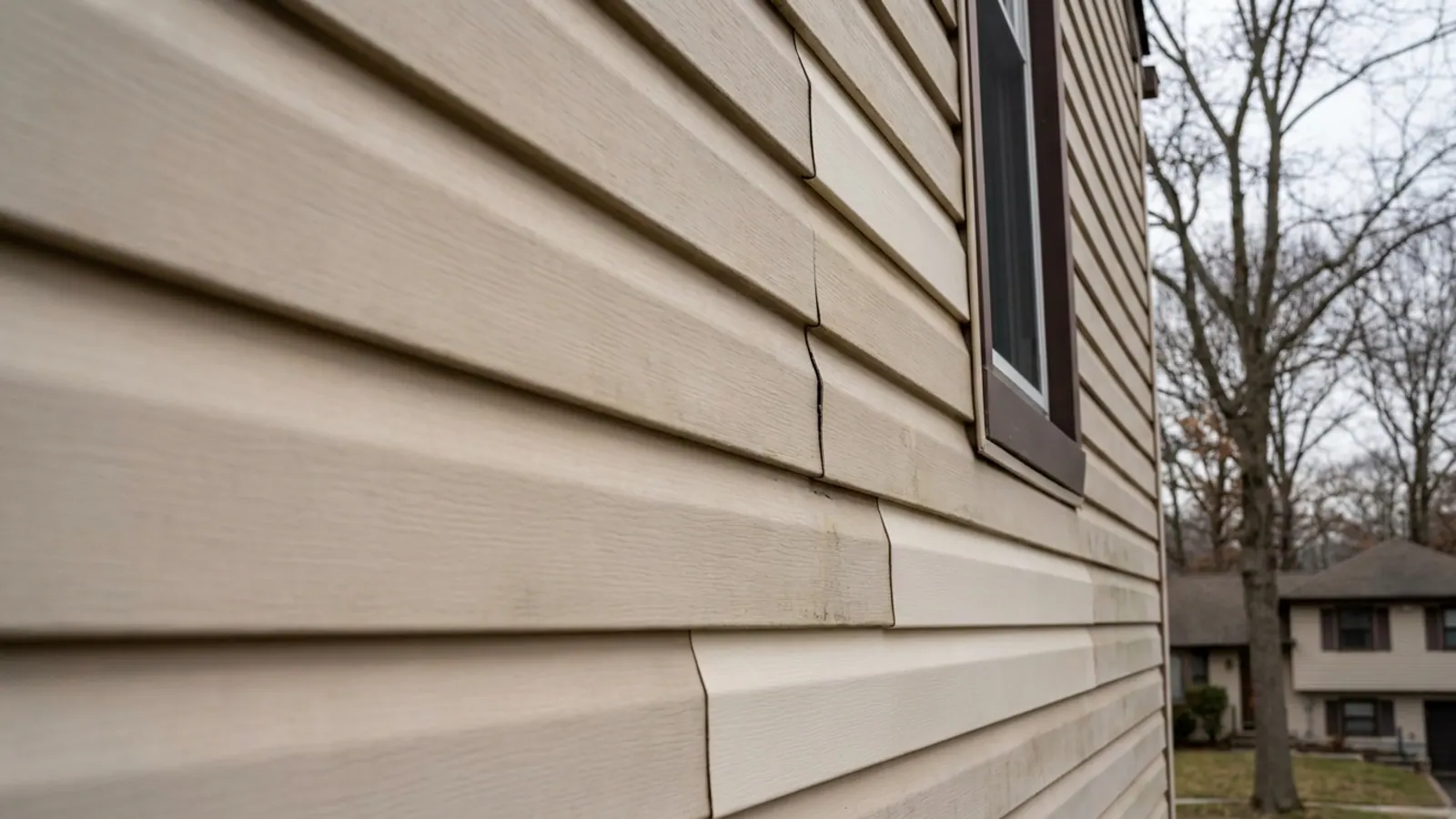
Age is the honest test. Vinyl gets brittle as it weathers, and brittle siding cracks when it is handled. If a panel snaps while the installer is zipping it loose, that is the wall telling you the whole side is near the end. Cracks in three or four unrelated spots mean the same thing, and so does a wall where panels have gone wavy from being nailed too tight originally.
A whole-house replacement also buys you things a patch cannot: new house wrap, new trim, and a chance to fix what is behind the siding while it is open. The siding options guide compares vinyl, insulated vinyl and fiber cement in depth, and it is worth reading before you decide that matching a discontinued panel is the goal.
On cost, Lightning Construction's siding ranges run $10,000-$22,000 in standard-value New Jersey towns, $16,000-$38,000 in higher-value towns, and $30,000-$70,000 for large or luxury homes. The band is set by the median home value of your municipality. Those are ranges for full siding work, not for a patch, and nobody should quote you a number for either one without walking the walls first.
What to do before you buy panels
Get the wall looked at, not just the panel. Damage that shows up as one cracked course is sometimes a gutter overflowing above it, a missing kick-out at a roof-to-wall junction, or a piece of trim that has been letting water in for years. Replacing the panel and leaving the source alone means doing it again.
Ask for the estimate in writing, with the profile and product line named, the number of panels or the square footage stated, and what happens to the house wrap and trim. At Lightning Construction the inspection and the written estimate are free with no obligation, and a salesperson does come to the house. There is no deposit, nothing is due until the work is finished and you have inspected it, and there are no change orders, because the conditions that normally cause them get found at the inspection and priced into the quote.
If you want an honest answer about whether your wall needs four panels or a full elevation, start with the siding page and then book a free estimate. Lightning is veteran-owned, GAF Certified, licensed and insured under New Jersey Home Improvement Contractor registration 13VH12437000, and works in all 21 New Jersey counties.