Short answer
Kickout flashing is a small bent piece of metal at the bottom of a roof-to-wall intersection that throws runoff out into the gutter instead of letting it run behind the siding. When it is missing, every rainstorm sends water down inside the wall, and the damage shows up years later as rotted sheathing, stained siding and sometimes rotted framing. It costs almost nothing to install during a roof replacement and thousands to fix once the wall is wet.
On this page
- Where the roof meets a wall, and what happens at the bottom of that run
- Why so many New Jersey houses do not have one
- What the damage actually looks like
- Right and wrong, side by side
- How to check your own house in ten minutes
- Adding a kickout without replacing the roof
- What to ask for in writing before the work starts
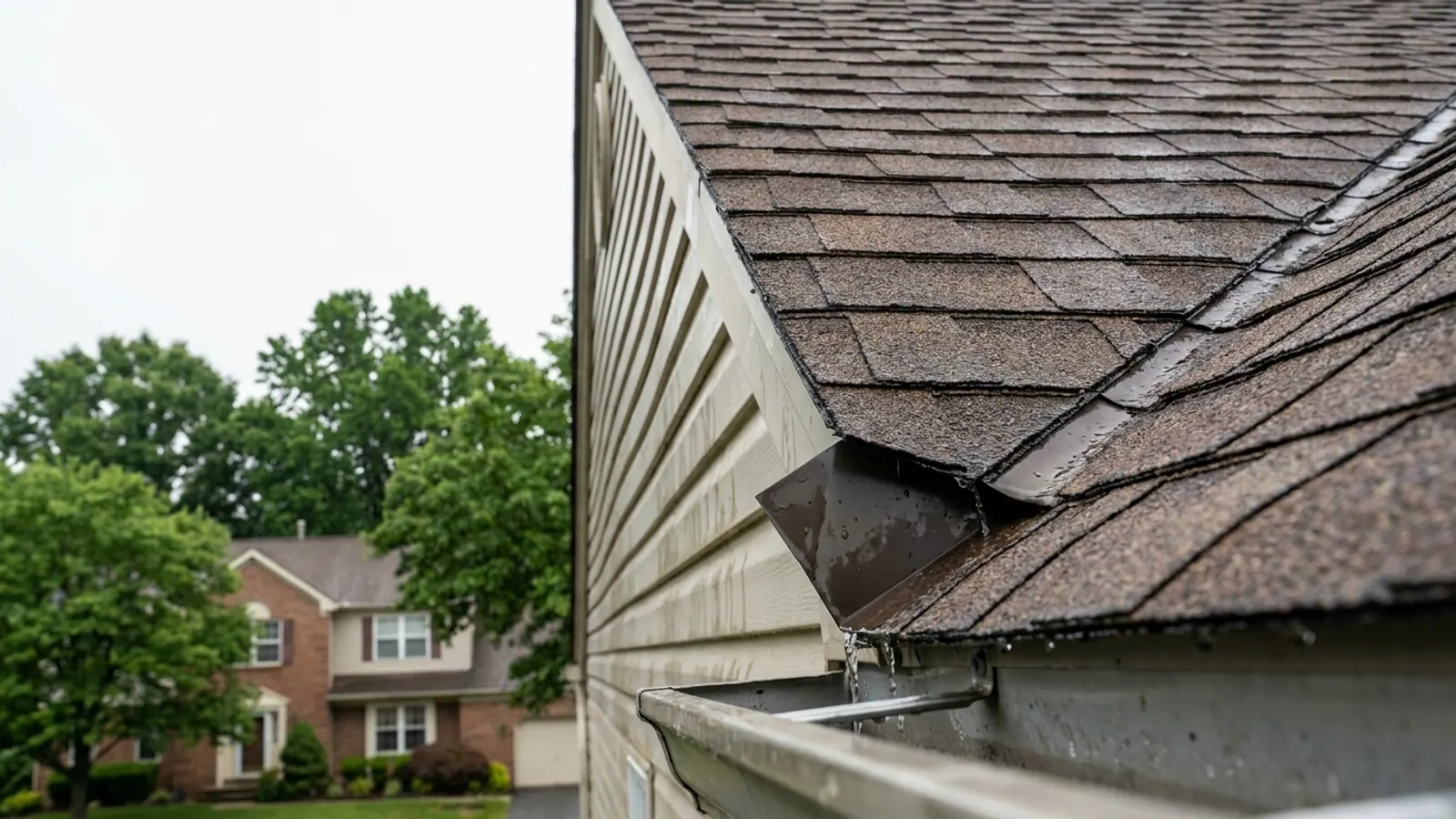
Kickout flashing is a small bent piece of metal that sits at the very bottom of a roof-to-wall intersection and throws runoff sideways, out of the roof valley and into the gutter, instead of letting it run straight down behind the siding. It is maybe six inches of metal. Leave it out and the wall behind the siding gets soaked every time it rains.
This is the single most common missing detail found on New Jersey houses built or re-roofed before the code language tightened. It is cheap to install while the roof is open and expensive to deal with later, because by then you are not paying for flashing, you are paying for sheathing, siding, and sometimes framing.
Where the roof meets a wall, and what happens at the bottom of that run
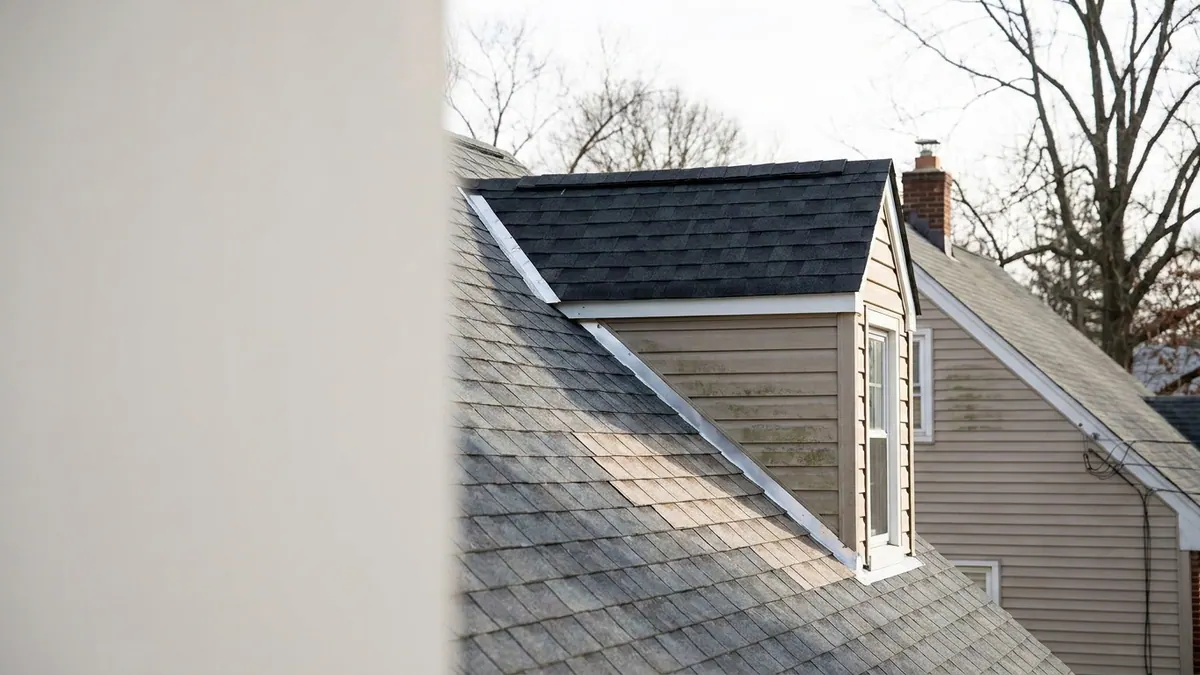
Look at any house with a second story that steps back, a garage roof that dies into the main wall, a dormer cheek, or a porch roof tied to the front of the house. The roof slope runs downhill and ends against a vertical wall.
That junction is sealed with step flashing: individual L-shaped pieces of metal, one per shingle course, each woven under the shingle above and lapped behind the siding or the wall's water-resistive barrier. Water running down the roof hits the vertical leg of the step flashing and is pushed down the slope toward the eave.
All of that water arrives at one point: the last few inches of the junction, right at the roof edge. At that spot the slope ends, the wall keeps going down, and the water has to go somewhere. Without a kickout, it has one option. It keeps going straight down the face of the wall, behind the siding, into the corner where the roof deck, the wall sheathing and the trim all meet.
The kickout is the piece that turns that stream outward and drops it into the gutter where it belongs.
Why so many New Jersey houses do not have one
Three reasons, and none of them are good.
The first is age. A large share of the state's housing stock went up between the 1950s and the 1970s, and that corner detail was not standard on a lot of those builds. Older towns are full of it — the median home in Clifton was built in 1951, in Bloomfield 1950, in Trenton 1953.
The second is re-roofing. A crew tearing off shingles reuses the old step flashing to save time, puts the shingles back the way they came off, and never adds what was not there before. A roof can be ten years old and still be missing it.
The third is siding work. A siding crew that did not install the roof will sometimes cut the existing kickout short or bury it behind new J-channel so the trim lines up cleanly. The metal is technically still up there and doing nothing.
What the damage actually looks like
It is slow and it is hidden, which is why it is so costly.
The first visible sign is on the outside: a vertical stain, streak or dark band on the siding directly below where the roof meets the wall. On vinyl it reads as a dirty stripe. On wood or fiber cement it reads as peeling finish and a swollen board. Sometimes you see nothing at all because the water is already inside the wall.
Underneath, the order is predictable. The water barrier gets saturated at the lap, the wall sheathing goes soft, the bottom plate and the rim area stay damp through the cold months, and mold grows in the cavity. Interior stains show up a floor below the junction, usually on a ceiling or at the top of a wall, long after the rot started. By the time anybody opens the wall, the repair is carpentry, not flashing.
If you are already seeing stains inside, walk through the signs you need a new roof guide before you assume the whole roof is finished. A wet wall at one junction is not the same problem as a failing roof, and the fix is different.
Right and wrong, side by side
| Done correctly | Done wrong, or not at all | |
|---|---|---|
| Metal at the bottom of the junction | Done correctlyA kickout, bent to throw water outward, soldered or sealed at the seam | Done wrong, or not at allNothing, or a flat piece of step flashing with an open corner |
| Height of the kickout leg | Done correctlyTall enough that a full stream of water cannot overshoot it | Done wrong, or not at allCut down so trim sits flush |
| Relationship to the wall barrier | Done correctlyLapped behind the house wrap or felt so water lands on top of the siding | Done wrong, or not at allFace-nailed over the siding, so water gets behind it |
| Where the water ends up | Done correctlyInside the gutter | Done wrong, or not at allDown the face of the wall, or behind it |
| Sealant | Done correctlyUsed at the bend as a backup to the metal | Done wrong, or not at allUsed instead of metal, as the whole detail |
That last row is the one to watch on a repair estimate. A bead of caulk in the corner is not a kickout. Caulk fails in a few New Jersey winters; bent metal does not.
How to check your own house in ten minutes
- Walk the perimeter and find every place a roof slope ends against a vertical wall. Garage into the main house, dormer sides, porch roofs, two-story step-backs, and any addition tie-in.
- Follow each junction downhill with your eye until it reaches the roof edge.
- Look at the last six to twelve inches. You want to see a piece of metal turned out away from the wall, with its open end over the gutter.
- Look at the siding directly below that point for streaking, swelling, loose boards, or paint failure in a vertical band.
- Press on the siding and trim at the base of that wall section. Soft or spongy means water has been getting in for a while.
- Check inside the room on the other side of that wall, and one floor below, for stains, a musty smell, or nails backing out of drywall.
- Photograph anything you find from the ground. Do not go up on the roof for this.
If the siding at that corner is already damaged, read the siding options guide before replacing it, since the repair is a chance to get the wall barrier right behind whatever goes back on.
Adding a kickout without replacing the roof
In most cases this is a repair, not a replacement. The crew pulls back the bottom few shingle courses and the lower piece of step flashing, removes the siding and trim at the base of that wall run, installs the kickout so it laps behind the wall's water barrier and in front of the roof underlayment, then rebuilds the shingle courses and siding over it.
The real question is what is behind the siding. If the sheathing is wet or soft, that gets opened up and replaced before anything new goes on. That is why the inspection matters more than the quote. Lightning finds this at the free inspection, prices the decking and sheathing work into the written estimate, and does not write change orders — the estimate is the final price.
Where the junction is also dumping water past the gutter, the gutter run at that corner usually needs to be looked at too, and sometimes re-pitched or extended. Our gutters page covers seamless aluminum, re-pitching and downspout work.
What to ask for in writing before the work starts
Ask for these four things by name on the estimate: new step flashing rather than reused, a kickout at the bottom of every roof-to-wall run, the kickout lapped behind the wall's water-resistive barrier, and any rotted sheathing replaced. If a quote is noticeably lower than the others, reused flashing is one of the most common reasons.
Ask who pulls the permit. Lightning pulls it from your municipality's own construction office under the New Jersey Uniform Construction Code and attends the inspection, in every municipality. You file nothing.
Most asphalt roof replacements are torn off and finished in one day, flashing included. Nothing is due until the work is finished and you have inspected it. See the roofing page for what the work covers, or book a free inspection and written estimate — it is genuinely no-obligation, and a salesperson does come to the house.