Short answer
Seamless aluminum gutters on a New Jersey house typically last 20 to 30 years. The aluminum itself rarely wears out in that time, so what ends the run is almost always the hangers, the sealed end caps and miters, the pitch, or physical damage from ladders, ice and falling limbs. Keep them clean and draining and you land at the long end of that range.
On this page
Seamless aluminum gutters on a New Jersey house generally last 20 to 30 years. That is the honest range, and the aluminum itself is almost never the reason the run comes down. Aluminum does not rust. What ends a gutter's life here is the hardware holding it up, the sealant at the corners and end caps, the pitch going flat, and the dents and bends it collects from ladders, ice and tree limbs.
So the useful question is not how long the metal lasts. It is which part of the system gives out first on your house, and whether that part can be fixed.
What actually determines how long your gutters last
Five things, roughly in order of how often they decide the outcome.
- Pitch. A gutter needs a slight continuous fall toward the downspout. When it goes flat or reverses, water stands in the trough between storms, debris cements into sludge, and the extra weight pulls the hangers further out of line. One flat section quietly shortens the life of the whole run.
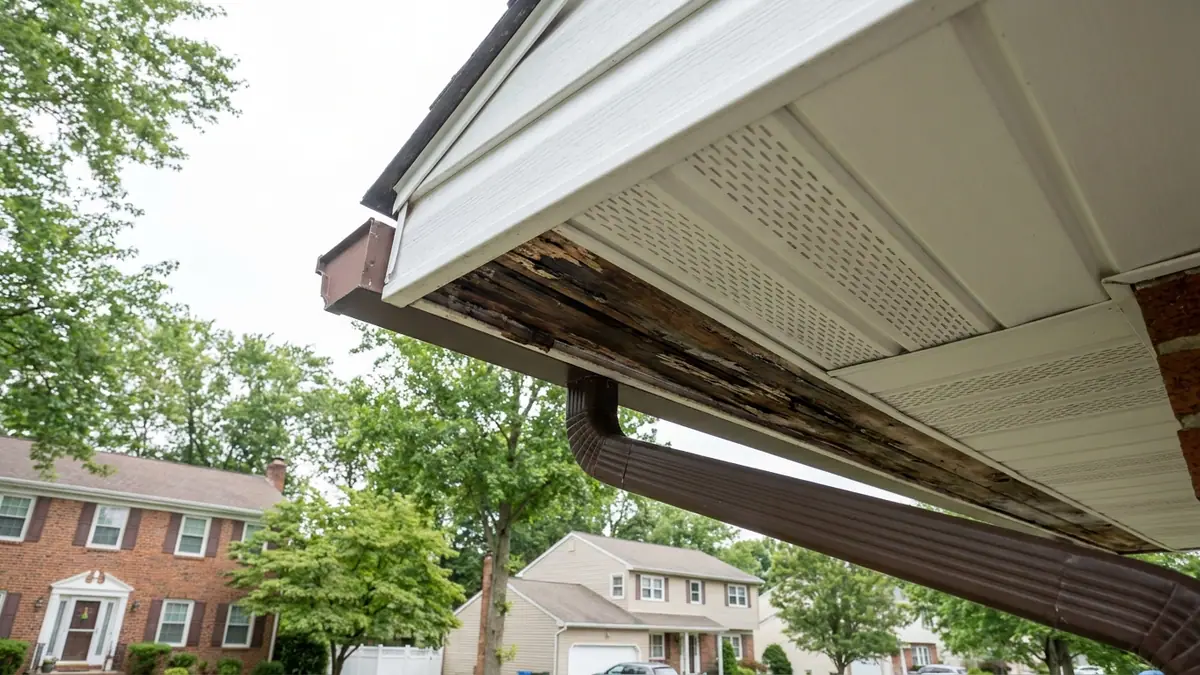
- Hangers and spacing. Hidden hangers screwed into solid fascia hold a loaded gutter. Spacing matters as much as type, and so does what they are screwed into. A hanger biting into soft, half-rotted fascia is a hanger that will let go.
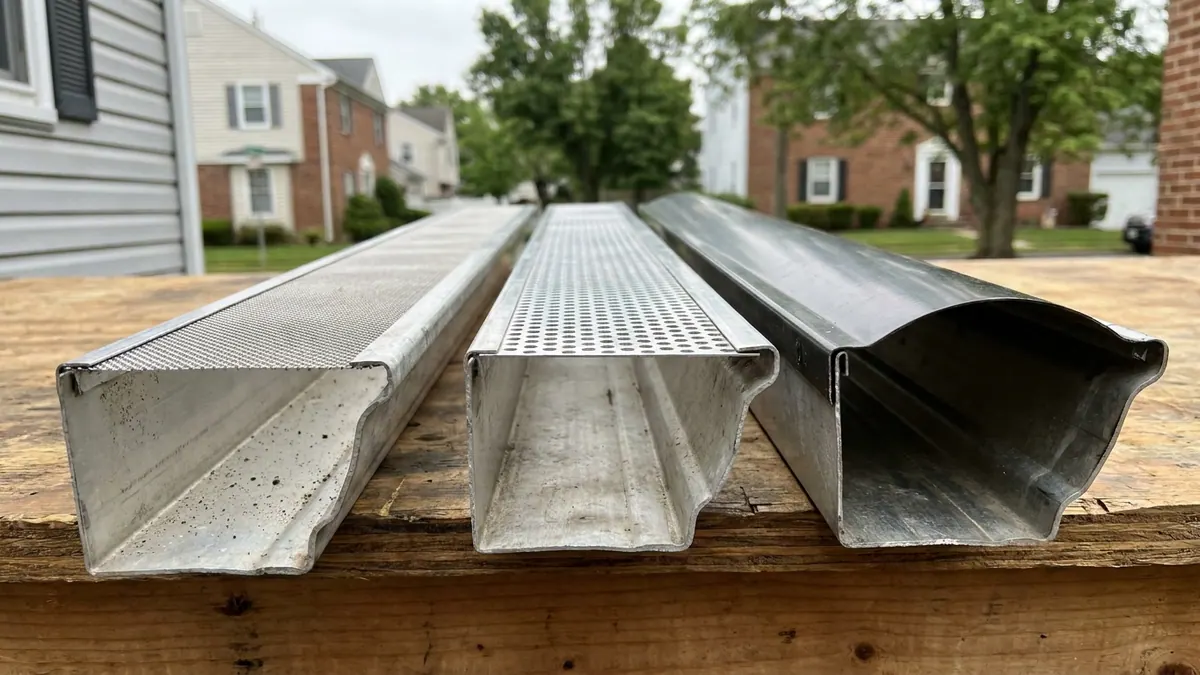
- Sealed joints. Seamless aluminum has no seams along its length, but it still has inside and outside miters at every corner, an end cap at each run and an outlet at every downspout. Those are sealed, and sealant ages.
- Debris load. Oaks and maples over the roof mean more weight, more standing water and more freeze damage. Clear gutters on a bare lot will outlive clogged gutters on a wooded one by years.
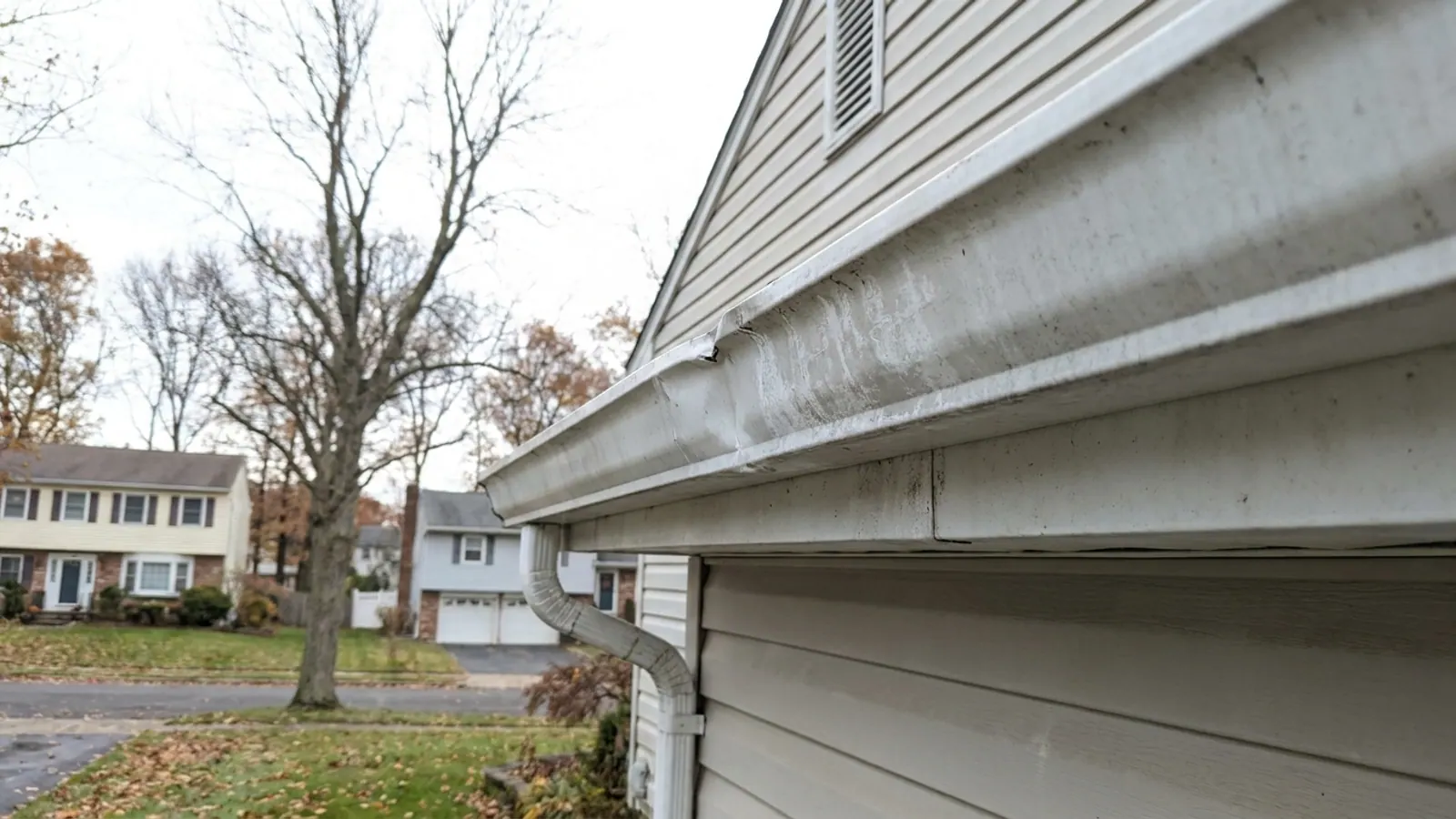
- Physical damage. Ladders set directly against the front edge, ice sliding off a steep slope, a limb coming down in a February storm. Aluminum dents and stays dented, and a dented section loses its pitch.
Signs your aluminum gutters are at the end
Age alone is not a reason to replace. These are.
- Water sheets over the front edge in moderate rain even though the gutter is clean.
- Visible sag between hangers, or a run that has pulled away from the fascia.
- Standing water and sediment in the trough days after a storm.
- Joints that drip at the corners after being resealed more than once.
- Pinholes, corroded spots or splits along the bottom of the trough, often where leaves sat for years.
- Screws that will no longer tighten because the fascia behind them is soft.
- Dark streaks running down the face with chalky, oxidized paint that rubs off on your hand.
One or two of these is a repair. Four or five across the whole house means you are paying someone to patch a system that is finished.
Repair, re-hang or replace
| What you are seeing | Likely cause | Reasonable fix |
|---|---|---|
| What you are seeingOne corner drips | Likely causeFailed miter sealant | Reasonable fixClean and reseal that joint |
| What you are seeingOne section sags | Likely causePulled hanger or soft fascia | Reasonable fixRe-hang, repair fascia behind it |
| What you are seeingStanding water in a long run | Likely causeLost pitch | Reasonable fixRe-pitch the run |
| What you are seeingOverflow in heavy rain, gutters clean | Likely causeUndersized gutter or too few downspouts | Reasonable fixAdd a downspout or upsize the system |
| What you are seeingPinholes and splits in multiple runs | Likely causeAluminum fatigued and corroded | Reasonable fixReplace |
| What you are seeingDents and bends over most of the house | Likely causeAccumulated physical damage | Reasonable fixReplace |
Re-pitching and re-hanging are real services, not consolation prizes. If the metal is straight and the finish is intact, they can buy several more years for a fraction of a replacement. Lightning Construction does re-pitching along with seamless gutters, guards and downspouts, and the gutters page lays out what is included.
Why New Jersey is harder on gutters than the number suggests
Two reasons: freeze and thaw, and leaf season.
Water that stands in a flat gutter in January freezes, expands, and works the seams and end caps. It happens dozens of times a winter in a normal New Jersey season, and each cycle does a little more. The gutters that split are almost always the ones holding water in December.
Ice at the roof edge compounds it. When heat escaping into the attic melts snow on the upper roof and that meltwater refreezes over the cold eave, the ice builds in and over the gutter. The gutter did not cause that, and no gutter prevents it, but it carries the weight. If this happens at your house every winter, the fix is in the attic, and the ice dams guide covers what actually stops it.
Leaf load is the other half. A roof under mature oaks fills twice a year, and the sludge that forms in the bottom of a gutter stays wet against the aluminum for months.
How to get the full 30 years
None of this is complicated.
- Clean them twice a year, after leaf drop and again in spring once the seed pods and maple helicopters are down.
- Flush the downspouts, not just the trough. A clogged elbow backs water up the whole run.
- Look at the gutter during a real rainstorm once a year. Overflow points and low spots announce themselves in ten seconds from the driveway.
- Keep ladders off the gutter face. Use a standoff.
- Check that discharge is carried away from the foundation, not dumping at the corner of the house.
- Reseal corners and end caps when they start to weep instead of waiting for the stain on the siding.
The seasonal routine is spelled out in the gutter maintenance guide, including what to do before and after storm season.
What new gutters cost, and when to do them
Lightning Construction quotes seamless aluminum gutters at $1,200 to $3,500 in standard-value New Jersey towns, $2,500 to $6,500 in higher-value towns, and $4,000 to $12,000 for large or luxury homes. The band is set by the municipality's median home value from ACS 2024 five-year estimates, not by a per-foot number invented on the phone. Linear feet, number of stories, downspout count, guards and any fascia repair move the figure within the band.
The best time to replace is with the roof. The drip edge, gutter apron and gutter all meet at the same four inches of roof edge, and setting them together means water leaves the shingles and lands in the trough instead of behind it. If your roof has five years left and your gutters have two, that is a different call, and a straight answer about which one is actually failing is worth more than a package price. For how seamless stock is formed on site and what gutter guards do and do not solve, read the seamless gutters guide.
What to do next
If your gutters are past 20 years and overflowing when they are clean, have someone look at the pitch, the hangers and the fascia behind them before you buy anything. Lightning Construction inspects and writes the estimate free with no obligation, and a salesperson does come to the house. There is no deposit, nothing is due until the work is done and you have looked at it, and the written estimate is the final price with no change orders. Book a free estimate and get told plainly whether you need new gutters or a morning of re-hanging.