Short answer
House wrap is the water-resistive barrier between your sheathing and your siding, and its job is to drain any water that gets past the panels back out of the wall. Before siding goes up, look for wrap that is dry, flat and tight over sound sheathing, laps that shed water downward, taped seams, and flashing tied into the wrap at every opening and penetration. If panels are going on over torn wrap or laps running the wrong way, stop the job and have it corrected.
On this page
House wrap is the water-resistive barrier that goes between your wall sheathing and your siding. Siding is not watertight, no siding is, and the wrap is what catches the water that gets behind it and drains it back out at the bottom of the wall. Everything worth checking happens in the few hours after tear-off and before the first panel goes up, so if you want to see it, that is the window.
Most homeowners never look. The wrap is up for a day or two, it gets covered, and nobody thinks about it again until there is a soft spot under a window ten years later. Below is what a correct job looks like from the driveway, in plain terms, and what to put in writing before the crew shows up.
What house wrap is doing behind your siding
Wind-driven rain gets past siding. It comes through the butt joints in vinyl, around trim, behind J-channel, and at every place something is fastened through the wall. That is normal and expected. The wrap's job is to keep that water off the plywood or OSB sheathing and give it a path down and out.
The second job is air. A well-lapped, taped wrap slows air moving through the wall assembly, which matters more for comfort than most people expect on an older New Jersey house with board sheathing and gaps at every stud bay.
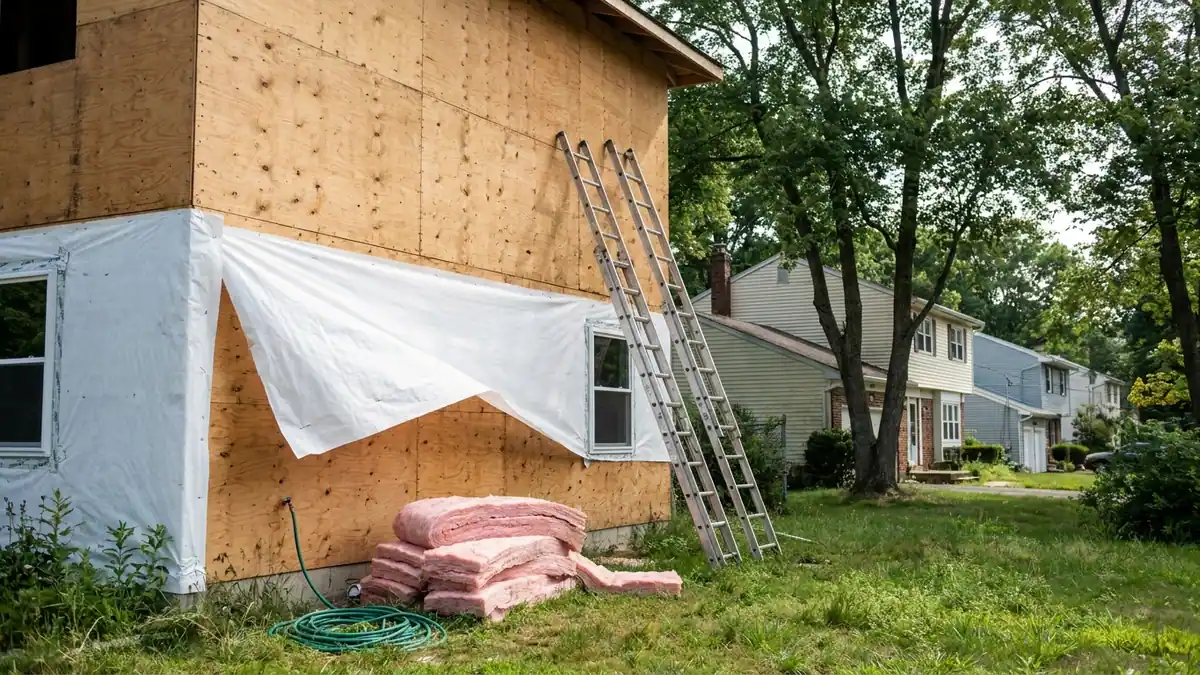
What the wrap is not is a vapor barrier. Modern house wraps are designed to stop liquid water from the outside while letting water vapor from inside the wall pass through and dry out. That is why plastic sheeting is the wrong material here, and why seeing poly stapled to the outside of a wall under new siding is a reason to stop and ask questions.
House wrap, felt and foam: what goes on the wall
| Material | What it is | Where it fits |
|---|---|---|
| MaterialWoven or spun-bonded house wrap | What it isPlastic sheet, water-resistive and vapor-permeable, rolled on in wide courses | Where it fitsThe default under vinyl and fiber cement on most New Jersey re-sides |
| MaterialDrainable house wrap | What it isSame sheet with a wrinkled or textured face that creates a small drainage gap | Where it fitsWalls that take heavy weather, and any wall with a past moisture problem |
| MaterialAsphalt felt | What it isTraditional 15 lb or 30 lb paper | Where it fitsStill used and still works, but it tears more easily and taping it is not as reliable |
| MaterialRigid foam board | What it isInsulation, taped, acting as the water barrier itself | Where it fitsAdds R-value and thickness; changes how trim and openings are detailed |
| MaterialFoam fanfold underlayment | What it isThin foam sheet for a flat nailing surface | Where it fitsLevels a wall under vinyl, but it is not a substitute for a water barrier behind it |
The important distinction: fanfold foam is a flattener, not a barrier. If a quote lists foam board and nothing else behind the siding, ask directly what is stopping water at the sheathing.
The laps and seams are most of the job
A roll of wrap installed wrong drains water into the wall instead of out of it. Three things to look at.
Laps run downhill. Wrap goes on in horizontal courses starting at the bottom of the wall. Each course above laps over the one below it, on the outside, by several inches, the same way shingles overlap. If an upper course tucks behind a lower one, water running down the face of the wrap goes straight in behind it. You can see this from the ground.
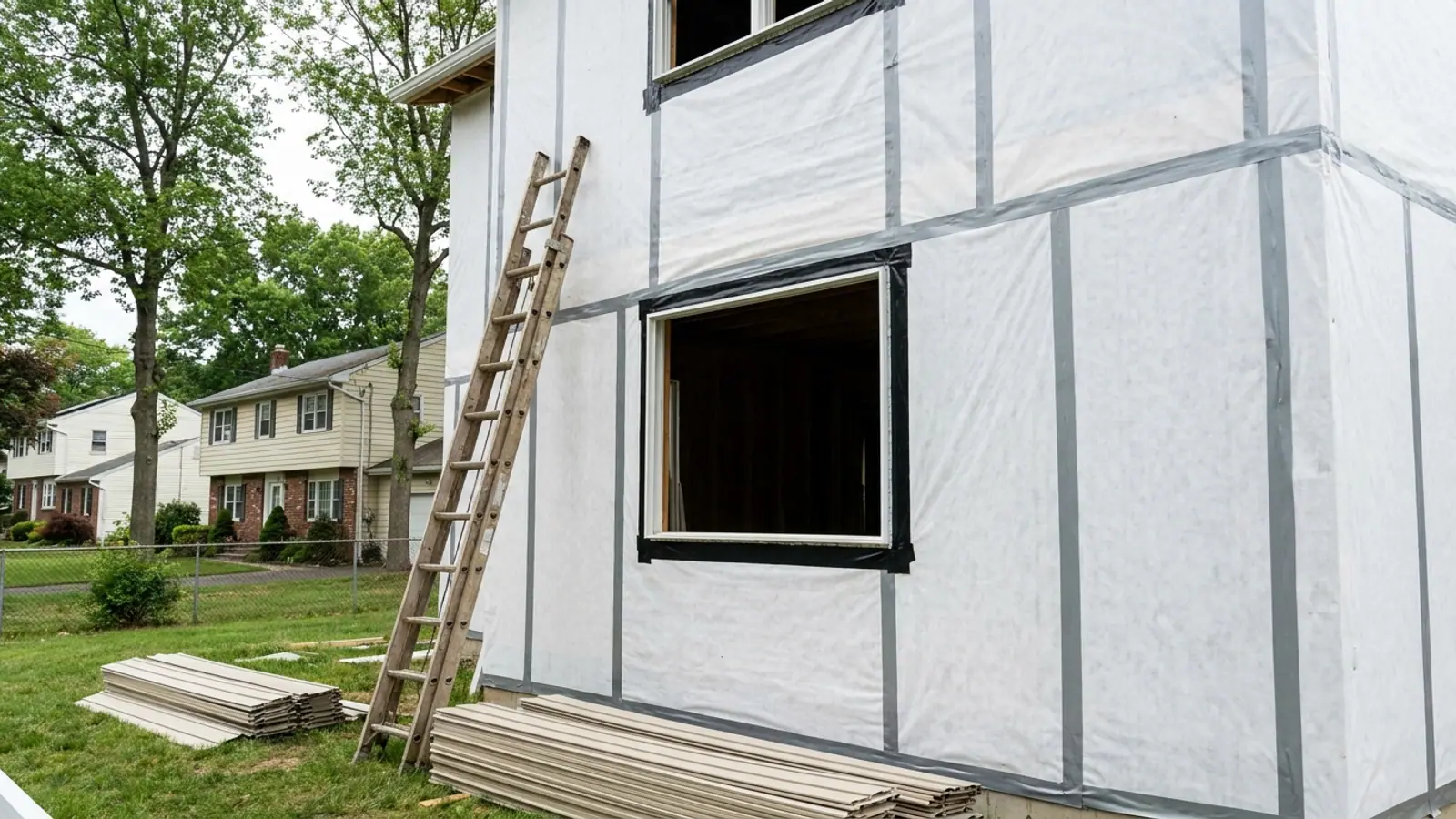
Vertical seams overlap toward the prevailing weather and get taped. Every horizontal and vertical seam should be taped with the tape the wrap manufacturer specifies, not whatever roll was in the truck. Mismatched tape lets go in a couple of summers of heat cycling.
The wrap is tight and it is fastened right. It should be pulled flat with no flapping bellies, capped fasteners rather than bare staples where the wrap has to hold on its own, and no tears left open. Tears happen; ladders and corners rip wrap. What matters is that they get patched with tape before anything covers them.
Openings, penetrations and the bottom of the wall
This is where walls actually fail. Water almost never comes through the middle of a wrapped wall. It comes in at a hole somebody cut in it.
Around window openings, the sequence matters: sill flashing first, then the sides, then the head flashing, with the wrap lapped so the layer above always covers the layer below. Lightning Construction does not sell or install windows. What the siding crew does is flash and wrap correctly around the openings you already have, and tie that flashing into the barrier so the drainage path is continuous.
Every penetration through the wall needs the same treatment: hose bibs, dryer vents, electrical boxes, the AC line set. Each one is a hole in the barrier, and each one should be sealed to the wrap with tape or a flashing boot rather than a bead of caulk and hope.
At the bottom of the wall, the wrap should end above a starter strip and flashing that lets water out. A barrier that drains water down to a dead end at the foundation has moved the problem rather than solved it. While the wall is open is also the right time to confirm the ground slopes away and that downspouts are not dumping against the siding.
What to ask for in writing before work starts
Put these on the estimate, not in a conversation:
- The brand and type of house wrap, and whether it is a drainable wrap.
- That all seams are taped with the manufacturer's tape.
- Flashing at every window and door opening and every wall penetration, described by material.
- What happens if rotted sheathing is found, and at what price.
- Who pulls the permit and attends the municipal inspection.
That fourth item is where most siding jobs turn ugly. A quote written from the curb cannot know what is under the old panels. Lightning finds those conditions at the free inspection and prices them into the estimate, so there are no change orders once the wall is open, and there is no deposit — nothing is due until the work is finished and you have looked at it. Lightning also pulls the permit from your municipality's construction office and attends the inspection under the New Jersey Uniform Construction Code, which means the wrap gets looked at by someone who is not the person who installed it.
A ten-minute walk-around after tear-off
Walk the perimeter before the panels start going up. Look for wrap that is flat and dry, laps that shed downward, tape on every seam, patched tears, flashing visible at the openings, and no exposed sheathing anywhere. Take photos on your phone from each elevation. If something looks wrong, that is the cheapest moment in the entire project to fix it, and any crew worth hiring will explain what you are looking at.
What material you pick changes the details
Fiber cement is heavier, holds moisture differently than vinyl, and benefits more from a drainage gap behind it. Insulated vinyl brings its own foam backing but does not remove the need for a proper barrier underneath. Standard vinyl sheds most water at the panel but leaks freely at every joint and at the J-channel, so the wrap behind it is carrying more of the load than people assume. The siding options guide covers how vinyl and fiber cement compare on cost, durability and appearance; the wrap decision follows the material decision, not the other way around.
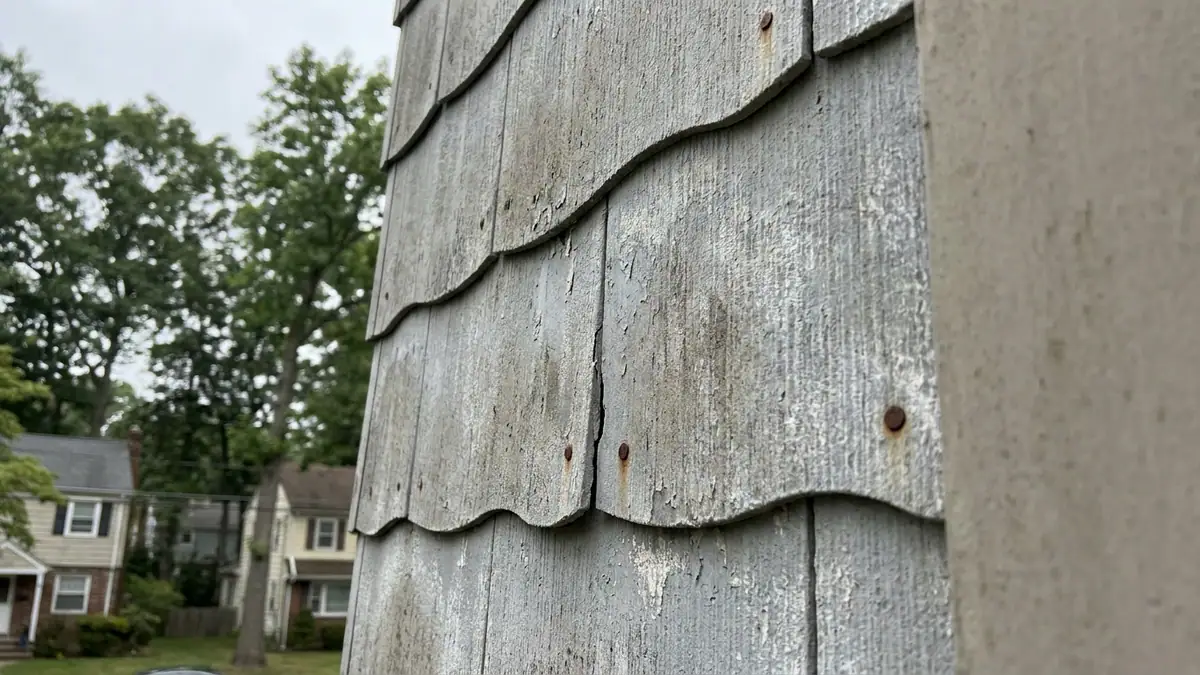
On older New Jersey housing stock with board sheathing rather than plywood, wrap does more work than usual, because the gaps between boards are an open path for air and water. Those houses are common across the state, and they are the ones where cutting the wrap line to save a few hundred dollars costs the most later.
What to do next
If you are getting siding quotes, ask each contractor the same five questions above and compare the answers, not just the totals. A number that is lower because the wrap, tape and flashing are thin or missing is not a better price.
Lightning Construction is veteran-owned, family-operated, licensed and insured, with New Jersey Home Improvement Contractor registration 13VH12437000, working in all 21 New Jersey counties. You can see the full scope of the siding work and who runs the company, and the inspection and written estimate are free with no obligation — a salesperson does come to the house, and there is no cost and no pressure to book. Schedule the free estimate and have the wall walked before anyone quotes it.