Short answer
In most New Jersey townhouse and condo communities the roof is a common element the association owns and replaces, and the unit owner approves nothing. Where the deed puts the roof on the owner, the association still controls material and color through architectural review, and that approval is separate from the municipal permit. Read the master deed first, because it decides which of those two situations you are in.
On this page
- Common element or limited common element: what your deed says
- What an HOA architectural review actually controls
- The permit is a separate approval, and it is not optional
- When the roof runs across several attached units
- Practical rules for working in a shared community
- Storm damage, master policies and unit policies
- What to do next
Whether you can hire a roofer for your townhouse depends on one document, and it is not the estimate. It is the master deed. In most New Jersey attached-housing communities the roof is a common element the association owns, maintains and replaces, and the individual owner approves nothing and hires nobody. In a smaller number of communities, usually fee-simple townhouses where each owner holds the land under the unit, the roof belongs to the owner and the association only controls what it looks like.
Those two situations lead to completely different phone calls. Below is how to tell which one you are in, what the association actually gets to decide, and where the municipal permit fits, because homeowners routinely confuse architectural approval with a construction permit and they are not related.
Common element or limited common element: what your deed says
Start with the master deed and the bylaws you received at closing. Somewhere in the first twenty pages there is a definitions section, and the roof will appear in one of three places.
- Common element. The association owns it, maintains it and replaces it. Funding comes from reserves or a special assessment. You do not hire a contractor. You can absolutely report a leak, and you should, in writing.
- Limited common element. The association still owns the roof, but only the owners it serves pay for it. This shows up in townhouse-style associations where each building has its own roof and the accounting is done building by building.
- Unit owner responsibility. The roof, and often the siding and gutters, belong to you. This is common in fee-simple townhouse developments. You hire the contractor and pay for it, and the association reviews the appearance.
If you cannot find your copy, the property manager or the association secretary will send it. The master deed is also recorded with the county clerk. Do not take a neighbor's word for which category you are in, and do not assume that because you pay a monthly fee the roof is covered by it.
What an HOA architectural review actually controls
When the roof is yours, the association's authority is normally limited to appearance and to the conduct of the work. That means shingle color, shingle line, sometimes the manufacturer, and rules about hours, staging and debris. It does not extend to how the roof is built. Nobody on an architectural review committee gets to tell a contractor to reuse old step flashing or skip ice and water shield at the eaves.
A typical submission asks for:
- The contractor's New Jersey Home Improvement Contractor registration number
- A certificate of insurance, often naming the association as an additional insured
- Manufacturer, shingle line and color, usually with a photo or a sample
- Start date, expected duration and daily work hours
- Where the dumpster and the material load will sit
Build the review timeline into your planning. Some committees meet monthly. Ask up front whether there is an expedited path for a leaking roof, because most documents allow emergency repairs first and paperwork after.
Color rules are stricter than people expect
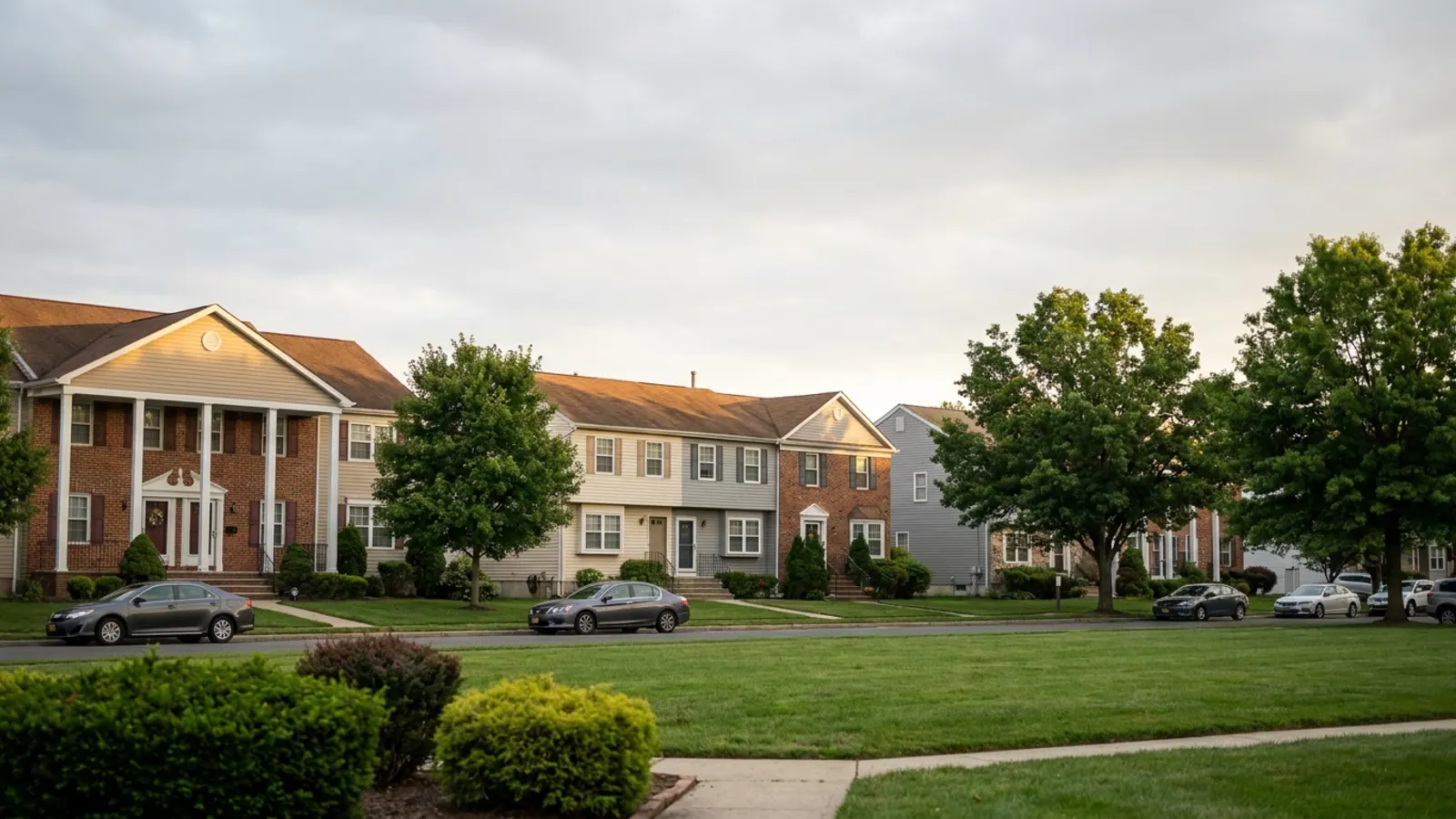
In a row of attached units the roof reads as one surface from the street, so associations that allow flexibility in almost everything else usually specify a single approved shingle color. If your community was built with a discontinued shingle, the committee has to pick a current equivalent, and that decision is easier when a roofer brings actual boards to the meeting rather than a printed chart. The GAF shingles guide explains how the lines and colors differ if you need to make that case.
The permit is a separate approval, and it is not optional
HOA approval is a private contract matter. The construction permit is law. Under the New Jersey Uniform Construction Code, a roof replacement is filed with the municipality's own construction office, and the municipal inspector, not the association, signs off on the work. Lightning Construction pulls that permit and attends the inspection in every municipality it works in, so the homeowner or the association files nothing. The permit guide covers what gets filed and why.
| Approval | Who grants it | What it covers | Who files |
|---|---|---|---|
| ApprovalArchitectural review | Who grants itYour HOA committee or board | What it coversColor, material, hours, staging | Who filesThe unit owner or the roofer |
| ApprovalConstruction permit | Who grants itThe municipal construction office | What it coversCode compliance, decking, flashing, ventilation | Who filesLightning Construction |
| ApprovalAssociation contract award | Who grants itThe board, for common element roofs | What it coversScope, price, schedule for the whole building | Who filesThe board or manager |
One more distinction worth holding on to. When the association owns the roof, the board awards the contract for the entire building or the entire section. An individual owner cannot hire a roofer for a common element roof and send the bill in afterward.
When the roof runs across several attached units
A roof over four attached townhouses is often a single deck with party walls under it. Where those walls run all the way to the underside of the deck with a fire separation, the roof can be divided at that line and one unit replaced on its own. Where the deck runs continuous over the units, it cannot be split cleanly, and any contractor who says otherwise is planning to end a tear-off in the middle of a shingle field.
The practical result is that in attached housing the decision is usually collective even when the deed makes the roof yours. It is worth knowing that doing the whole building at once costs less per unit than four separate mobilizations, and that most residential asphalt roofs are torn off and replaced in a single day. On a shared building that matters more than usual, because it decides how long the parking area is blocked and how many days your neighbors live next to a dumpster.
Practical rules for working in a shared community
Attached housing puts the work closer to other people than a detached lot does. Settle these before the crew arrives:
- Dumpster placement. Many associations restrict where a container can sit and require plywood under it to protect asphalt. Confirm the spot in writing.
- Parking and access. Fire lanes and shared driveways get enforced. The crew needs a staging area for material and a place to set ladders.
- Work hours. Some communities prohibit starting before a set time. Crews often begin very early in summer, so this needs to be agreed, not assumed.
- Nail cleanup on shared lawn. The sweep should cover the common lawn and walkways, not just the ground under your unit.
- Gutters and downspouts. On attached buildings a single gutter run can serve two or three units and drain through one downspout. Replacing that run is a building decision, not a unit decision, and gutter work is usually best done at the same time as the roof.
Storm damage, master policies and unit policies
When wind or hail damages a common element roof, the claim goes on the association's master policy and the board or the manager files it. Your own HO-6 unit policy generally covers what is inside the walls, plus the deductible assessment if your documents allow one. Where the roof is the owner's responsibility, it is your homeowner's policy and your claim. Either way, get photographs and a written inspection report before an adjuster comes out. The roof insurance claim guide walks through the sequence.
What to do next
Pull the master deed and find the word "roof" in it. That single step tells you whether you are hiring a contractor or writing a letter to the board. Then, whichever it is, get an inspection with photos and a written price before any meeting, because a committee or a board can only act on a real number.
Lightning Construction inspects and quotes free, with no obligation, and a salesperson does come to the house. The written estimate is the final price. There are no change orders, because extra shingle layers, damaged decking and failed flashing are found at the inspection and priced in, and there is no deposit at any point. Nothing is due until the work is finished and inspected. If you are presenting to a board, that combination is straightforward to explain, and the contractor selection guide lists the questions a board should be asking every bidder. Book the free estimate when you are ready for a number in writing.