Short answer
Call in this order: 911 or your electric utility if wires are involved, a licensed tree service to get the tree off the house, your insurance carrier to open the claim, a roofing and siding contractor to cover the opening and photograph the damage, and the municipal construction office for the permit. The order matters because no roofer can work under a tree that is still resting on the structure, and an adjuster wants photographs of the damage before anything gets moved.
On this page
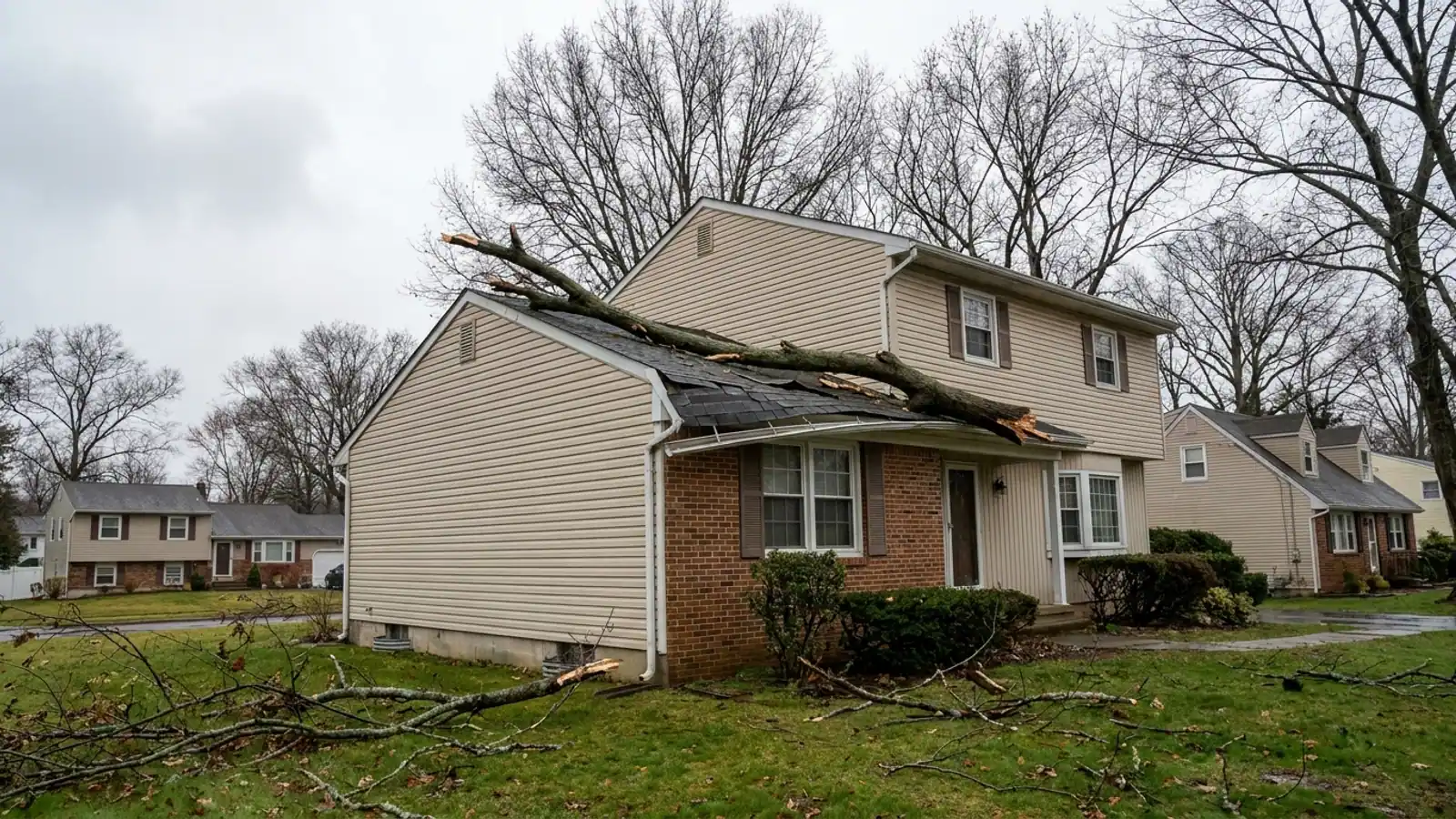
A tree on your roof is two separate jobs handled by two separate trades, and doing them out of order costs you money. The tree has to come off before anyone can tell you what the roof, the gutters and the siding actually need. Here are the five calls, in the order they should happen, and what each one is for.
The five calls, in order
- 911 and your electric utility's emergency line, if wires are down, sparking, or pinned under the tree. Also call if you smell gas or the tree hit a service mast.
- A licensed, insured tree service to remove the tree and the loaded limbs.
- Your insurance carrier, to open a claim and get a claim number.
- A roofing, siding and gutter contractor, to cover the opening, photograph the damage and write the repair estimate.
- The municipality's construction office for the permit — or in practice, the contractor who pulls it for you.
Everything below is what happens on each of those calls.
Call one: the utility, before anything else
If the tree took the service drop, the meter, or the mast off the wall, nobody goes near the house until the utility says so. That includes you, the tree crew and the roofer. A downed line in wet leaves is live in every direction, and the tree is now a conductor. Get everyone away from it, call 911 if anyone is hurt or a line is on the ground, and call the electric utility's outage and emergency number.
If the roof is open and water is coming into a finished room, shut power off to that area at the panel if you can reach it safely. Move what is under the leak. Do not go up into the attic to look at a hole with a limb through it.
Call two: a tree service, not a roofer
This is the call homeowners get backward. A roofing crew cannot work under a tree that is still on the structure, and cutting a loaded limb without rigging drops the rest of it through the decking. Tree removal is its own trade with its own equipment and its own insurance.
When you call, ask three things: are they licensed and insured, can they send proof of that insurance before they start, and do they crane or rig limbs off a roof rather than dropping them. A crew that plans to cut the limb where it lies and let it fall will turn a repairable roof section into a larger one.
Ask for the debris to be stacked clear of the walls, not leaned against the siding. Branch ends pressed into vinyl for three days in the sun leave marks.
Call three: your insurance carrier
Call the carrier the same day and get a claim number. Tell them what happened, what is damaged, and whether the house is open to the weather. Ask them directly: is emergency covering authorized, what documentation do you want, and do you need to inspect before repairs begin.
Do not guess at what your policy covers. Tree removal, roof repair, siding, gutters, fence and interior water damage are often treated differently from one another, and the language that decides it is in your own policy, not in any article. Read the declarations page and ask the adjuster to explain each line.
Before anything moves, photograph everything from the ground: the tree on the house, the wide shot showing where it fell from, the crushed gutter, the torn siding, every room with water in it. Photograph the debris pile after removal too. The New Jersey roof insurance claim guide walks through how the claim is built and what an adjuster actually looks for.
Call four: a roofing, siding and gutter contractor
This call does three jobs. It gets the opening covered so the interior stops taking water. It gets the damage photographed by someone who knows what he is looking at. And it produces a written estimate the adjuster can work from.
Emergency covering is temporary and it should be described that way in writing. It is not a repair, and it is not a substitute for getting the decking and flashing looked at once the tree is gone.
When the crew inspects, expect them to check more than the crushed area. A tree that lands on one slope shocks the whole roof edge. What turns up regularly:
- Broken or punctured decking well past the visible hole.
- Shingles cracked across the mat on the impact path, which look fine from the ground and leak in the first hard rain.
- Flashing at a sidewall or chimney knocked loose by the limb sliding.
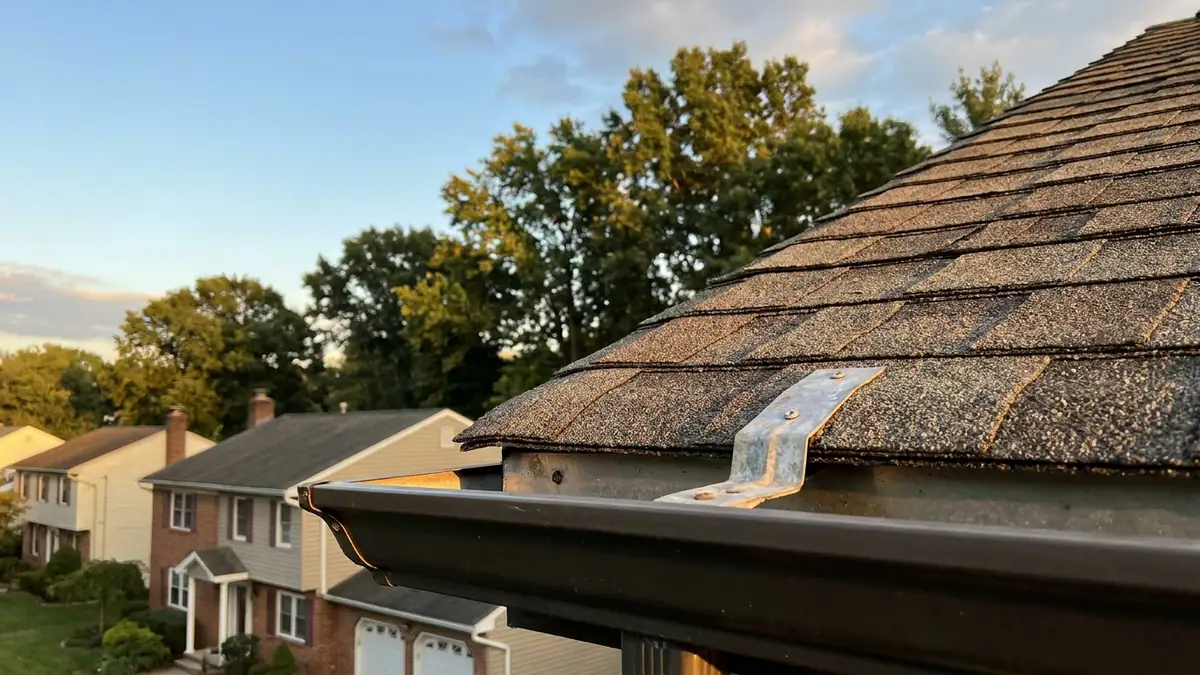
- A gutter run bent, torn off its hangers, or re-pitched so it now holds water.
- Siding cracked, gouged or pulled off the nail hem, with the house wrap torn behind it.
- Bent or split fascia, which is what the gutter hangs from.
What each trade handles
| Item | Who does it |
|---|---|
| ItemLive wires, service drop, meter | Who does itElectric utility |
| ItemTree and limb removal, stump | Who does itLicensed tree service |
| ItemDecking, underlayment, shingles, flashing | Who does itRoofing contractor |
| ItemGutters, downspouts, re-pitching | Who does itGutter contractor |
| ItemSiding, trim, soffit, fascia | Who does itSiding contractor |
| ItemDrywall, insulation, flooring inside | Who does itInterior trades |
Lightning Construction handles the four middle trades and none of the first or last, so ask plainly who is doing what before you sign anything. Gutter and downspout work after impact damage is covered on the gutters page, and wall damage behind a fallen limb is siding work.
Call five: the permit
A repair large enough to replace decking or a roof section needs a permit from your municipality's construction office under the New Jersey Uniform Construction Code. Lightning pulls that permit and attends the municipal inspection, in every municipality, so the homeowner files nothing. If a contractor tells you to pull it yourself as the property owner, that is your signal to stop and call someone else.
Repair the section, or replace the roof
Both answers are honest, and the deciding factors are the age of the roof and how far the damage travels.
A young roof with a limb strike on one slope is usually a repair: replace the broken decking, re-shingle the area, redo the flashing it disturbed. The trade-off is that new shingles next to weathered ones will not match, and on a roof with age on it the patch stays visible.
A roof already near the end of its service life is usually a replacement, because you are paying mobilization, permit and crew time either way and a patch buys you two or three years. Most asphalt replacements in New Jersey run $9,000 to $22,000 in standard-value towns, $14,000 to $35,000 in higher-value towns, and $25,000 to $60,000 on large or luxury homes, with the band set by the municipality's median home value from ACS 2024 five-year estimates. Most of those replacements are torn off and finished in a single day. The broader picture on storm losses is in the storm damage guide.
What to do next
Get the wires cleared, get the tree off, get the claim number, then get a real set of eyes on the roof, the gutters and the walls. Inspections and written estimates from Lightning Construction are free with no obligation, a salesperson comes to the house, there is no deposit, and the written estimate is the final price with no change orders. Emergency response runs 24 hours a day at (862) 860-6254.
When the tree is clear and you want the damage priced properly, request a free estimate.