Short answer
Yes. A roof and a siding job can be sold, permitted and scheduled as one project, and on most New Jersey houses that is the cheaper and less disruptive way to do it. The two trades do not happen on the same day, though: the roof goes on first, then the siding crew works up to the new roof edge.
On this page
Yes. One contractor can quote, permit and schedule both on a single project, and on most New Jersey houses that is the better way to buy it. What it does not mean is both trades happening on the same day. The roof goes on first and the siding follows, because siding tucks under the roof edge and behind flashing, and doing it the other way around means cutting into work you just paid for.
Here is what a combined project actually looks like, what it saves, and when splitting it up is the honest answer.
What "at the same time" really means on a job site
It means one contract, one permit package, one crew schedule and one price, not two trades working shoulder to shoulder on the same wall.
Most residential asphalt roofs are torn off and replaced in a single day. Standing-seam metal runs two to four. Siding is a multi-day job on almost every house, because every course has to be cut, lapped and fastened by hand, and the trim, soffit and fascia work at the top of the wall takes as long as the flat runs.
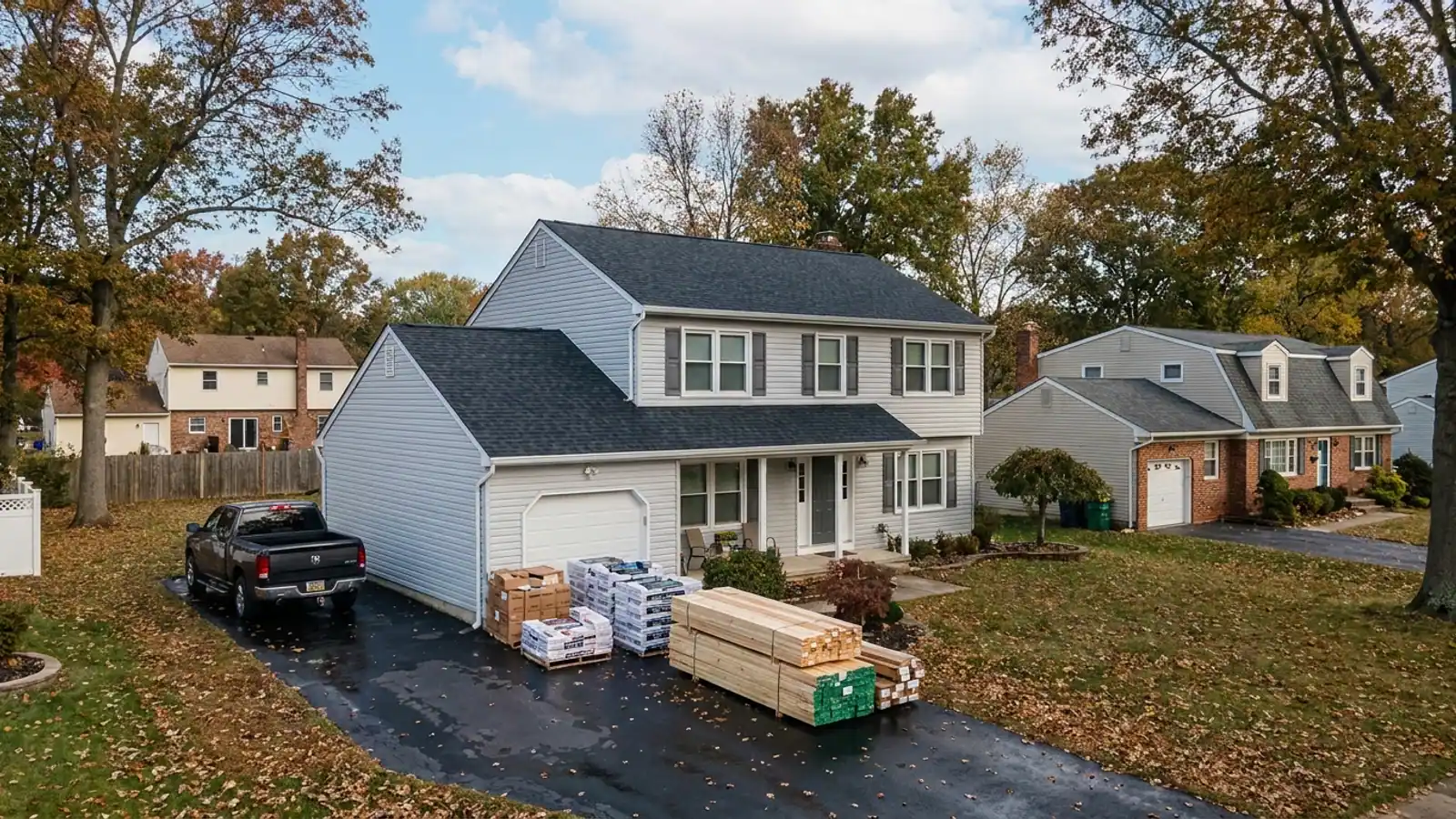
So a combined project usually reads: roof day, then the siding crew starts the next working day and runs until the walls are done. You get one mobilization, one dumpster cycle, one set of ground protection and one final cleanup instead of two rounds of all of it, months apart.
What the roof and the siding share at the edge of the house
The top of your wall and the bottom of your roof are the same assembly, and that is the strongest practical reason to do both together.
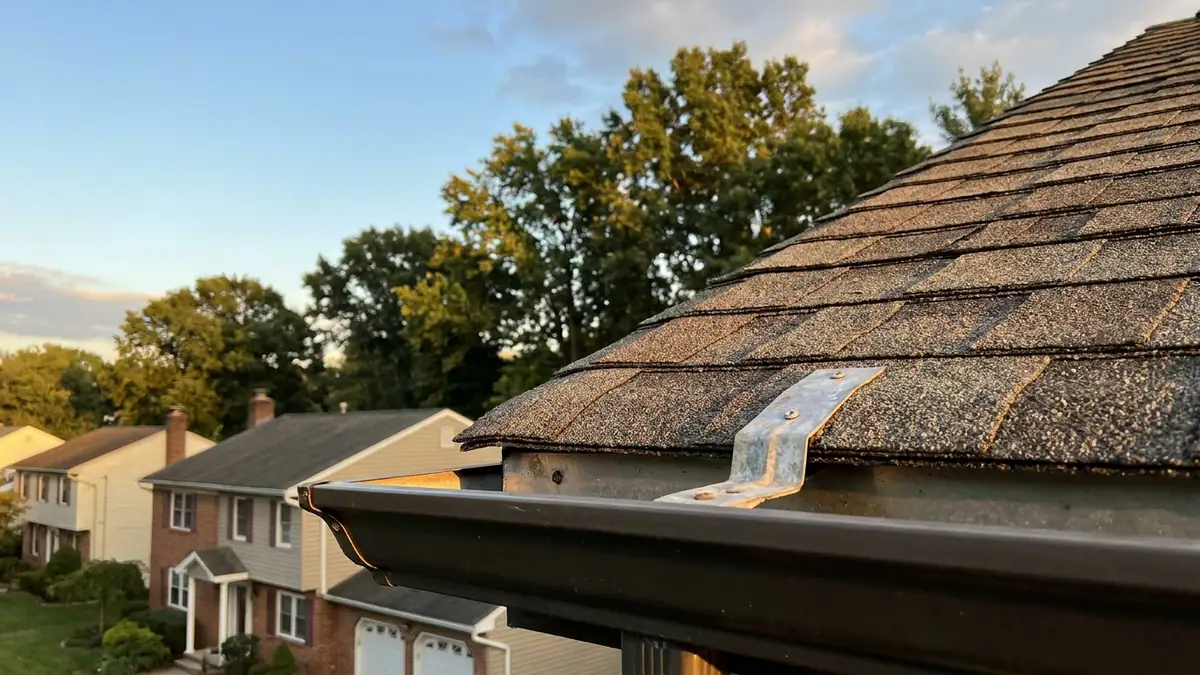
Drip edge, gutter apron, fascia board, soffit, the gutters hanging off the fascia, the house wrap that has to lap correctly behind the siding, and the step flashing where a roof plane dies into a wall — all of it lives in the same six inches of the house. When a roofer does the roof in spring and a siding contractor does the walls in fall, someone has to disturb the other's work at that junction, and nobody owns the result.
Step flashing is the clearest example. Where a garage roof or a porch roof meets a wall, the flashing goes up behind the siding, course by course. If the siding is new and the roof is old, the roofer either reuses flashing that should have been replaced or he cuts your new siding to get at it. Doing both together lets one crew set that flashing once, correctly, with new material on both sides of it. The same logic covers the roofing work at every dormer cheek and every sidewall on the house.
The costs that only get paid once
There is real money in the overlap, and it is not the materials.
| Cost item | Two separate projects | One combined project |
|---|---|---|
| Cost itemMobilization and setup | Two separate projectsTwice | One combined projectOnce |
| Cost itemDumpster and disposal runs | Two separate projectsTwo cycles | One combined projectOne cycle, shared |
| Cost itemGround and landscaping protection | Two separate projectsSet and struck twice | One combined projectOnce for the whole job |
| Cost itemPermit trips and inspections | Two separate projectsHandled twice | One combined projectHandled together |
| Cost itemFascia, soffit and gutter detail at the roof edge | Two separate projectsTouched twice, by two contractors | One combined projectBuilt once, by one |
| Cost itemFinal cleanup and nail sweep | Two separate projectsTwice | One combined projectOnce |
It is not a fixed percentage and any contractor quoting you one off the top of his head is guessing. Ask for both scopes on one written estimate and compare that total against two standalone quotes for your own house.
How a combined project runs, step by step
- Free inspection. A salesperson comes to the house, goes on the roof, and opens or probes at the problem areas on the walls. Layers, decking condition, flashing, rot behind siding and failed house wrap are found here, not later.
- One written estimate covering both trades, with the roof scope and the siding scope itemized so you can see what each one costs.
- Lightning pulls the permits from your municipality's own construction office under the New Jersey Uniform Construction Code and attends the inspections. You file nothing.
- Roof day. Tear-off to the decking, deck repairs, underlayment, ice and water shield, flashing, shingles or panels, then cleanup and a nail sweep.
- Gutters, if they are part of the job, go on with the roof edge work rather than being added months later.
- Siding. Old siding off, sheathing inspected and repaired, house wrap, then siding, trim, soffit and fascia, working up to the roof edge that is already finished.
- Municipal inspection, final walkthrough with you, then payment. There is no deposit on any Lightning job and nothing is due until the work is done and you have inspected it.
What it costs in New Jersey
The two scopes are priced as two scopes, and both are banded by your municipality's median home value from ACS 2024 five-year estimates.
Asphalt roof replacement runs $9,000 to $22,000 in standard-value towns, $14,000 to $35,000 in higher-value towns, and $25,000 to $60,000 on large or luxury homes. Metal starts higher, at $18,000 to $35,000 standard. Siding runs $10,000 to $22,000 standard, $16,000 to $38,000 higher-value, and $30,000 to $70,000 on large or luxury homes. Seamless gutters run $1,200 to $3,500 standard.
Roof size, pitch, existing layers, the number of valleys and penetrations, wall area, the number of corners and window openings to trim around, and the siding material all move the number inside those bands. The roof cost guide breaks down the roofing side, and the siding options guide covers what vinyl and fiber cement do to the siding price. Do not accept a per-square or per-square-foot number over the phone as a price on either trade.
If the combined total is more than you want to write at once, financing through GreenSky and FTL includes 24 months at 0% interest and 120-month terms with no prepayment penalty. Nothing is owed before the work is finished either way.
When you should not combine them
Sometimes the right answer is roof now, siding later.
- The roof is leaking and the siding is only tired. Fix the active water problem. Siding that looks dated is not costing you anything this winter.
- You are not sure what you want on the walls yet. Color and material decisions made under schedule pressure get regretted. The roof does not have to wait for them.
- The siding failure is local. If one elevation took sun and weather and the rest is sound, a partial job may be the honest scope, and that is a different conversation than a full wrap.
- Budget forces a choice. Doing one trade properly beats doing two thinly. Put the money where water is getting in.
A contractor who will not tell you which one to do first is selling, not advising.
What to get in writing before you sign
Both scopes itemized on one estimate. The roof system components by name. The siding product, the trim package, and whether soffit and fascia are included. What happens at every roof-to-wall junction. Whether gutters are in or out. Who pulls the permits and attends the inspections. And a clear statement that the written number is the final number.
On a Lightning estimate it is, because there are no change orders. The conditions that normally trigger one on a combined job — an extra shingle layer, soft decking, rot behind the old siding, flashing that cannot be reused — are found at the free inspection and priced into the quote. Lightning Construction is veteran-owned and family-operated, GAF Certified, licensed and insured, New Jersey Home Improvement Contractor registration 13VH12437000, rated 4.9 out of 5 from 264 Google reviews.
If both the roof and the walls are at the end of their life, have both looked at on the same visit and get one written price. Book the free estimate and a salesperson will come out, inspect the roof and the siding, and leave you a number you can hold.