Short answer
Anything bolted to your fascia, your gutter or the first course of shingles has to come off before the roof or the gutters do, and the roofer is not always the one allowed to remove it. Energized solar equipment and anything under an active service contract is detached and reset by the company that owns it; a dead satellite dish or an old bracket is removed by the roofing crew and the holes are sealed. Get the removal, the sealing and the remounting written into the estimate before the job is scheduled.
On this page
Anything bolted to your fascia, hung on your gutter or screwed through the first course of shingles has to be dealt with before the old roof or the old gutters come off. The question homeowners get wrong is who does it. A roofing crew can pull a dead satellite dish and a rusted light bracket. It cannot legally or sensibly touch live solar equipment, a powered camera run or a refrigerant line, and it should not promise to realign an active dish afterward.
Here is how that gets sorted out before the truck shows up, and what belongs in writing.
What counts as eave-mounted equipment
The eave is the busiest few feet of a New Jersey house. On a typical 1960s or 1970s split level you can find all of this inside a six-foot span:
- A satellite dish lagged into the fascia or the rake board.
- An old VHF antenna mast strapped to the gable end.
- Solar conduit running from the array down behind the gutter to a disconnect on the wall.
- Micro-inverters and rapid-shutdown wiring clipped to the racking near the roof edge.
- A doorbell transformer wire, a camera, or a floodlight screwed to the soffit or fascia.
- Mini-split refrigerant lines in a line-set cover crossing under the gutter.
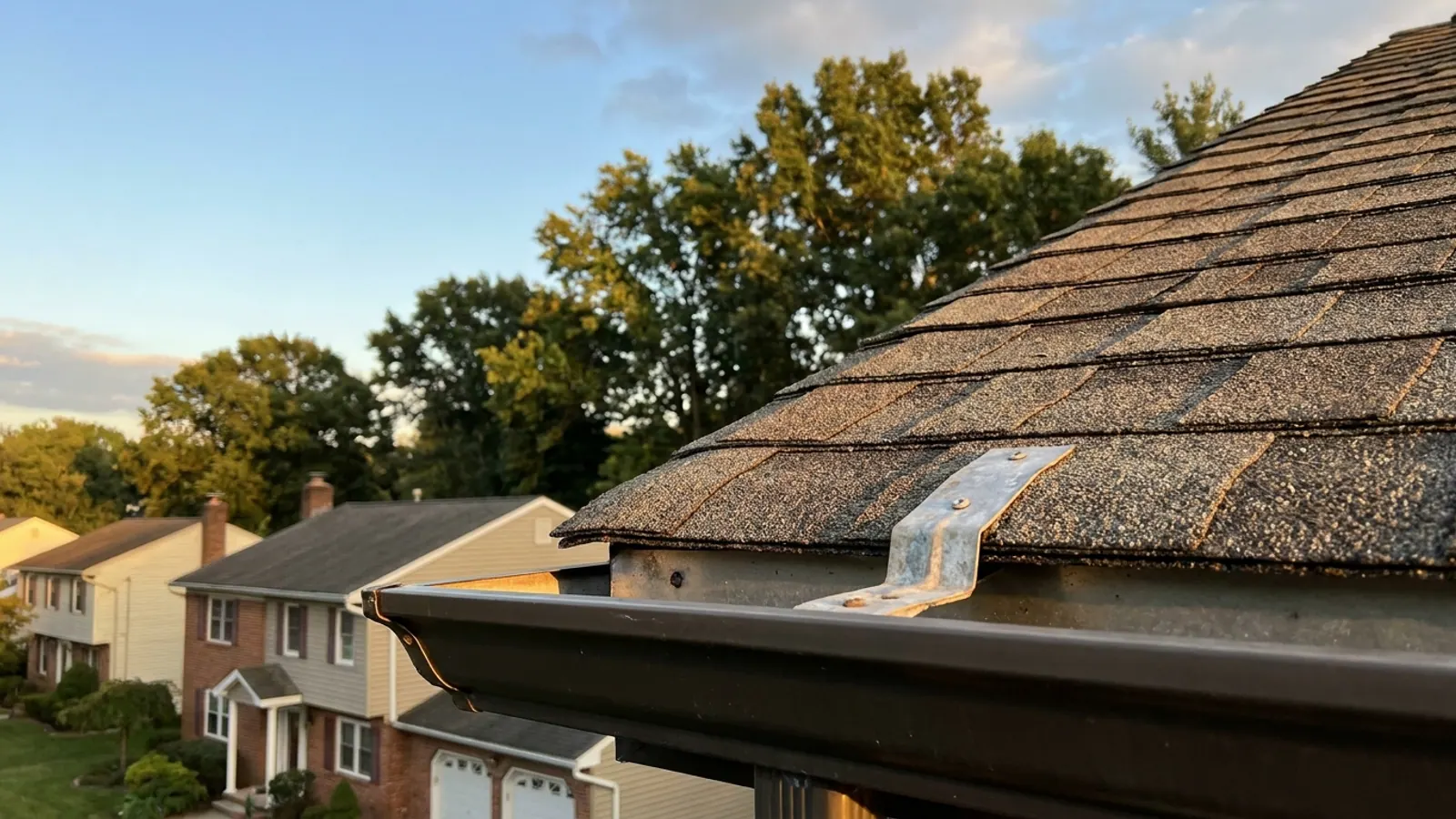
- Permanent holiday light clips hooked over the gutter lip, or worse, nailed through the drip edge.
- Snow retention brackets on an older metal porch roof.
Every one of those is either a penetration, an obstruction, or both. Penetrations leak. Obstructions mean a crew either works around them badly or stops and waits for someone else.
Who is allowed to touch what
This is the part to settle at the estimate, not on the morning of the job.
| Equipment | Who removes and resets it | Why |
|---|---|---|
| EquipmentSolar array, racking, conduit, inverters | Who removes and resets itSolar company or licensed electrical contractor | WhyEnergized system, separate permit and inspection |
| EquipmentActive satellite dish | Who removes and resets itThe service provider | WhyAim and signal are their responsibility, not the roofer's |
| EquipmentDead dish, old antenna, abandoned bracket | Who removes and resets itRoofing crew | WhyNo live service, holes get sealed and fascia repaired |
| EquipmentCameras, floodlights, low-voltage wire | Who removes and resets itUsually the roofing crew, if you agree in writing | WhySimple mounts, but somebody has to own the reinstall |
| EquipmentMini-split line set | Who removes and resets itHVAC contractor | WhyRefrigerant lines are not a roofing trade |
| EquipmentGutter guards, hangers, light clips | Who removes and resets itRoofing or gutter crew | WhyPart of the gutter system itself |
If you are replacing panels or anything electrical as part of a larger project, know that Lightning Construction does roofing, metal roofing, siding and gutters. It does not do electrical work and does not sell solar. The estimate will say what the crew handles and what you need to schedule with another company.
Why a bracket on the fascia is usually already a problem
Pull a satellite dish off a New Jersey fascia board and you often find four lag holes that have been taking water for years. The sealant someone smeared on at installation dried, shrank and cracked. Water tracked down the lag shank into the end grain of the board.
So the removal is rarely just a removal. It is removal, then an honest look at the fascia behind it, then repair. Soft, dark, spongy wood under the bracket means that section of fascia gets replaced before the new gutter goes up, because a gutter hanger screwed into rotted wood pulls out in the first heavy ice load. If the soffit behind it is stained, that is a sign the water got further than the board.
This is exactly the kind of condition that triggers a change order with most contractors, because they quoted from the driveway and never looked behind the dish. Lightning finds it at the free inspection and prices it into the written estimate, and that estimate is the final price. There is also no deposit, so you are not paying for a discovery you have not seen yet.
How this changes a gutter replacement
New seamless aluminum gutter is run and hung the same day it is formed on site, which means the whole fascia line has to be clear and sound when the crew gets there. Three things to decide in advance.
- Nothing gets remounted on the gutter. A gutter is light aluminum hung on hidden hangers. It carries water and ice, not a dish, not a camera, not a flag bracket. Anything that was hanging on the old gutter needs a new home on the fascia over solid blocking, on a rafter tail, on a gable wall or on a pole in the yard.
- Conduit and line sets need clearance. If solar conduit or a line-set cover crosses the fascia, the gutter run and the hanger spacing have to be planned around it. Skipping a hanger at that spot and hoping is how a gutter sags.
- Hooked-on light clips come off for good. Clips that hook the front lip deform it over time and hold leaf litter. If you want permanent lighting, mount it to the fascia above the gutter, not to the gutter.
If you are deciding on guards or profile at the same time, the seamless gutters guide covers that in depth, and the gutters page lists what the install includes. Gutter work in standard-value New Jersey towns generally runs $1,200 to $3,500, with higher bands set by the municipality's median home value, and fascia repair behind old mounts is part of what moves a quote inside that range.
Sequencing the job when something has to come off first
Most asphalt roof replacements here are torn off and finished in a single day. That is an advantage, but it makes scheduling tight when a third party is involved, because a one-day job cannot sit half-open waiting for a solar truck.
The working order on most houses:
- Free inspection, with photos of every mount, bracket and penetration at the eave and in the field.
- Written estimate that names each item and says who removes it and who resets it.
- You schedule the detach with the solar company, the satellite provider or the HVAC contractor, and give Lightning the date.
- Detach happens first, far enough ahead that a delay does not cost you the roofing date.
- Lightning pulls the permit from your municipality's construction office under the New Jersey Uniform Construction Code and attends the inspection. You file nothing. If any electrical work is involved, that is a separate permit under the other contractor.
- Tear-off, deck repair, underlayment, flashing, shingles, gutters, cleanup and a nail sweep.
- Reset of the detached equipment, scheduled after the roof is complete.
The roof permit guide explains what the municipal inspection actually looks at, which matters when a second trade is working on the same roof.
What to get in writing before you sign
Ask for these, by name, on the estimate:
- Each piece of equipment listed individually, with removal and reinstall assigned to a specific party.
- Sealing and flashing of every abandoned penetration, including lag holes in fascia and rake boards.
- Linear feet of fascia or soffit replacement, if the inspection found rot behind a mount.
- The remount location for anything going back up, and what it is anchored into.
- Confirmation that no bracket will be fastened to the new gutter.
A contractor who waves this off and says the crew will "figure it out up there" is telling you the price is not final. For a wider checklist on judging an estimate and a contractor, read the guide on choosing a roofing contractor in NJ.
What to do next
Take photos of every mount, dish, conduit run and light bracket on your eave, including close-ups of the fascia around them. Bring those to the inspection. Lightning Construction is veteran-owned, family-operated, GAF Certified, licensed and insured under New Jersey Home Improvement Contractor registration 13VH12437000, and serves all 21 New Jersey counties.
The inspection and the written estimate are free with no obligation, and a salesperson does come to the house. Book the free estimate and have the equipment questions answered before the scope is set, not after the old roof is in the dumpster. If the roof itself is the larger question, the roofing service page lays out what a replacement includes.