Short answer
K-style is the right profile on almost every New Jersey house because it carries more water per inch of width, costs less installed, and hangs off the fascia with hidden hangers. Half-round is a period-correct look for older architecture and it sheds debris better, but it needs to be one size larger to match a K-style trough for capacity, and it costs more to buy and hang. Pick K-style unless the house or a historic district gives you a reason not to.
On this page
K-style belongs on almost every New Jersey house. It carries more water per inch of width, it costs less installed, and it screws to the fascia with hidden hangers that disappear from the ground. Half-round is worth paying for when the house is old enough that the flat, angular K-style face looks wrong on it, or when a historic district asks for the period profile.
That is the decision. Here is what actually separates the two, and what each one does on a real roof edge in February.
What the two profiles actually are
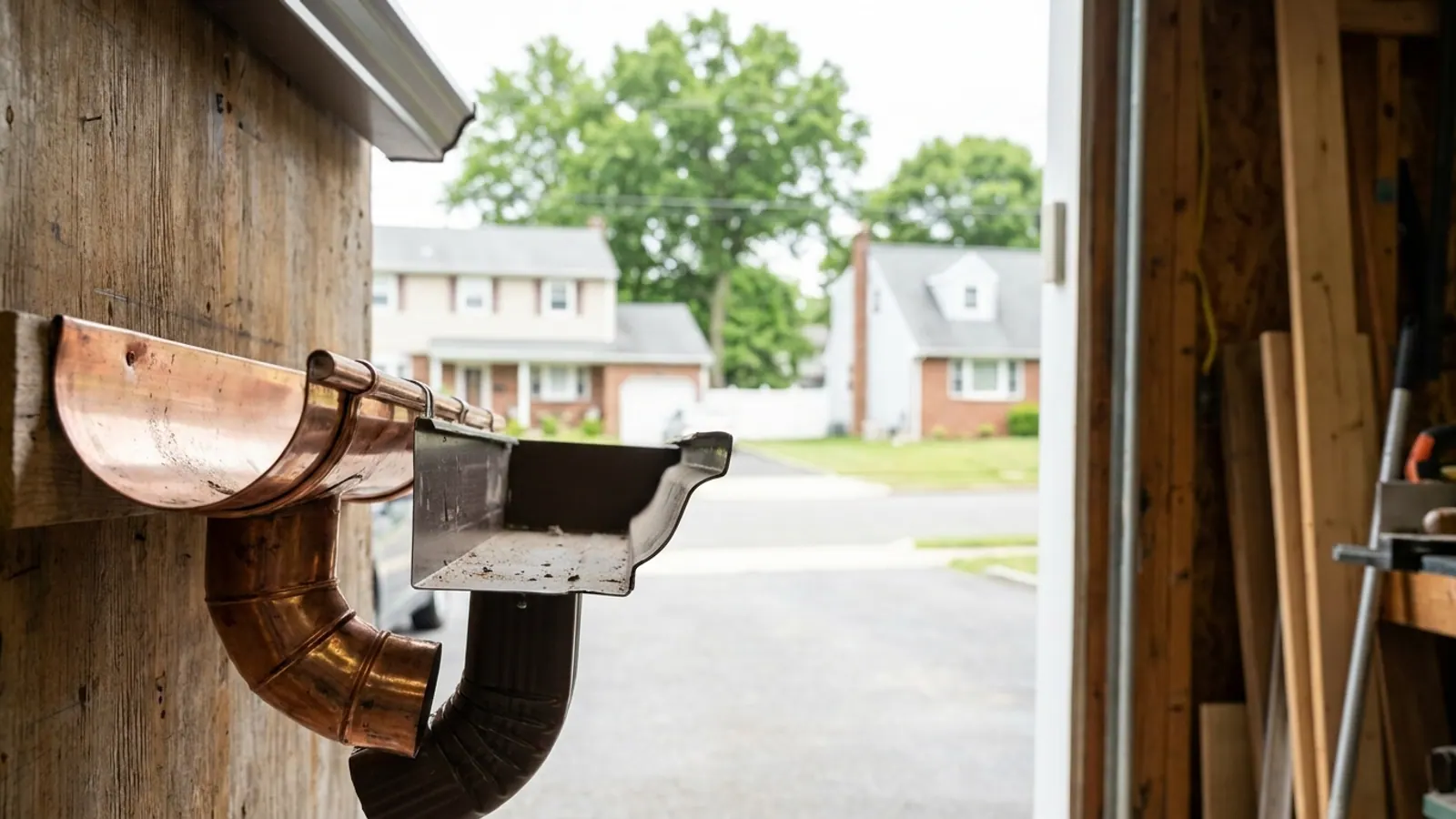
K-style gets its name from the shape of its front face. The back is flat and vertical against the fascia, the bottom is flat, and the outside face is folded into an ogee curve that reads as crown molding from the street. The trough is roughly square in section with a decorative front.
Half-round is exactly what the name says: a semicircular trough, usually with a rolled or beaded lip on both edges. It does not touch the fascia along its whole back. It hangs in brackets, either mounted to the fascia or hooked over the roof deck, and the pipe sits slightly away from the board.
That structural difference drives everything else. A flat back can be screwed straight through into the fascia every two feet. A round back cannot, so it needs a bracket system, and brackets cost money and take labor.
Capacity: which gutter moves more water
K-style wins, and not by a small margin. A semicircle is the least efficient way to fill a given width, so a half-round trough of the same nominal size holds roughly a fifth less water in cross-section than a K-style. In practice, a 6-inch half-round is closer in capacity to a 5-inch K-style than to a 6-inch K-style.
So if you want half-round on a house that already needs every bit of a 5-inch gutter, you go up to 6-inch half-round and up-size the outlets with it. That is one more reason the half-round job costs more.
Capacity is not just about the trough, either. It is about how fast the trough empties. K-style takes rectangular 2x3-inch or 3x4-inch downspouts. Half-round takes round 3-inch or 4-inch pipe. Round pipe actually handles debris better at the elbows, because there are no corners for a wad of maple seeds to wedge into, but it needs more clearance where it runs past window trim and corner boards.
If your existing gutters overflow in a hard rain while they are clean, the profile is not your problem and neither is the size in isolation. That is a pitch, outlet count or roof-area problem, and the seamless gutters guide walks through how a run gets sized and drained.
Side by side
| K-style | Half-round | |
|---|---|---|
| Shape | K-styleFlat back and bottom, ogee front face | Half-roundSemicircular trough with rolled edges |
| Capacity at same width | K-styleHigher, roughly a fifth more cross-section | Half-roundLower, usually needs one size up |
| Attachment | K-styleHidden hangers screwed through the flat back into fascia | Half-roundBrackets under or around the trough, fascia- or deck-mounted |
| Downspouts | K-styleRectangular 2x3 or 3x4 | Half-roundRound 3-inch or 4-inch |
| Debris behavior | K-styleGrit and needles pack into the inside corners | Half-roundRounded bottom moves debris toward the outlet |
| Look | K-styleReads like crown molding, standard on postwar and modern houses | Half-roundPeriod profile, correct on Victorian, Tudor, Colonial Revival and stucco houses |
| Installed cost | K-styleLower | Half-roundHigher, from brackets, labor and material |
| Availability seamless | K-styleCommonly run on site in long lengths | Half-roundFar less commonly run seamless |
Cost: what actually drives the difference
The metal is a small part of a gutter price. Linear feet, the number of inside and outside corners, how many downspouts the runs need, how high the eaves are, and whether the fascia is sound enough to hold a hanger — those move the number more than the profile does.
Half-round adds cost in three places. The brackets are a separate hardware line instead of a hanger clipped into the trough. Hanging brackets to a consistent pitch takes longer than driving hidden hangers. And half-round in copper, which is where a lot of homeowners end up because that is the look they saw, is a different material conversation entirely.
Lightning Construction's New Jersey gutter work runs $1,200 to $3,500 in standard-value towns, $2,500 to $6,500 in higher-value towns, and $4,000 to $12,000 for large or luxury homes. The band comes from the municipality's median home value in the ACS 2024 five-year estimates, not from the profile you choose. Get the number in writing before anyone touches the house. Lightning's estimates are the final price with no change orders, and there is no deposit, so nothing is due until the work is done and you have looked at it.
Curb appeal: which houses each profile suits
K-style looks correct on the great bulk of New Jersey housing stock. Split levels, ranches, capes, postwar colonials, anything built from the 1950s on — the ogee face matches the scale of the trim already on the house.
Half-round looks correct where the house predates the K-style profile entirely. Late-19th-century and early-20th-century houses, stucco and Tudor elevations, Colonial Revival with heavy crown at the eave, and anything with exposed rafter tails where a flat-backed gutter would cover detail worth seeing. Some municipal historic commissions in older towns have an opinion about the profile; check before you order rather than after.
One more consideration: color and finish read differently on a curved face than on a flat one. A rounded trough catches a highlight along its whole length, so a dark half-round gutter looks lighter and thinner from the street than the same color in K-style. View a real length outdoors, not a chip.
Debris, cleaning and gutter guards
Half-round is the easier profile to keep clear. Shingle granules and pine needles do not have an inside corner to pack against, so a rain event tends to move debris to the outlet instead of building a ridge along the back wall. K-style, especially under oaks and white pines, collects a compacted shelf of grit in that corner that a leaf blower will not lift.
Guards exist for both, but the selection is much wider for K-style and the fit is more standardized. If you want a specific guard product, confirm it is made for your profile before choosing the profile. Either way the gutters still need looking at seasonally, and the gutter maintenance guide covers what to check and when.
What to settle before you sign
- Profile and size, stated as a number: 5-inch or 6-inch, K-style or half-round.
- Downspout size and count, and where each one discharges. Two downspouts on one long run beats one downspout every time.
- Hanger or bracket type and spacing, and whether any fascia or drip edge work is included.
- Pitch, and who is responsible for verifying it drains after installation.
- Whether the runs are seamless and, if not, how many joints there are and where they land.
Ask for all five in writing. A gutter estimate that says only "replace gutters" tells you nothing about what you are getting.
Next step
If your gutters overflow, sag, or simply look wrong on the house, have someone measure the roof area feeding each run before choosing a profile. Lightning Construction is veteran-owned, family-operated, registered in New Jersey as Home Improvement Contractor 13VH12437000, licensed and insured, and rated 4.9 out of 5 from 264 Google reviews. See what the gutter work covers — seamless aluminum, guards, downspouts and re-pitching — and book the free estimate. It is free and genuinely no-obligation, and a salesperson does come to the house.