Short answer
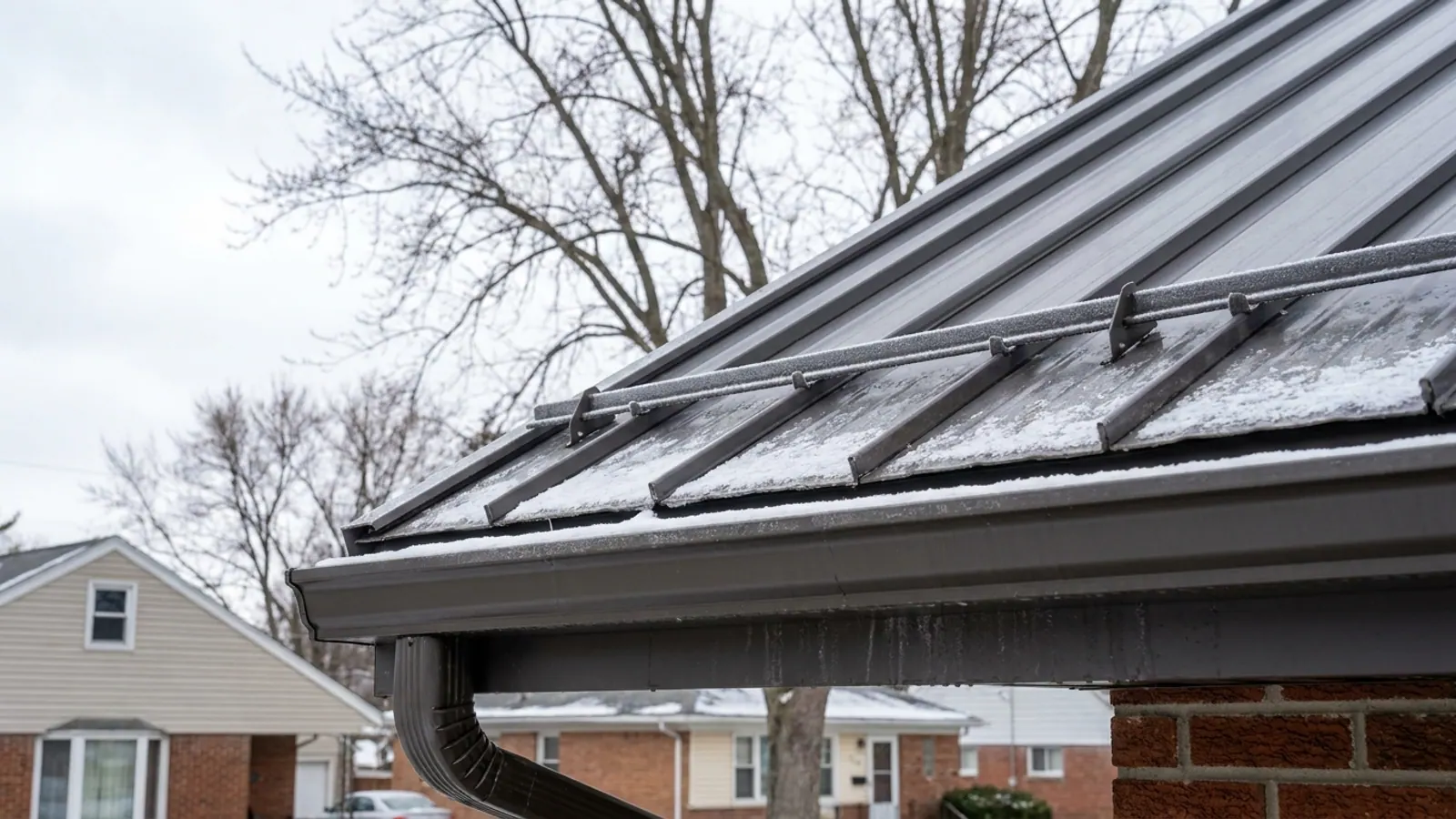
Yes, a metal roof still needs gutters, but the gutter has to be built for a surface that sheds water and snow much faster than shingles. That means hangers on tighter centers, snow retention on the panels above the eave, and a gutter sized and positioned so fast-moving water does not shoot past it.
On this page
A metal roof still needs gutters, and the gutters have to be detailed differently than the ones that were under your shingles. A standing seam or metal shingle roof is a slick, continuous surface. Water does not slow down crossing it the way it does crossing granules, and snow does not stay put on it. Both of those facts land at the eave, which is exactly where the gutter is.
Here is what changes, in the order it matters.
Why a metal roof is harder on gutters than asphalt
Three things are different, and they compound.
Water moves faster. Shingle granules create friction that slows runoff and spreads it across the eave. A painted metal panel does neither. The same rainfall arrives at the gutter sooner, with more speed, and in defined channels where the panel pans guide it.
Snow releases all at once. Shingles hold a snowpack until it melts. A metal roof holds it until the sun warms the panel enough to break the bond at the surface, and then the whole sheet of snow slides. The load that hits the gutter in that moment is nothing like steady weight.
The eave is often colder. Metal roofs are frequently installed over a well-vented attic, which is correct, and that keeps the deck cold. Cold decks are good for ice dams and hard on gutters, because whatever meltwater does reach the gutter can refreeze there.
Hangers, spacing and what gets fastened where
Spacing is the first thing to settle. On a typical shingled house, hidden hangers go in at roughly 24- to 36-inch centers. Under a metal roof, especially in the northern counties, that spacing gets tightened, commonly to 16 to 24 inches, so a sliding snow load is shared across more fasteners instead of concentrating on two or three.
Hidden hangers with a screw into solid fascia are the only thing worth installing here. Spike-and-ferrule gutters work loose under repeated impact, and a metal roof delivers repeated impact every thaw. The screw has to land in sound wood. If the fascia is soft, replacing or sistering it is part of the gutter job, not something to discover later.
Ask for three things in writing on the estimate: hanger type, hanger spacing in inches, and what happens if fascia is found rotted. On a Lightning estimate those conditions are found at the free inspection and priced into the quote, because there are no change orders and the written estimate is the final price.
| Condition at the eave | What it calls for |
|---|---|
| Condition at the eaveSteep metal roof, northern county | What it calls forHidden hangers at the tight end of the range, snow retention above |
| Condition at the eaveLong run draining a large roof area | What it calls for6-inch gutter, 3x4-inch downspouts, extra outlet |
| Condition at the eaveEave over a door, walkway or deck | What it calls forSnow guards required, regardless of gutter size |
| Condition at the eaveSoft or split fascia | What it calls forFascia replaced before the gutter goes up |
Snow load is the part homeowners underestimate
New Jersey ground snow loads are set in DCA Bulletin 19-1, and they are not the same across the state. Sussex County is 50 psf. Passaic is 40. Warren, Hunterdon and Morris are 35. Somerset is 30. Other counties generate site-specific values. A roof in Sussex is designed for a heavier snowpack than one in Cape May, and on a metal roof that entire snowpack can arrive at the eave in a few seconds.
The fix is snow retention on the panels, not a stronger gutter. Snow guards or a continuous bar system hold the snow in place so it melts and drains in a controlled way. They are installed to the seam or the panel per the manufacturer's method, and on standing seam they usually clamp to the seam without penetrating the panel. The standing-seam metal roofing guide covers how those systems attach.
If your metal roof has no snow retention and you are replacing gutters, add the retention at the same time. Hanging a new gutter under an unprotected metal eave in Sussex or Morris County is spending money on something that will be bent by February.
Overshoot: when water jumps the gutter entirely
Overshoot is water leaving the roof edge with enough speed that it clears the front lip of the gutter and lands on the ground. You see it in heavy rain as a sheet of water falling in front of a gutter that is clean and empty. It is a metal roof problem far more than a shingle problem, and it has four causes worth checking:
- The gutter sits too low, so the water arcs over it instead of dropping into it.
- The gutter is too far out from the fascia, or too narrow for the volume.
- The roof pitch is steep enough that water is still accelerating when it leaves the panel.
- The eave trim or drip edge is sending water past the back of the gutter instead of into it.
The cure is some combination of raising the gutter, moving it in, going to a 6-inch profile with 3x4-inch downspouts, and correcting the metal edge detail so water is released into the trough rather than off the nose of it. Sizing is covered in the seamless gutters guide, and the same logic applies under metal, just one size up more often.
Dissimilar metals at the eave
Seamless aluminum gutters under a painted steel or Galvalume roof are standard and cause no trouble. What causes trouble is metal-to-metal contact or runoff between materials that react with each other. Copper is the one to watch. Runoff from a copper roof or copper flashing onto aluminum gutters will corrode the aluminum over time, which is why a copper roof gets copper gutters. Fasteners matter for the same reason, and stainless or coated screws are the normal answer where the gutter meets the metal roof edge.
Salt air adds to this. Along the shore, the fastener and the gutter finish both take a beating, and that is worth raising at the estimate rather than after the first winter.
Sequence and cost
Gutters go on after the metal roof is finished, not before. The panels and the eave trim set the geometry the gutter has to work with, and the gutter height relative to the roof plane cannot be judged until that edge is complete. A standing seam roof takes two to four days, so the gutters follow at the end of that window.
Seamless aluminum gutters in New Jersey run $1,200 to $3,500 in standard-value towns, $2,500 to $6,500 in higher-value towns, and $4,000 to $12,000 for large or luxury homes. The band is set by the municipality's median home value from ACS 2024 five-year estimates. Guards, extra downspouts, larger profiles, two-story access and fascia repair all move the number within the band.
Maintenance does not disappear because the roof is metal. You are not getting shingle granules in the trough anymore, but leaves, seed pods and roof grit still collect, and a clogged gutter under a metal roof backs up faster because it fills faster. The seasonal gutter maintenance guide has the checks worth doing twice a year.
What to do next
If your metal roof is overshooting, if the gutters have been bent by sliding snow, or if you are planning a metal roof and want the drainage handled correctly the first time, get the eave looked at before the next freeze. Lightning Construction installs seamless aluminum gutters across all 21 New Jersey counties, takes no deposit, and holds the written estimate as the final price. The inspection and the written estimate are free with no obligation, and a salesperson does come to the house. Request an estimate and have the hanger spacing, gutter size and snow retention spelled out on the paperwork before anyone starts.