Short answer
On most houses the two never touch, because gutters hang on the fascia and the lights and outlets sit up in the soffit panel behind it. The risk comes from hanger screws, downspout routing and any fascia board that has to be replaced, since that is the point where a fixture or a cable can get disturbed. Walk the eave with the estimator, mark every fixture and receptacle, and have the downspout locations settled in writing before anyone brings a ladder.
On this page
- Where soffit wiring runs and what a gutter crew can hit
- The four ways gutter replacement damages soffit lighting
- Walk the eave with the estimator before you sign
- Downspout placement around outlets, switches and holiday light receptacles
- When fascia replacement means the fixtures have to come down
- What to get in writing before the gutter crew shows up
- What to do next
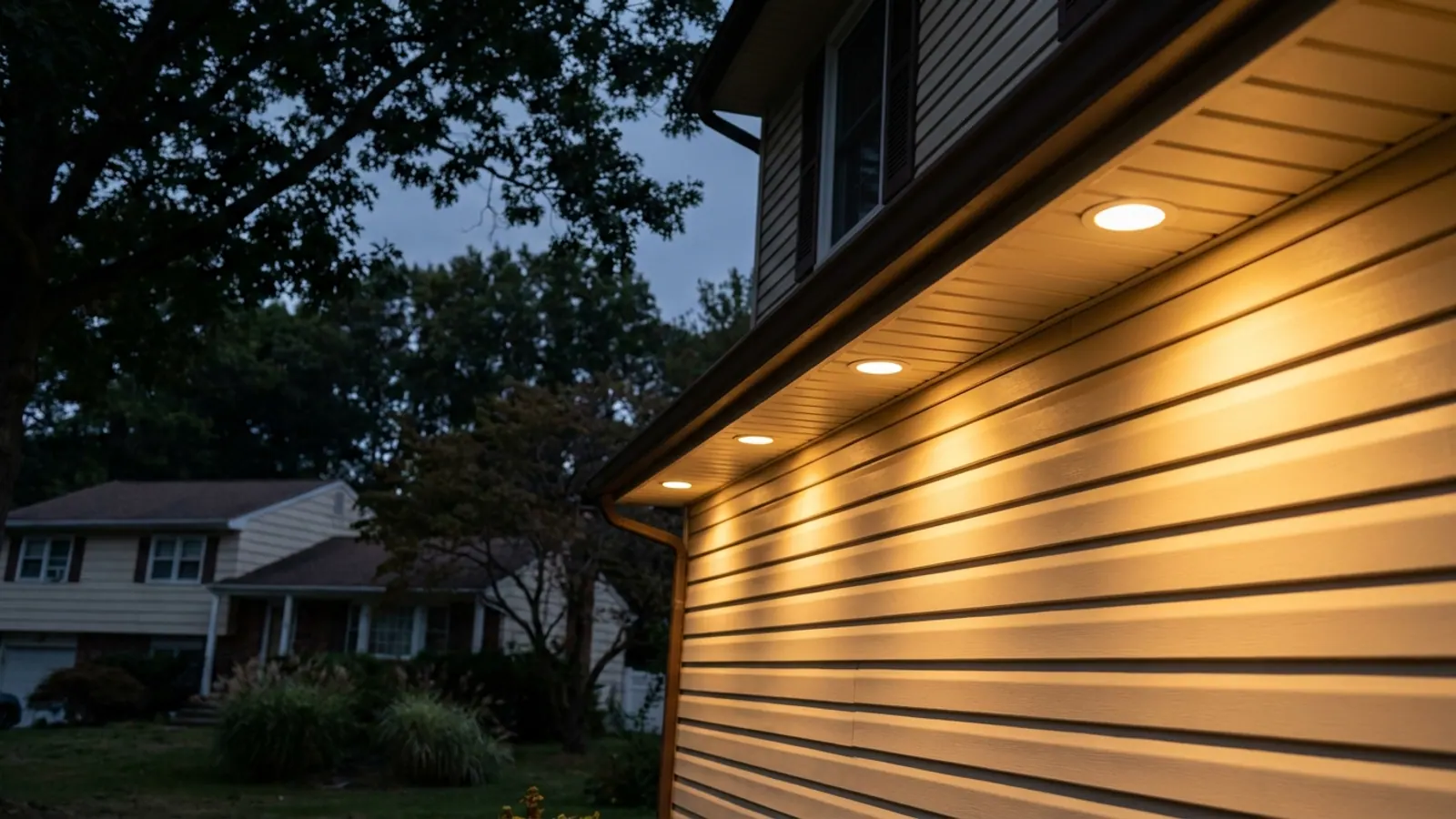
Gutters hang on the fascia. Recessed soffit lights, outdoor receptacles and holiday light outlets sit up in the soffit, which is the horizontal panel behind and above the gutter. Two different planes, two different trades, and on most New Jersey houses a gutter replacement finishes without anyone getting near the wiring.
The exceptions are specific and worth knowing before you sign anything. Hanger screws go into the fascia. Downspouts come down the corners and sometimes through the middle of a run. And if a fascia board is rotted, it comes off, which is the one scenario where a light can and a wire are genuinely in play.
Where soffit wiring runs and what a gutter crew can hit
In a correctly built eave, the cable feeding a soffit downlight runs inside the soffit cavity, between the rafter tails or lookouts, and drops into the fixture can from above. Nothing is visible from outside and nothing is within reach of a gutter hanger.
What gets hit is wiring that was never put there properly. On older New Jersey housing stock, and on houses where soffit lighting was added years after the eave was built, you find cable stapled to the face of the fascia, run along the back wall of the gutter, or fished through a hole drilled in the fascia board itself. A low-voltage landscape transformer feeding eave lights is a common version of this. None of that survives a tear-off of the old gutter unless the crew knows it is there.
The second thing a crew can hit is the fixture housing. A shallow remodel can mounted in a vented soffit panel sticks up into the cavity. If the fascia is being replaced and the new board is nailed back through the same plane, a long nail can find the can or the cable clamp on it.
The four ways gutter replacement damages soffit lighting
- A hanger screw into a surface-run cable. Hidden hangers screw through the back of the gutter into the fascia every 18 to 24 inches. Any cable sitting between gutter and fascia gets found eventually.
- A downspout dropped onto a receptacle or switch. The outlet still works, but you cannot plug anything into it anymore, and a GFCI you cannot reach to reset is useless.
- Fascia replacement disturbing a fixture. Rotted fascia has to come off. If a light can is mounted in the soffit right at that joint, it gets moved whether anyone planned for it or not.
- Ladder and plank contact with a lens. A soffit downlight that hangs even slightly below the panel face is in the path of every ladder set along that eave.
All four are avoidable. All four are a walk-around, not a technique.
Walk the eave with the estimator before you sign
Do this at the free inspection, not on install day. The estimate is free and there is no obligation, and a salesperson does come to the house, so use the time.
Walk every side of the house and point out, out loud, every one of these:
- Recessed soffit downlights and their switch location
- Wall-mounted fixtures near the eave line
- Outdoor receptacles within three feet of the eave, especially the ones used for holiday lights
- Any low-voltage transformer, photocell or timer mounted on the siding
- Security cameras and their cable runs
- Any cable you can actually see on the fascia or behind the old gutter
Take photos while you are standing there. Photograph each eave with the fixtures in frame, from the ground, before anything comes down. If something does go wrong, a dated photo of the original condition settles the conversation in about a minute.
Downspout placement around outlets, switches and holiday light receptacles
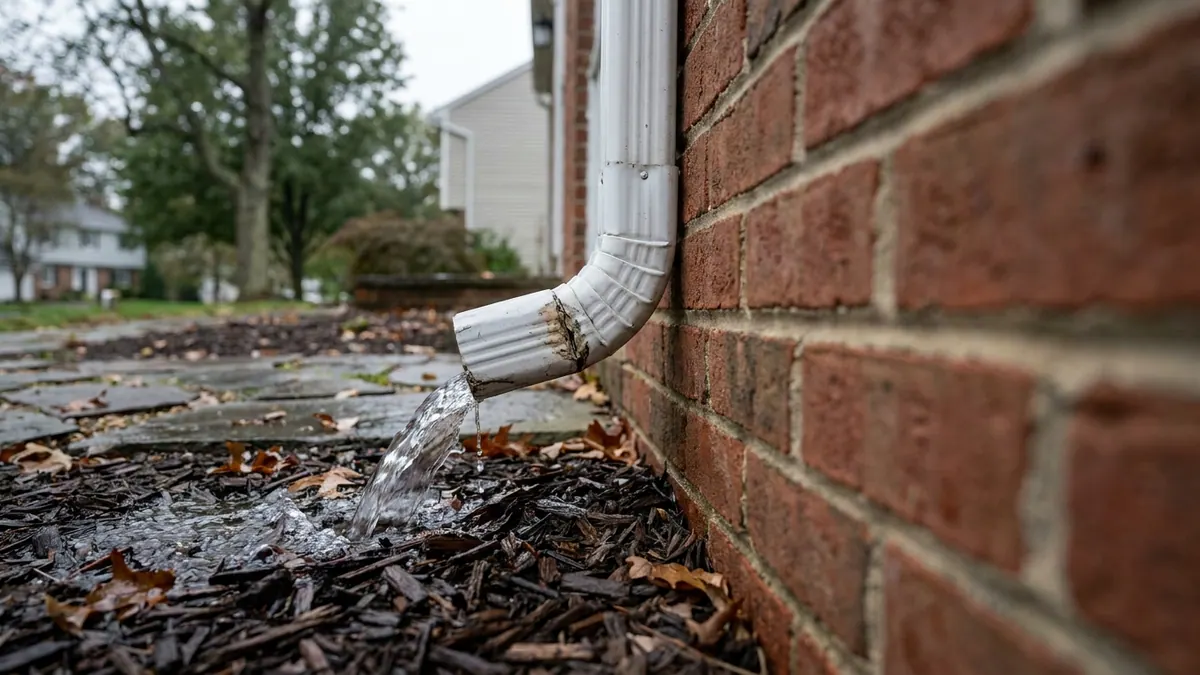
Downspouts have more flexibility than homeowners assume. A gutter run has to be pitched to drain, and the downspout has to land somewhere that moves water away from the foundation, but within those limits there is usually a few feet of play along the run and a choice of which corner to drop.
Say where the receptacle is before the measurements are taken. Moving a downspout three feet at the measuring stage costs nothing. Moving it after the gutter is hung and the outlet is installed means cutting and re-hanging.
The practical clearances to ask for:
| What is on the wall | What to ask for |
|---|---|
| What is on the wallOutdoor GFCI receptacle | What to ask forDownspout offset far enough that the cover opens and you can reach the reset button |
| What is on the wallHoliday light outlet | What to ask forKeep the downspout off the corner you run lights from, so cords are not threaded around it |
| What is on the wallExterior switch or timer | What to ask forClear face access, no elbow crossing in front of it |
| What is on the wallHose bib | What to ask forDownspout to one side, so the handle turns without the knuckles hitting aluminum |
| What is on the wallSoffit downlight directly above | What to ask forNothing required; the gutter sits below the light's throw |
If the downspout genuinely has to come down over a receptacle, the honest answer is to have an electrician relocate the box, not to live with a buried outlet.
When fascia replacement means the fixtures have to come down
This is the real intersection. Gutters are the first thing to come off when fascia is bad, and rotted fascia on an eave with finished lighting needs a sequence rather than improvisation.
- The fascia condition is assessed at the free inspection, with the gutter still up, and the bad sections are identified and priced into the written estimate.
- If a fixture sits at an affected joint, you schedule a licensed electrician to disconnect and drop that fixture before the crew arrives.
- The old gutter comes down and the damaged fascia is cut out and replaced.
- Soffit panels are reset where they were disturbed, with the fixture openings back in the same places.
- The electrician resets and reconnects the fixtures.
- The new seamless gutter is hung on sound wood, pitched, and the downspouts are run to the agreed locations.
Lightning Construction does roofing, metal roofing, siding and gutters, which includes the fascia and soffit work. Electrical connections are not part of that, and anyone telling you a gutter crew will rewire your downlights is telling you something you should not accept. What you should get is coordination: a date you can give your electrician, so the fixture is out for one day and back in the same week.
The cause of the rot matters more than the board. Fascia almost never fails on its own. It fails because the old gutter overflowed, or because there was no gutter apron sending roof water into the trough. Replacing the wood without fixing that puts you back here in a few years, and the gutter maintenance guide covers what keeps the trough draining once the new one is up.
What to get in writing before the gutter crew shows up
Four items, on the estimate, in text:
- Downspout count and locations, described by wall and corner, not just a number.
- Fascia replacement, with the sections identified and the price included. Conditions that normally trigger a change order are found at the free inspection and priced into the quote here, so there is no mid-job renegotiation.
- Who handles the fixtures, and the date the eave will be open.
- Gutter size and color, since 5-inch and 6-inch sit differently against a soffit with recessed lights in it. The seamless gutters guide explains how seamless aluminum is rolled on site and what the guard options actually do.
On cost: seamless aluminum gutters run $1,200 to $3,500 in standard-value New Jersey towns, $2,500 to $6,500 in higher-value towns, and $4,000 to $12,000 on large or luxury homes. The band is set by the municipality's median home value from ACS 2024 five-year estimates. Fascia repair and the number of downspouts move the number inside that band. There is no deposit on any job. Nothing is due until the work is finished and you have inspected it.
Holiday light clips, not screws
One rule after the new gutter is up: nothing gets screwed or nailed into it. Use clips that hook over the front lip. Every hole in a seamless aluminum gutter is a leak waiting for the first hard rain, and no workmanship coverage anywhere covers a hole somebody else put in.
What to do next
Book the free inspection, walk the eave with the estimator, and point at every light and outlet while you are both standing under it. Get the downspout locations and any fascia work written into the estimate before you agree to anything. Lightning Construction is veteran-owned, family-operated, licensed and insured, and registered in New Jersey as Home Improvement Contractor 13VH12437000.
See what a seamless gutter replacement includes, then request a free estimate and have the eave looked at before the next storm fills the old trough.