Short answer
Gutters pull away because the fasteners holding them can no longer carry the load, and the load is usually standing water, debris or ice rather than the gutter itself. The three causes behind almost every sagging run are old spike-and-ferrule fasteners working loose, hangers nailed into soft or rotted fascia, and a gutter that holds water because it is clogged or pitched wrong. Fixing the fasteners without fixing the water or the wood puts the gutter back on the same failing edge.
On this page
A gutter pulls away from the fascia board when the fasteners holding it can no longer carry what is in it. The gutter itself weighs very little. What tears it loose is standing water, packed debris and ice, working on fasteners that were either the wrong type, spaced too far apart, or driven into wood that had already gone soft.
That means the visible problem — a gap between the gutter and the wood, or a run that dips in the middle — is the last step in a sequence, not the start of one. Reattaching the gutter without dealing with the water and the wood buys a season or two at most.
What actually holds a gutter to the house
On most New Jersey homes, the gutter hangs from the fascia, the vertical board that runs along the bottom edge of the roof behind the gutter. The fasteners pass through the gutter's back wall and into that board. The roof edge, drip edge and shingle overhang sit above.
So the whole system depends on three things being right: the fastener type, the spacing, and the condition of the wood. Get one wrong and the other two carry the load until they cannot.
Standing water is the load that pulls it loose
Water weighs about 8.3 pounds per gallon. A gutter that drains properly holds almost none of it — water hits the trough, runs to the outlet, and leaves. A gutter that holds water carries that weight continuously, and the pull is both downward and outward, which is exactly the direction a nail resists worst.
Three things make a gutter hold water:
- Debris. Leaves and shingle grit pack into a dam at the outlet. Behind the dam, the trough becomes a trough of water and wet sludge. This is the most common version by far, especially under mature trees.
- Wrong pitch. A gutter hung dead level looks correct from the driveway and drains nothing. It needs a consistent fall toward the outlet along the whole run.
- Too few outlets. A long run with one downspout at the far end fills faster than it drains during a heavy storm and stands full afterward.
Seasonal cleaning and what to check each spring and fall is covered in the gutter maintenance guide. If your gutters have pulled away and they were full when you found it, the cleaning schedule is part of the diagnosis.
Spike and ferrule vs hidden hangers
Older New Jersey gutters were hung with spikes: a long nail driven through the front of the gutter, through a tube called a ferrule, and into the fascia. It works when the nail is fresh and the wood is dry. It stops working with time, because the wood expands and contracts through the seasons and the smooth nail shaft slowly walks back out. You can usually see it — the spike heads standing proud of the gutter face by a quarter inch or more.
Hidden hangers are clips inside the trough, screwed into the fascia. The screw threads grip the wood instead of relying on friction, and the load is carried at the top of the gutter where it belongs.
| Fastener | How it holds | Typical failure | Best use |
|---|---|---|---|
| FastenerSpike and ferrule | How it holdsFriction along a smooth nail shaft | Typical failureBacks out over seasons; enlarges its own hole; splits the fascia edge | Best useOlder installations; rarely specified new |
| FastenerHidden hanger with screw | How it holdsScrew threads biting into fascia | Typical failurePulls when the wood behind it is rotted, or spacing is too wide | Best useStandard on new seamless gutter work |
| FastenerStrap hanger over the roof deck | How it holdsAnchored to the deck, under the shingles | Typical failureRequires lifting shingle courses; not practical on a finished roof | Best useSome low-slope and older edge details |
If your gutters are held by spikes and one section has pulled away, the rest of the run is on the same clock. Fastening one bad spot and leaving twenty spikes in place is a repair you will repeat.
Rotted fascia: the cause people skip
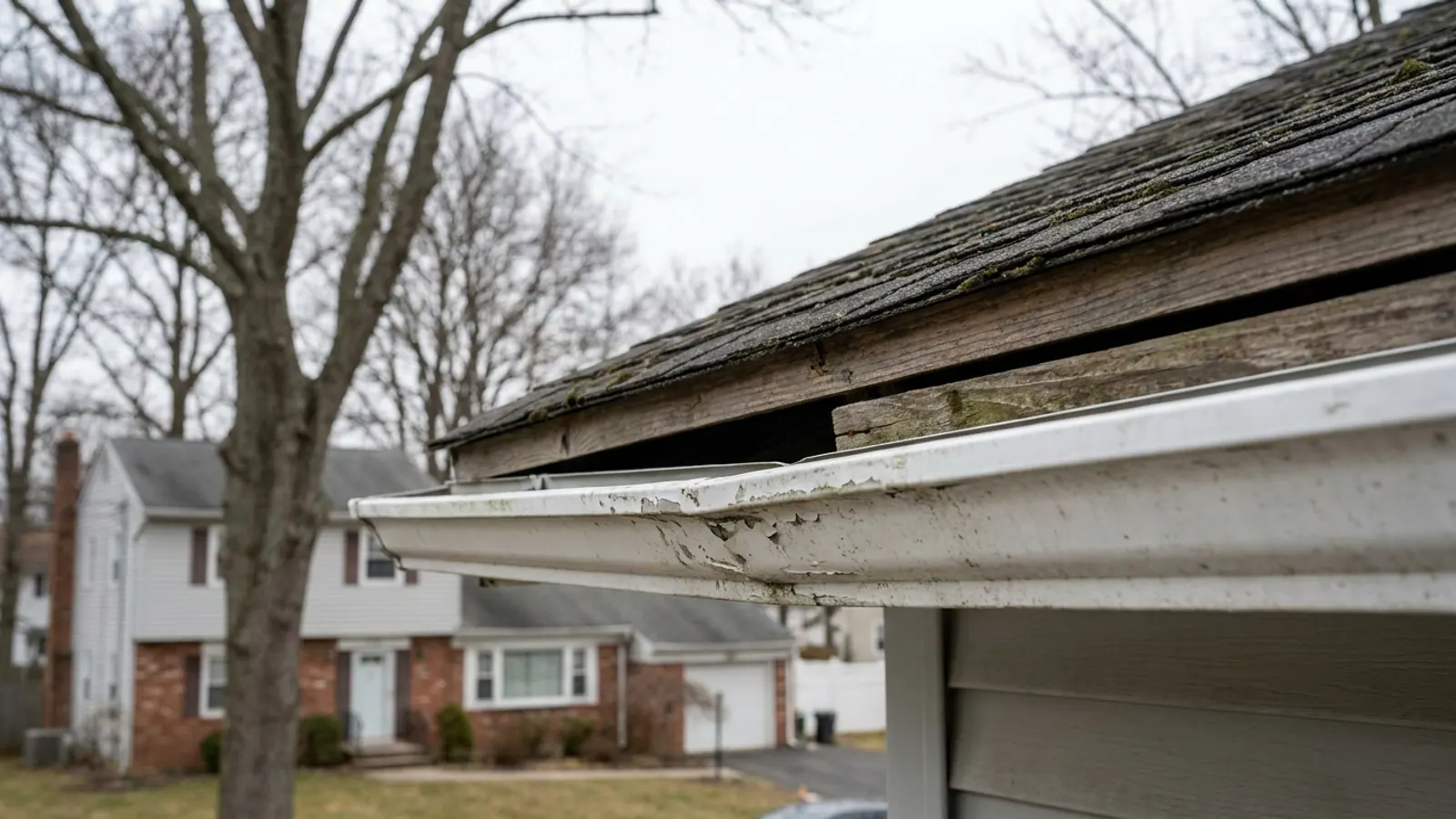
A screw needs solid wood. If the fascia board has gone soft — dark, spongy, crumbling at the nail holes — no hanger will hold in it, and the tighter you drive the screw the more wood you destroy.
Fascia rot at the gutter line almost always comes from water that has been overflowing the gutter and running down the back of it, or from a missing or badly lapped drip edge letting roof water get behind the trough. That is why the wood and the water are one problem and not two. The mechanics of how the roof edge, drip edge and fascia interact are worth understanding before you buy hangers.
Repairing or replacing rotted fascia, soffit and trim is siding work, and it is normal to do it in the same visit as the gutters. Doing it after is doing it twice, because the gutter has to come off again.
Ice, and why New Jersey edges take the worst of it
Ice loads a gutter far harder than water. A trough that has frozen solid holds a heavy block that no residential hanger spacing is designed to carry indefinitely, and freeze-thaw cycles work the fasteners the way a pry bar would.
The ice usually starts in a clogged or poorly draining gutter, then grows into an ice dam at the roof edge above it. New Jersey gets enough marginal winter weather — freeze overnight, thaw by afternoon — to run that cycle many times each season. Causes and prevention are in the ice dams guide. Two points matter here: ice in the gutter is a symptom of drainage and attic heat, and a gutter that empties fully before a freeze has much less to freeze.
How to tell which cause you have
Work through these in order, from the ground and from a ladder on a dry day.
- Look along the front face of the gutter. Spike heads standing out from the aluminum mean spike-and-ferrule fasteners backing out. Count how many are proud, not just the ones near the sag.
- Look at the spacing. Fasteners three or four feet apart on a long run are undersupported for a New Jersey winter.
- Press the fascia board with a screwdriver near the sag. If it sinks in, the wood is the problem and no fastener will fix it.
- Check for standing water and a debris line. A dark sludge stain along the bottom of the trough tells you the gutter has been holding water even if it is dry today.
- Look at the back of the gutter and the wood behind it. Staining running down the fascia means water has been getting behind the trough, usually a drip edge or overflow issue.
- Watch it in a real rain. Where it overflows tells you where the dam or the low point is. A dry-day inspection cannot show you that.
Repair, re-hang, or replace
A single loose section on sound wood is a repair: pull the spikes, install hidden hangers into fresh wood, restore the pitch. A whole side that dips, holds water and sits on spike fasteners is a re-hang at best, and usually a replacement, because the aluminum has been bent and the seams stressed.
Replacement is also the moment to correct what caused it. Seamless aluminum removes the joints that leak and clog first, and outlet count and downspout size get set based on what the roof actually drains rather than what was there before. The trade-offs between guard styles and open gutters are laid out in the seamless gutters and gutter guards guide.
New gutter work in New Jersey runs $1,200 to $3,500 in standard-value towns and $2,500 to $6,500 in higher-value towns, with large homes higher; the band depends on the median home value of your municipality. Those are ranges, not quotes, and the only way to get a number for your house is to have the edge looked at.
What to get in writing
Before anyone hangs a gutter on your fascia, the estimate should state:
- Hanger type and spacing, in inches.
- Whether any fascia or trim is being replaced, and how much.
- The pitch and where each run drains to.
- Number and size of downspouts, and where each one discharges.
- Whether the drip edge is being corrected at the same time.
Lightning Construction takes no deposit — nothing is due until the work is finished and you have inspected it — and writes no change orders, because rotted fascia and undersized outlets get found at the free inspection and priced into the estimate. Where a permit applies, Lightning pulls it and attends the municipal inspection under the New Jersey Uniform Construction Code.
If a run has already pulled away, look at seamless gutter options and then book the free inspection. It is free and no-obligation, and a salesperson comes to the house with the written estimate.