Short answer
Some houses have no fascia board at all, either because the rafter tails are exposed by design or because the board rotted away and was never replaced. Gutters can still be installed, using wraparound rafter hangers, roof-mount straps, or a new sub-fascia run across the rafter ends first. Which method is right depends on the condition of the rafter tails, the roof pitch, and whether the open eave is something you want to keep.
On this page
Gutters go up fine on a house with no fascia board. The gutter has to hang off something, and when there is no flat board at the roof edge the options are wraparound hangers bolted to the rafter tails, roof-mount straps that run up under a shingle course, or a new sub-fascia installed across the rafter ends so the gutter has a continuous surface to attach to. All three are normal work. What is not normal is a contractor pricing a gutter run without going up and looking at what is actually at that edge.
Here is what you are dealing with, what each fix involves, and what should be written on the estimate before anyone starts.
Why some New Jersey houses have no fascia board
There are two completely different reasons, and they lead to different answers.
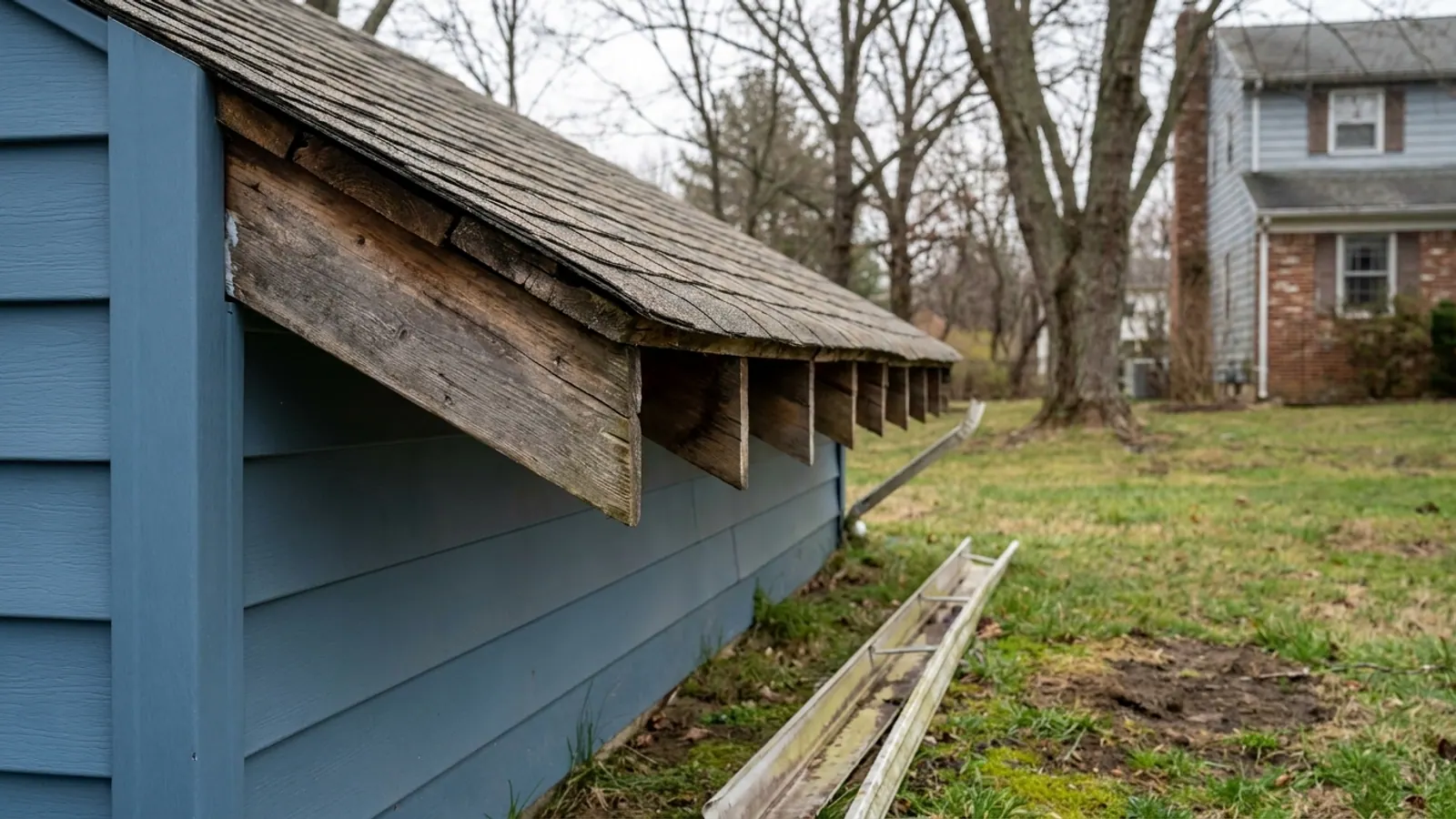
The first is design. Bungalow, craftsman and some mid-century ranch eaves were built with the rafter tails exposed on purpose. The rafters run past the wall, get cut to a clean profile, and nothing closes them off. There is no fascia because there was never supposed to be one. Plenty of older housing stock across the state has this detail, and a lot of it has been covered up at some point by a later remodel.
The second is failure. There was a fascia board, water got behind it, and it rotted out. Somebody tore the bad section off, took the gutter down with it, and never put either back. You can usually tell which one you have by looking at the rafter ends: a designed open eave has rafter tails cut to a matching angle or profile, all the same. A failed fascia leaves square-cut ends, often with old nail holes, splits and dark staining where the gutter used to sit.
If the fascia rotted, the water that rotted it is still coming from somewhere. That is almost always a missing or wrong-sized drip edge at the roof edge, or a gutter that spent years overflowing and running down the back of the board. Fixing the drainage comes first. Hanging a new gutter onto the same unaddressed detail just restarts the clock.
Three ways to hang gutters when there is no fascia
Wraparound and rafter-mount hangers
These fasten to the side or bottom of each individual rafter tail and wrap around to support the gutter. They are the most direct answer on a designed open eave because they leave the rafter tails visible. The limitation is spacing: the gutter can only be supported where there is a rafter, so support points land wherever the framing lands, typically 16 or 24 inches on center. That is usually acceptable, but it gives you less control over the pitch, since you are shimming at fixed points rather than anywhere along a board.
They also require sound wood. A hanger bolted into a rafter tail with a soft, punky last four inches will pull loose the first time the gutter fills with wet leaves and ice.
A new sub-fascia across the rafter tails
The crew cuts the rafter tails to a consistent line, then runs a continuous board across all of them. Now you have a straight, flat surface for the full length of the run. Hidden hangers can be placed anywhere, the pitch can be set exactly, and the drip edge or gutter apron has something to lap over.
This is carpentry before it is gutter work, and it costs more than hangers alone. It is the right call when the rafter ends are at different lengths or heights, when the old fascia is gone because it rotted, or when you want the eave to read as a conventional closed edge.
Roof-mount straps
Straps slide under a shingle course, run back over the top of the gutter and screw down into the decking. They avoid the fascia question entirely. The trade-off is that you are putting fasteners through the roof surface, which only makes sense when the roof is being replaced at the same time and the straps go in under new shingles with proper sealing. Retrofitting straps under an existing weathered roof means lifting shingles that no longer want to be lifted. On a low-slope porch roof or a shallow eave with no usable rafter tail, straps are sometimes the only workable option.
Comparing the three approaches
| Wraparound hangers | New sub-fascia | Roof-mount straps | |
|---|---|---|---|
| Keeps exposed rafters visible | Wraparound hangersYes | New sub-fasciaNo | Roof-mount strapsYes |
| Control over gutter pitch | Wraparound hangersLimited to rafter spacing | New sub-fasciaFull | Roof-mount strapsLimited |
| Carpentry required | Wraparound hangersMinor repairs only | New sub-fasciaYes, full run | Roof-mount strapsNone |
| Works with a drip edge or gutter apron | Wraparound hangersAwkward, needs detailing | New sub-fasciaYes | Roof-mount strapsYes |
| Best timed with | Wraparound hangersA standalone gutter job | New sub-fasciaAny gutter job on a failed fascia | Roof-mount strapsA roof replacement |
| Relative cost | Wraparound hangersLowest | New sub-fasciaHighest | Roof-mount strapsMiddle |
What the crew checks before quoting
A gutter estimate on a house with no fascia should come from someone who climbed up, not someone who squinted from the driveway. What gets checked:
- The condition of each rafter tail, pressed with a tool to find soft wood rather than judged by eye.
- Whether the rafter ends are in a straight line and plumb, which decides whether a sub-fascia can be run without cutting.
- What is happening at the roof edge itself, specifically whether there is a drip edge and where water leaves the shingles.
- The length of each run and where downspouts can land, because support spacing matters more when there is no continuous board.
- Whether the soffit is open, vented or absent, since airflow at the eave affects the roof above it.
That last one connects to more than gutters. An eave detail that dumps water back against the sheathing in winter is the same detail that feeds ice at the roof edge, and the ice dams guide explains how the eave, the attic and the gutter interact in a New Jersey winter.
What this costs and what belongs in writing
Seamless aluminum gutter work in New Jersey runs $1,200 to $3,500 in standard-value towns, $2,500 to $6,500 in higher-value towns, and $4,000 to $12,000 on large or luxury homes. The band comes from the municipality's median home value in the ACS 2024 five-year estimates, not from your house. Carpentry at the eave, added sub-fascia, rafter tail repair and the number of downspouts all move the number inside that range.
What the estimate should name specifically:
- The hanger type and the spacing.
- Whether a sub-fascia is included, and the linear footage of it.
- How many rafter tails are being repaired or built out.
- Gutter and downspout sizes, and where each downspout discharges.
- Whether a drip edge or gutter apron is being added at the roof edge.
Lightning Construction finds all of that at the free inspection and prices it into the written estimate, which is why there are no change orders on the day. There is also no deposit; nothing is due until the work is finished and you have inspected it. The inspection and the estimate are free and carry no obligation, and a salesperson does come to the house for it.
For the material and guard decisions that sit on top of this, the seamless gutters guide covers sizing, seams and guard types, and the gutter maintenance guide covers the seasonal work that keeps a new system from loading up and pulling at those rafter tails again.
What to do next
If your gutters came down with the fascia and never went back up, get the eave looked at before another winter runs water down the wall. If the rafter tails are exposed by design and you like the look, say so up front, because that decides between hangers and a sub-fascia before any material is ordered.
Lightning Construction is veteran-owned and family-operated, based in Manalapan, licensed and insured under New Jersey Home Improvement Contractor registration 13VH12437000, and works in all 21 New Jersey counties. See the gutters page for what the work covers, or book a free estimate and have the eave inspected before anything is quoted.