Short answer
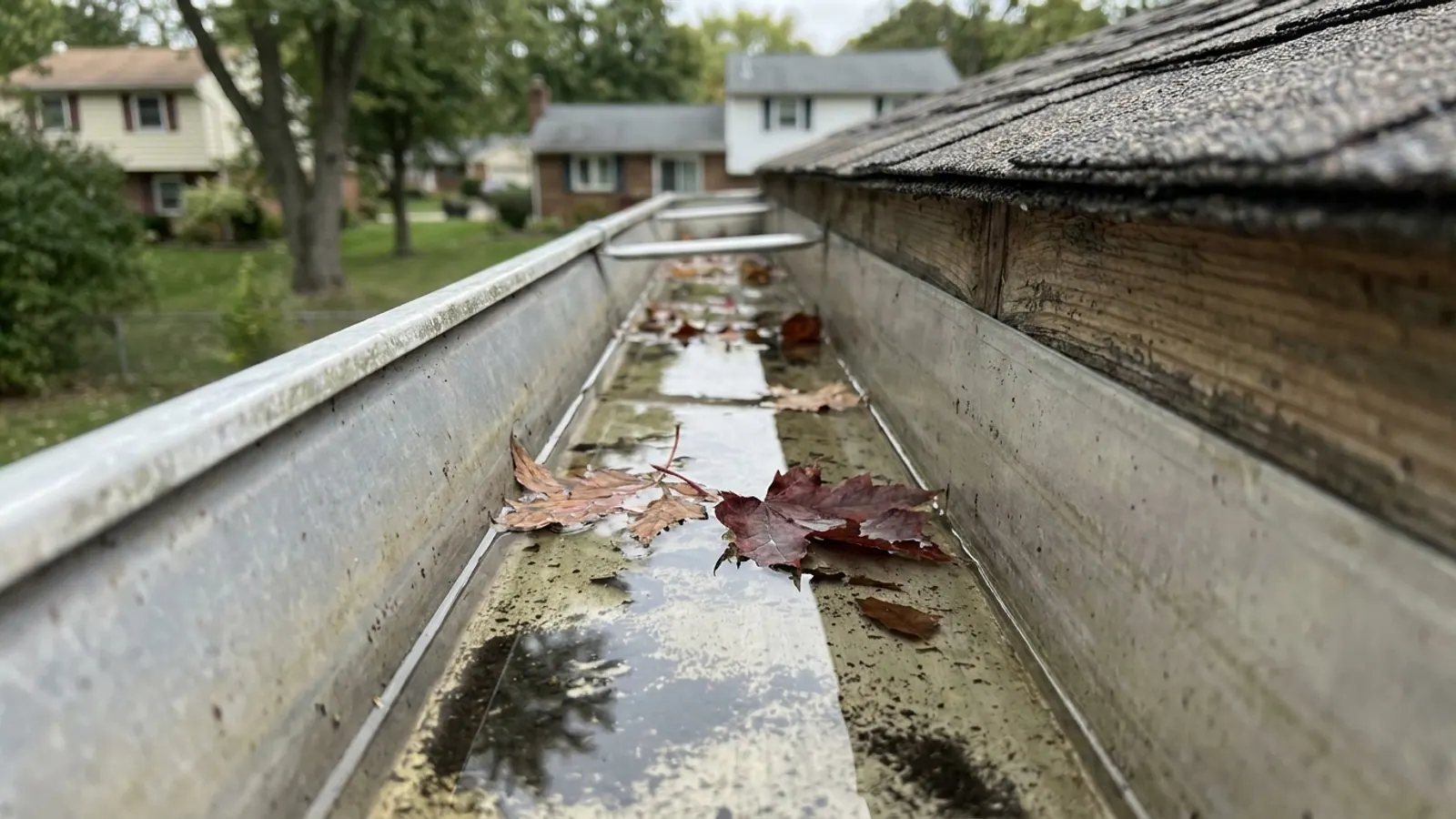
Standing water in a gutter that is already clean means the trough is not sloped enough toward the downspout, or it has sagged in the middle and lost the slope it started with. A clog stops water at one point; a pitch problem leaves shallow pools sitting in the low spots after the rain has stopped and the downspout is running dry. The fix is re-hanging that run at the correct slope, not cleaning it again.
On this page
Standing water in a clean gutter is a pitch problem. A clog stops water at one spot and backs it up behind the blockage; a pitch problem leaves shallow pools sitting in the low points of a trough that is otherwise clear, with the downspout running dry the whole time. If you have cleaned the gutters, watched the downspout discharge normally, and still find water sitting up there a day later, nothing you scoop out is going to fix it.
That matters because most homeowners keep treating it as a maintenance issue. They clean twice a year, add guards, clean again, and the pool comes back after every rain because the gutter was never sloped to drain in the first place, or it has sagged and lost the slope it was hung with.
How much slope a gutter actually needs
The common standard is about a quarter inch of fall for every ten feet of run, sloping toward the downspout. On a 40-foot run that is a full inch of drop from one end to the other. It is enough to move water and little enough that nobody standing in the driveway notices the gutter is not parallel to the roof edge.
Long runs are handled differently. Rather than dropping one continuous slope across 50 feet, the run is usually crowned at a high point somewhere in the middle and pitched down to a downspout at each end. That halves the required drop, keeps the line looking level from the ground, and gets water out of the trough faster in a heavy rain. If your house has one 50-foot gutter feeding a single downspout at one corner, the far end is the first place to look for a pool.
Five reasons a gutter loses its pitch
Hangers spaced too far apart
Hidden hangers screwed through the trough into the fascia hold the whole run. Spaced too far apart, the aluminum between them sags under the weight of water and debris, and a sag is a pool. Water weighs about 8.3 pounds per gallon, so a long unsupported span carrying a wet load of leaves is being pulled down every time it rains.
Rotted or soft fascia
The hangers are only as good as the wood they are screwed into. When the fascia board behind the gutter has gone soft, the screws lose their grip and the run drops at that point. This is why a gutter with standing water often has a rot problem behind it that nobody has looked at. Re-hanging on rotted fascia buys a season at most.
Spikes and ferrules
Older gutters were hung with long spikes driven through a ferrule into the fascia. Aluminum expands and contracts through a New Jersey year, and that movement works the spikes back out. You can usually see the heads standing proud of the front edge. Every one that has backed out is a low spot forming.
Ice and ladders
A gutter loaded with ice in January is carrying weight it was never designed for, and it stays deformed after the thaw. So does a gutter someone leaned a ladder against without a standoff. Both leave a dent or a dip that traps water for the rest of the gutter's life. If ice is a recurring problem on your house, the cause is usually up on the roof, and the ice dam guide explains what is driving it.
It was hung level on purpose
Some installers hang gutters dead level because it looks tidier against a fascia line, or because they were working fast. A level gutter does not drain. It holds a film of water across the entire run and only empties when the volume is high enough to spill over the outlet.
How to check the pitch yourself
You do not need a level or a ladder for most of this.
- Wait until at least an hour after a rain has fully stopped. Look up at the underside of the gutter line from the ground and note where you can see the trough bellying downward between hangers.
- Put a hose on the roof near the end of the run farthest from the downspout and let it run for two or three minutes.
- Watch the downspout. Water should reach it within seconds and discharge steadily.
- Shut the hose off and wait ten minutes. Then look into the trough with a ladder set safely, or from a second-floor window.
- Any pool still sitting there is a low spot. Mark where it is relative to a window or a corner so you can point at it later.
If the water never reaches the downspout at all, and instead sits at one end, that run is pitched the wrong way. That happens more often than you would expect on additions and porch roofs where the gutter was matched to the trim line instead of to the drainage.
What standing water does if you leave it
It is not just an eyesore in the trough. Standing water sits directly on the seams and the sealed end caps, and constant wetting is what pushes those joints to fail. Sediment settles into the pool and turns into a wet sludge that holds moisture against the aluminum around the clock, which is how the bottom of a trough corrodes from the inside.
The weight is a second problem. A sagging section holding water pulls harder on the same hangers that are already failing, so the low spot deepens every season until the run separates from the fascia.
Then there are mosquitoes. A pool that never fully dries is a breeding site for the whole summer, sitting a few feet above your porch. And in winter, that same pool freezes first, because it is standing water rather than moving water, and the ice that starts there builds outward along the run.
Re-pitch or replace
Here is the honest split.
| What you find | What it means | The fix |
|---|---|---|
| What you findPool in one spot, trough straight, seams dry | What it meansHanger pulled or spaced too far apart | The fixAdd or replace hangers, re-pitch that section |
| What you findWater at the far end, downspout dry | What it meansRun pitched the wrong way or hung level | The fixTake the run down and re-hang it sloped |
| What you findSag in the middle of a long run | What it meansNot enough support, or one downspout doing too much work | The fixRe-hang, and often add a second downspout |
| What you findSoft or dark fascia behind the gutter | What it meansWood has rotted and will not hold screws | The fixReplace the fascia, then hang new gutter |
| What you findTrough dented, back edge corroded, seams weeping | What it meansThe aluminum is finished | The fixReplace the run with seamless gutter |
Re-pitching an otherwise sound gutter is normal repair work and part of what a gutter contractor does. Full replacement in seamless aluminum runs $1,200 to $3,500 in standard-value New Jersey towns and $2,500 to $6,500 in higher-value towns, with the band set by the municipality's median home value. If you are replacing rather than re-hanging, the seamless gutters guide covers sizing, guards and outlet placement in more detail.
What to do next
Get the run looked at before winter, because standing water is where ice starts. Lightning Construction inspects gutters and writes an estimate free with no obligation, and a salesperson does come to the house — that is a straight sales appointment, not just an inspection. Whatever the estimate says is the price: there is no deposit, nothing is due until the work is finished and you have looked at it, and there are no change orders, because conditions like rotted fascia get found at the inspection and priced into the quote instead of being sprung on you mid-job. When gutters go on as part of a roof replacement, Lightning pulls the permit and attends the municipal inspection.
Once the pitch is right, keep it right. Clearing the troughs on a schedule keeps weight off the hangers, and the seasonal gutter maintenance guide lays out when to do it in New Jersey. If you already know the run needs work, request a free estimate and point the estimator at the exact spot where the water sits.