Short answer
Almost every gutter installed today should be hung on hidden hangers, which are clips inside the trough fastened to the fascia with a screw. Spikes are long nails driven through the front of the gutter into the fascia, and they loosen over time because a nail has nothing holding it in once the wood around it swells, shrinks and splits. If your gutters sag between fasteners or show nail heads across the face, you have spikes.
On this page
Your gutters are held to the house one of two ways. Either a hidden hanger is clipped inside the trough and screwed into the fascia, or a spike is driven through the front lip, through a ferrule, through the back of the gutter and into the wood. Hidden hangers hold. Spikes work loose, and once one lets go the whole run starts to fail in sequence.
This is a small piece of hardware that decides whether a gutter system lasts as long as the aluminum does. Here is what each one is, how to tell which you have, and what to put in writing before anyone hangs new gutters on your house.
What a spike and ferrule actually is
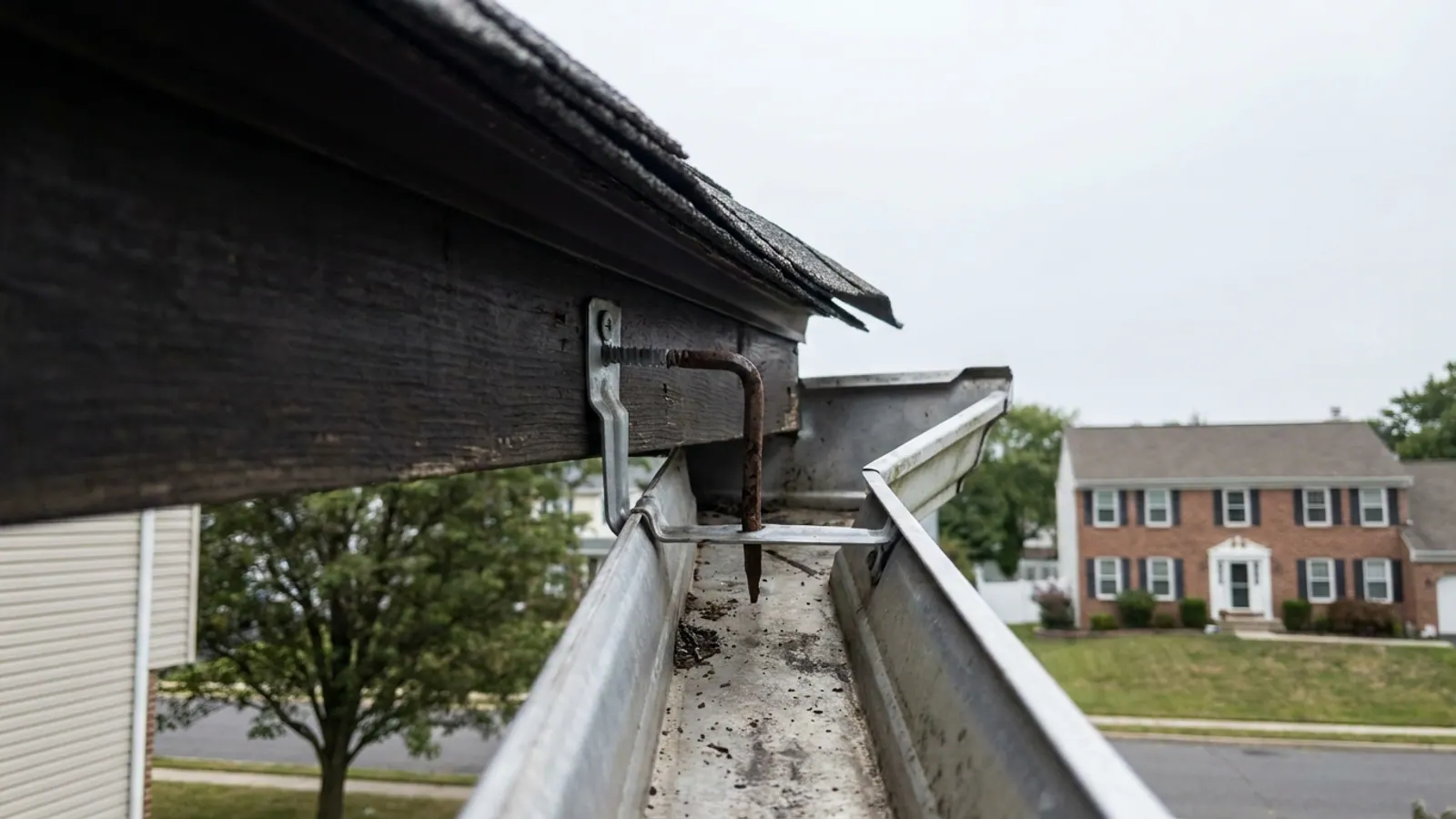
A spike is a long nail, usually seven inches, made of aluminum or steel. The ferrule is a hollow tube that sits inside the gutter between the front and back walls so the nail does not crush the trough when it is driven home. You can see the heads from the ground: a row of dots across the face of the gutter, every couple of feet.
Spikes were standard for decades because they are fast. One person on a ladder with a hammer can hang a run quickly, and the materials cost almost nothing.
The problem is that a smooth nail in wood only holds by friction. Fascia boards get wet, dry, freeze and thaw all year in New Jersey. The wood swells and shrinks around the shank, the hole opens up, and the nail walks out a fraction at a time. Then you get the sequence every homeowner recognizes: one spike head sticking out an inch, a dip in the gutter under it, water pooling in the dip, extra weight on the two fasteners either side, and those two backing out next.
Ice makes it worse. A gutter full of frozen water is heavy, and the load pulls straight down and outward on the fastener at the exact moment the wood is saturated. Northern New Jersey carries the heaviest design snow loads in the state under DCA Bulletin 19-1, at 50 psf in Sussex County and 40 psf in Passaic County, and roofs there shed a lot of wet snow into the gutter line.
A spike also leaves a hole in the front face of the gutter. Every hole is a place aluminum can tear when something loads it, and re-driving a loose spike into the same soft hole buys a season at most.
What a hidden hanger is
A hidden hanger is a formed bracket that drops inside the gutter. The front hooks over the gutter's inner lip, the back sits against the rear wall, and a self-tapping screw runs through the hanger and the back of the gutter into the fascia board.
Three things change because of that.
The fastener is a screw, not a nail. Threads bite into wood fiber and resist pull-out in a way a smooth shank does not, and a screw does not slowly work its way out through seasonal movement.
The load path is better. The hanger supports the gutter from inside across the full width of the trough, so weight is carried by the bracket instead of hanging off a single point on the front lip.
Nothing shows. No nail heads across the face, no holes in the front of the gutter, and nothing on the outside for water to run behind.
Hidden hangers vs. spikes, side by side
| Spike and ferrule | Hidden hanger | |
|---|---|---|
| Fastener | Spike and ferruleSmooth nail driven through the gutter face | Hidden hangerScrew through a bracket into the fascia |
| Visible from the street | Spike and ferruleYes, a row of nail heads | Hidden hangerNo |
| Holes in the gutter face | Spike and ferruleTwo per fastener | Hidden hangerNone |
| Resists ice and debris weight | Spike and ferrulePoorly | Hidden hangerWell |
| Typical failure | Spike and ferruleNail backs out, gutter sags, then pulls away | Hidden hangerFascia rot or a stripped screw, both localized |
| Works with most gutter guards | Spike and ferruleAwkward, the ferrule is in the way | Hidden hangerYes |
| Re-tightening | Spike and ferruleRe-driving into a worn hole rarely holds | Hidden hangerA screw can be replaced or moved slightly |
How to tell what your gutters have
You do not need a ladder for the first check.
- Stand across the driveway and look at the front face of the gutter. Evenly spaced round heads, sometimes with rust streaks running down from them, mean spikes.
- Look along the top edge of the gutter for a straight line. Spiked gutters develop a scalloped profile, dipping between fasteners.
- Look for a head standing proud of the face. That is a fastener already halfway out.
- From a ladder, look down into the trough. Hidden hangers appear as small metal brackets spanning the inside, usually every couple of feet. Spikes appear as a tube crossing the trough at each nail.
- Check the fascia below the gutter for dark staining or soft paint. Water running behind a loose gutter goes straight into that board.
If the answer is spikes and the gutters are otherwise straight and draining, this is not an emergency. It is a system with a known end point, and it belongs on the list with the roof.
Spacing, screws and the details that matter more than the bracket
A hidden hanger installed badly is not better than a spike. Three specifics separate a hung gutter from a hung gutter that lasts.
Spacing
Every 24 inches is the normal spacing. Tighten it to roughly 16 to 18 inches where the run is long, where a valley dumps a large area of roof into one spot, and in the northern counties where snow sits. Ask what spacing is being quoted. A crew stretching hangers to three feet apart is saving twenty brackets and giving you a gutter that sags in five years.
What the screw goes into
A hanger screw needs solid wood. If the fascia is soft, spongy or already split from old spikes, the screw has nothing to hold. Rotted fascia has to be replaced before gutters go back up, not after. This is the single most common reason a gutter job turns into a bigger job, and it is why the board condition should be checked at the estimate rather than discovered on installation day.
Pitch
Hangers set the height of the gutter, so they set the pitch. The run has to fall toward the downspout, consistently, or you get standing water sitting on the seams and the hangers. Pitch is decided while the hangers go in and is difficult to correct afterward without pulling fasteners.
What to ask for in the written estimate
Get these on paper before the job:
- Hidden hangers, with the spacing stated in inches.
- Screw type, and confirmation that hangers land in solid fascia.
- Any fascia board replacement, itemized, with the count.
- Gutter size and downspout size, plus the number and location of downspouts.
- Where the downspouts discharge.
On a Lightning Construction estimate, the conditions that normally turn into a change order later — rotted fascia, a bad roof edge, an undersized run — are found at the free inspection and priced into the quote. The written estimate is the final price, there is no deposit, and nothing is due until the work is finished and you have inspected it. The estimate is free and no-obligation, and a salesperson does come to the house.
For how sizes, seams and guards fit together, the seamless gutters guide covers the system end to end, and the gutter maintenance guide sets out what to check each season once they are up.
When to replace instead of re-hanging
Converting a spiked gutter to hidden hangers is real work, and it is worth doing when the aluminum is straight, the seams are tight and the fascia is sound. In that case the crew removes the spikes, sets hangers on proper spacing, corrects the pitch, and seals the old spike holes.
Replace instead when the trough is bent or kinked, when the spike holes have torn, when there are sectional seams leaking every few feet, or when the fascia needs replacing anyway. At that point you are paying twice to save an old gutter. Seamless aluminum runs $1,200 to $3,500 in standard-value towns, $2,500 to $6,500 in higher-value towns, and $4,000 to $12,000 on large or luxury homes, with the band set by the municipality's median home value from ACS 2024 five-year estimates.
If the roof is also due, do both at once. The gutter comes off for a tear-off anyway, and the drip edge, roof edge and gutter line all get set together.
What to do next
Walk the perimeter and look at the front face of your gutters. If you see nail heads, you know how the system is attached and roughly how it will fail. If you see nothing, you have hidden hangers, and the next thing to check is pitch and debris.
Either way, have someone look at the fascia behind the gutter before you spend money on the gutter itself. Lightning Construction is veteran-owned, GAF Certified, licensed and insured under New Jersey Home Improvement Contractor registration 13VH12437000, and rated 4.9 out of 5 from 264 Google reviews across all 21 counties. See what a full seamless gutter installation includes, or book the free estimate and get the hanger spacing in writing.