Short answer
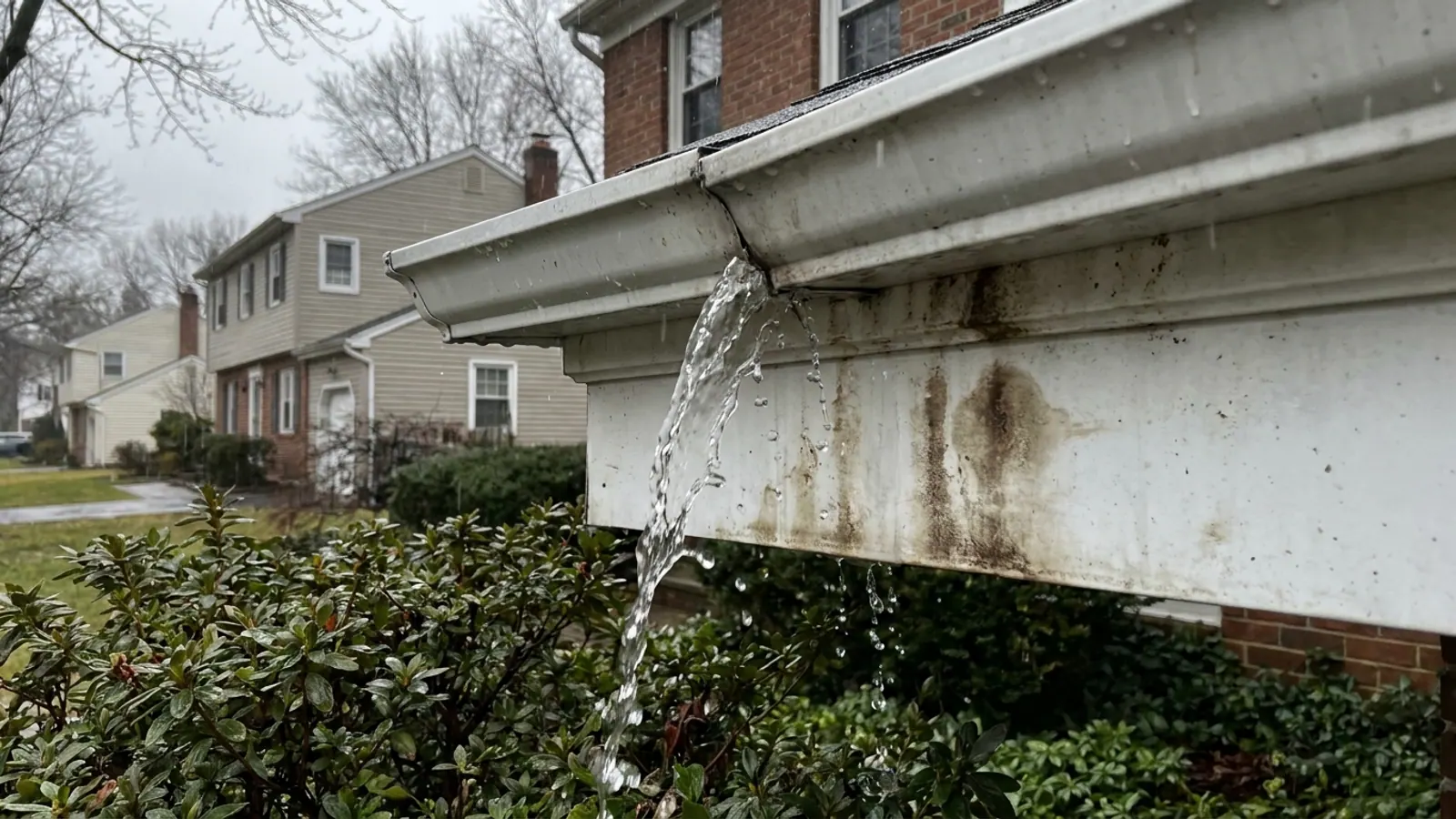
Corners leak because a corner is a seam. The straight runs of a seamless gutter are rolled in one continuous piece, but every miter and every end cap is two pieces of aluminum cut, riveted and sealed by hand, and that sealed joint is the first thing on the gutter to fail. A corner that drips in light rain is a failed seam; a corner that only spills in heavy rain is usually a pitch, capacity or valley-dumping problem instead.
On this page
A gutter corner leaks because the corner is a seam. The long straight runs on a seamless aluminum gutter are rolled out of a single coil on the truck, with no joints at all. Every corner is different: two pieces of aluminum, cut at an angle, lapped, riveted and sealed by hand. End caps are the same story. That hand-made joint is the weakest point on the whole system, and it is where almost every gutter leak in New Jersey starts.
That means two different problems get reported the same way. Water at the corner in a light drizzle is a failed seam. Water pouring over the corner only in a downpour is not a seam problem at all. The fix is completely different, so figure out which one you have before anyone quotes you.
Why gutter corners fail before the rest of the gutter
The sealant is doing structural work it was never going to do forever.
Aluminum moves. A 40-foot run expands and contracts with temperature all year, and in New Jersey that swing runs from single digits in January to the high 90s in July. Every one of those cycles works the riveted lap at the corner back and forth a fraction of an inch. The sealant bead stretches, then loses elasticity, then cracks. Once there is a hairline crack, water gets behind the bead and the failure spreads along the joint instead of staying in one spot.
Three other things accelerate it:
- Debris sits in corners. An inside corner is a collection point. Wet leaf pack holds standing water against the seam for weeks, and constant wet is far harder on sealant than rain that drains off.
- Ice loads the joint. Freeze-thaw in an inside corner packed with debris pushes the two pieces of aluminum apart. That is the single most common way a sealed miter comes open.
- The original bead was thin. Sealing a miter properly means clean, dry, degreased metal and a full continuous bead on the inside of the joint. Done fast on a cold day over dirty aluminum, it fails in a couple of years.
Strip miters vs. box miters
There are two ways to build a corner, and they do not fail the same way.
| Strip miter | Box miter | |
|---|---|---|
| How it is built | Strip miterThe two gutter ends are cut on an angle and overlapped, keeping the profile continuous | Box miterA separate pre-formed corner piece that both runs butt into |
| Number of joints | Strip miterOne long angled lap | Box miterTwo joints, one on each side |
| Appearance | Strip miterThe front face reads as one continuous line | Box miterA visible break at each side of the corner |
| Install time | Strip miterSlower, done on site with more skill | Box miterFaster, less field work |
| Common failure | Strip miterSealant cracks along the lap | Box miterOne of the two butt joints opens |
| Where it fits | Strip miterMost residential outside and inside corners | Box miterTight spaces, repairs, odd angles |
Neither is wrong. A carefully built strip miter on clean metal with a full sealant bead is the better long-term corner because there is one joint instead of two. A box miter is the practical answer when a single corner needs replacing without pulling the whole run down.
End caps leak for the same reason
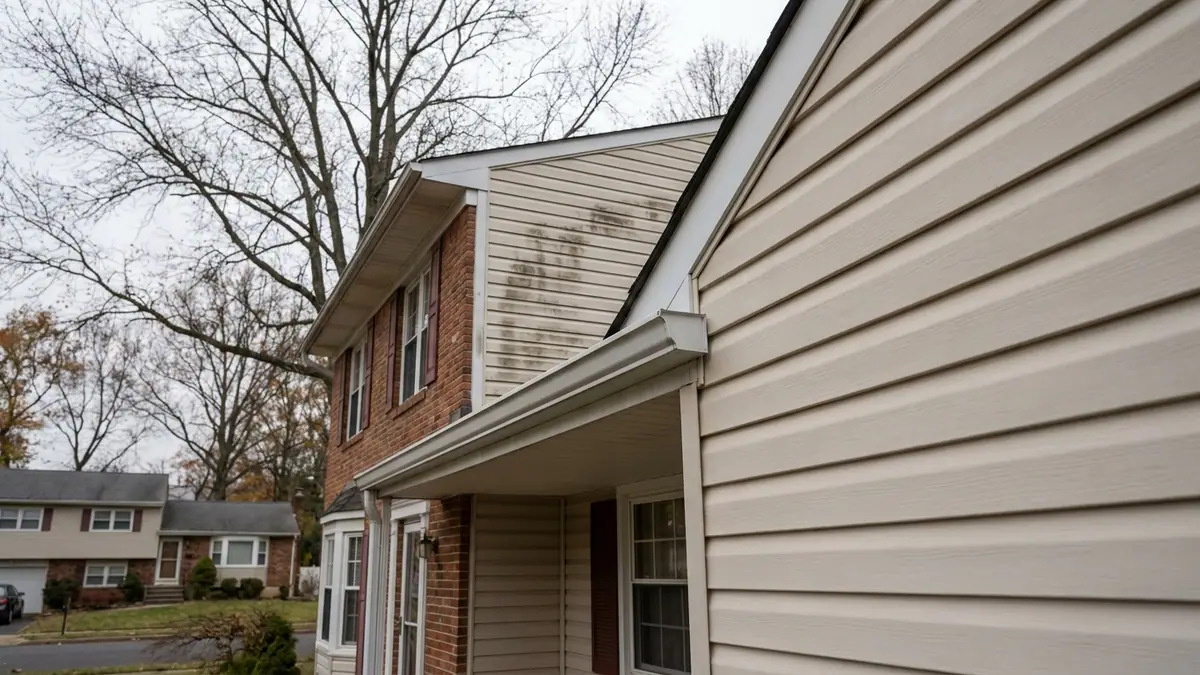
An end cap is a crimped or riveted-and-sealed piece at the end of a run, usually at a rake edge. It gets less attention than a miter and fails just as often, and because it sits at the outside end of the gutter the water tends to run straight down the fascia, then behind the frieze board and into the wall. The stain shows up on the siding below the roof edge before anyone notices the cap itself.
If you see a vertical stain streak on the trim at the end of a gutter run, that is the cap. The fix is the same as a miter: strip the old sealant back to bare aluminum, re-rivet if the cap has loosened, and reseal with a full bead.
Overflow at the corner is a different problem
If the corner is dry in light rain and spills in a hard one, stop looking at the seam. Work through this in order:
- Check the debris. Clear the corner and the downspout outlet first. A packed inside corner will overflow no matter how well it is sealed. The seasonal gutter maintenance guide covers what to clear and when.
- Look at what drains into it. Roof valleys concentrate water. When a valley dumps into a short section of gutter a few feet from the corner, the water arrives faster than that corner can carry it away, and it shoots over the front edge.
- Check the pitch. Water should be moving toward a downspout. If it stands in the corner after a rain, the run is pitched flat or backward, and every joint in it stays wet.
- Check the capacity. A 5-inch gutter with 2x3-inch downspouts handles most New Jersey houses. Steep roofs, very long runs and large single roof planes need 6-inch gutter and 3x4-inch downspouts.
- Check the roof edge. If water is getting behind the gutter rather than over the front of it, the problem is drip edge or gutter apron at the eave, not the miter.
What a leaking corner does to the house
A corner leak puts water in exactly the wrong place. It falls on the fascia, the soffit return and the corner of the siding, and then on the ground at the corner of the foundation. Left alone through a couple of New Jersey winters, that produces soft fascia, a stained soffit, and a wet spot in the basement at that corner. The gutter repair is cheap. The carpentry and the grading work after two years of ignoring it are not.
Check the wood before you pay for a reseal. Push a screwdriver into the fascia under the corner. If it goes in, resealing the miter is putting a good joint on a rotted board, and the new gutter will pull loose from it.
Repair, or replace the run
Reseal the corner when the aluminum is straight and solid, the fascia behind it is sound, and it is one or two joints on the house.
Replace the run when the miter is cracked through, when the gutter has been taken apart and resealed more than once, when the profile is bent from ladder or ice damage, or when the corner is failing along with sagging, standing water and loose hangers on the same elevation. At that point you are paying repeatedly for the same section. New seamless gutter on that elevation, with corners built on clean metal and hangers screwed into solid fascia, ends the cycle. Full seamless gutter and guard details are in the guide.
New Jersey gutter work runs $1,200 to $3,500 in standard-value towns, $2,500 to $6,500 in higher-value towns, and $4,000 to $12,000 on large or luxury homes. The band is set by the municipality's median home value from ACS 2024 five-year estimates, not by how many corners your house has.
What to get in writing
Ask the estimate to state four things:
- Which corners are being rebuilt and whether they are strip or box miters.
- That the joints are cleaned to bare metal and sealed with gutter sealant, not painted over.
- Any fascia or soffit board being replaced, by count, and at what price.
- Hanger type and spacing on any run being rehung.
Lightning Construction prices the fascia repair, the re-pitch and the miter work into the written estimate at the free inspection, so there is no change order once the old gutter is down. There is no deposit, and nothing is due until the work is done and you have looked at it.
If a corner on your house has been dripping since spring, get eyes on it before winter, because ice is what turns a cracked seam into a pulled-apart one. Book a free inspection and written estimate and have the corner, the pitch and the wood behind it checked at the same time.