Short answer
Clogging once or twice a year under trees is normal and cleaning fixes it. Clogging within weeks of a cleaning, or overflowing in heavy rain when the trough is visibly clean, is a capacity or drainage problem that cleaning will never solve. The fix in those cases is more downspouts, a larger gutter and outlet, or a corrected pitch, not another service call.
On this page
- The test that separates a dirty gutter from an undersized one
- Where the blockage sits tells you what is wrong
- Symptom, cause and the actual fix
- Why one downspout per side is the most common mistake in New Jersey
- What cleaning does and does not buy you
- When replacement is the honest answer
- What to get in writing before anyone starts
Clogging once or twice a year under mature trees is a cleaning problem, and cleaning solves it. Clogging again within a few weeks, or water pouring over the front lip during a heavy rain when the trough is clean, is a sizing or drainage problem. No amount of cleaning fixes that, and paying somebody three times a year to scoop out a gutter that was never big enough is money spent on the wrong thing.
Here is how to tell the two apart from the ground, and what each one actually costs to fix.
The test that separates a dirty gutter from an undersized one
Clean the gutters, or have them cleaned, then wait for a hard rain and go outside and look.
A correctly sized, correctly pitched, clean gutter takes everything a New Jersey downpour throws at it and carries it to the downspout. You will see water moving along the trough and out the outlet, and nothing coming over the front edge.
If water sheets over the lip while the inside is still clean, you have found a capacity problem. The gutter is filling faster than the outlet can empty it. That happens for four reasons, and all four are fixable:
- Too much roof is draining to one downspout.
- The gutter profile is too small for a steep roof that throws water hard at the eave.
- The outlet or the downspout is undersized compared to the trough feeding it.
- The gutter is pitched wrong, so water sits in the middle instead of running to the outlet.
If water comes over at one specific spot and the rest of the run is dry, that is almost always debris packed at a corner or an outlet, or a low spot holding standing water. That is maintenance, not replacement.
Where the blockage sits tells you what is wrong
The location of the jam is the most useful piece of information you have, and you can usually see it from a ladder at the corner without walking the roof.
Debris packed at the outlet
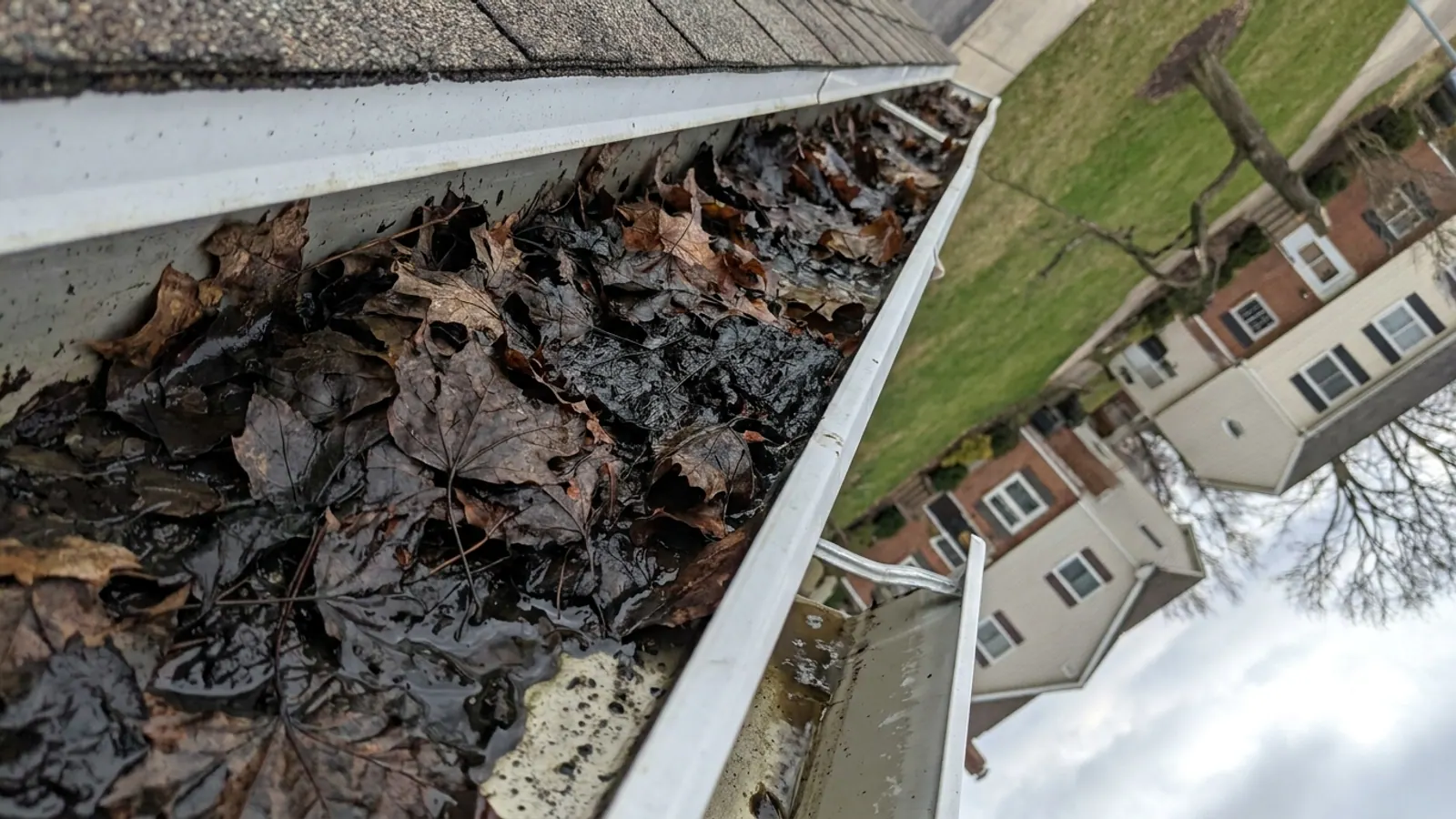
This is the common one and it is normal. Leaves float down the trough, reach the hole, and bridge over it. Everything behind it backs up. Cleaning fixes it, and a guard cuts how often it happens.
Debris spread evenly along the whole run
A uniform layer of black sludge from end to end usually means the gutter is not moving water fast enough to self-flush. Slow water drops its silt and shingle grit. That points at pitch or capacity rather than the trees.
Water standing in the middle of a dry run
Standing water after the rain stops is a pitch problem. Hangers have loosened, a long run has sagged in the middle, or the gutter was hung level to look straight against the fascia. Standing water breeds mosquitoes, freezes in January and pulls the gutter further off the house.
The trough is clean but the downspout is plugged
A 2x3-inch downspout with an elbow at the top jams easily, especially with pine needles and maple seeds. If the trough is clean and still overflows at one end, tap the downspout. A hollow sound is clear; a dull thud is packed.
Symptom, cause and the actual fix
| What you see | Likely cause | The fix |
|---|---|---|
| What you seeOverflow at one corner only | Likely causeDebris at the outlet or miter | The fixCleaning, then a guard |
| What you seeOverflow along the whole front in heavy rain, trough clean | Likely causeUndersized gutter or outlet | The fixLarger gutter and outlet, or an added downspout |
| What you seeClogs again within weeks of cleaning | Likely causeHeavy tree cover, or slow water dropping silt | The fixGuards, plus a check of pitch and outlet count |
| What you seeStanding water days after rain | Likely causeWrong pitch, sagging run, loose hangers | The fixRe-pitch and re-hang |
| What you seeWater behind the gutter, stained fascia | Likely causeMissing gutter apron at the roof edge | The fixFlashing correction during roof or gutter work |
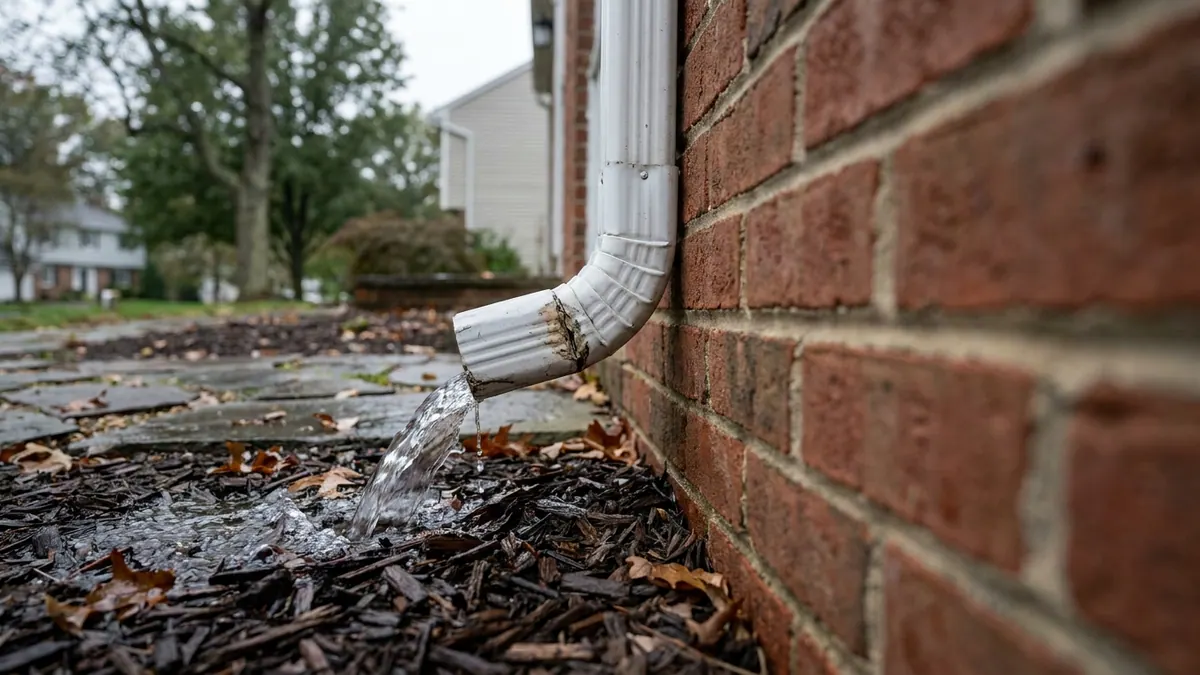
| What you seeDownspout overflows at the elbow | Likely causeDownspout too small for the volume | The fix3x4-inch downspout, or a second one |
Why one downspout per side is the most common mistake in New Jersey
Most of the housing stock here was built between the 1950s and the 1990s, and a lot of it got the cheapest workable gutter layout at the time: one downspout per long run, placed wherever it was easiest to drop to grade. That layout fails when a big rear roof plane, a dormer and a garage return all drain to the same trough and then to one 2x3-inch leader.
Adding a second outlet halves the water each one has to carry and usually solves repeat overflow without touching the trough at all. It is the cheapest real fix available, and it should be the first thing anybody looks at before quoting a full replacement.
The profile matters too. Five-inch seamless aluminum handles most New Jersey houses. Six-inch with 3x4-inch downspouts is the right call on a steep roof, on an unusually long run, or when clean 5-inch gutters still overflow. A larger outlet also clogs less often, because the same leaf that bridges a small hole falls straight through a bigger one.
What cleaning does and does not buy you
Cleaning removes the material that is in there now. It does not change capacity, pitch, hanger spacing or the number of outlets. If the system is right and the trees are heavy, cleaning twice a year in New Jersey is the correct answer and nothing needs replacing. Late spring handles the maple seeds and oak tassels; late fall handles the leaf drop. Houses under pine need a third pass. The seasonal gutter maintenance guide walks through the timing and what to check each visit.
Where cleaning becomes a trap is when it is sold repeatedly against a system that is failing for structural reasons. Three cleanings a year, every year, on gutters that are twenty years old, pulling away at the hangers and rusted at the seams, costs more over five years than seamless replacement and leaves you with the same gutters.
When replacement is the honest answer
Replace when more than one of these is true at the same time:
- The gutters are sectional, and the joints leak no matter how often they are sealed.
- Hangers have pulled out and the fascia behind them is soft.
- The run is visibly sagging and cannot be re-pitched because the metal is deformed.
- The profile is genuinely too small for the roof area and cannot be solved with another downspout.
- The roof is being replaced anyway, which is the cheapest moment to do gutters because the crew is already at the eave.
Seamless aluminum gutters run $1,200 to $3,500 in standard-value New Jersey towns, $2,500 to $6,500 in higher-value towns, and $4,000 to $12,000 for large or luxury homes. The band comes from the municipality's median home value in the ACS 2024 five-year estimates, not from your house. Length, the number of stories, corners, guard choice and how many downspouts have to run to grade move the number within the band. The seamless gutters guide covers profiles, guard types and how seamless runs are rolled on site.
What to get in writing before anyone starts
Ask for the gutter size, the downspout size, the number of downspouts and where each one discharges, all written on the estimate. Ask whether gutter apron is included at the roof edge. Ask what happens if the fascia behind the old gutter is rotted, because that is the condition most likely to turn a gutter job into a surprise bill.
At Lightning Construction, conditions like soft fascia are found at the free inspection and priced into the written estimate, so there is no change order on the day. There is no deposit either; nothing is due until the work is finished and you have inspected it. The estimate is free and carries no obligation, and a salesperson does come to the house for it.
If your gutters clog every year and you are tired of paying to find out why, have the system measured rather than scooped. See the gutters page for what the work covers, or book a free estimate and get the sizing answer in writing.