Short answer
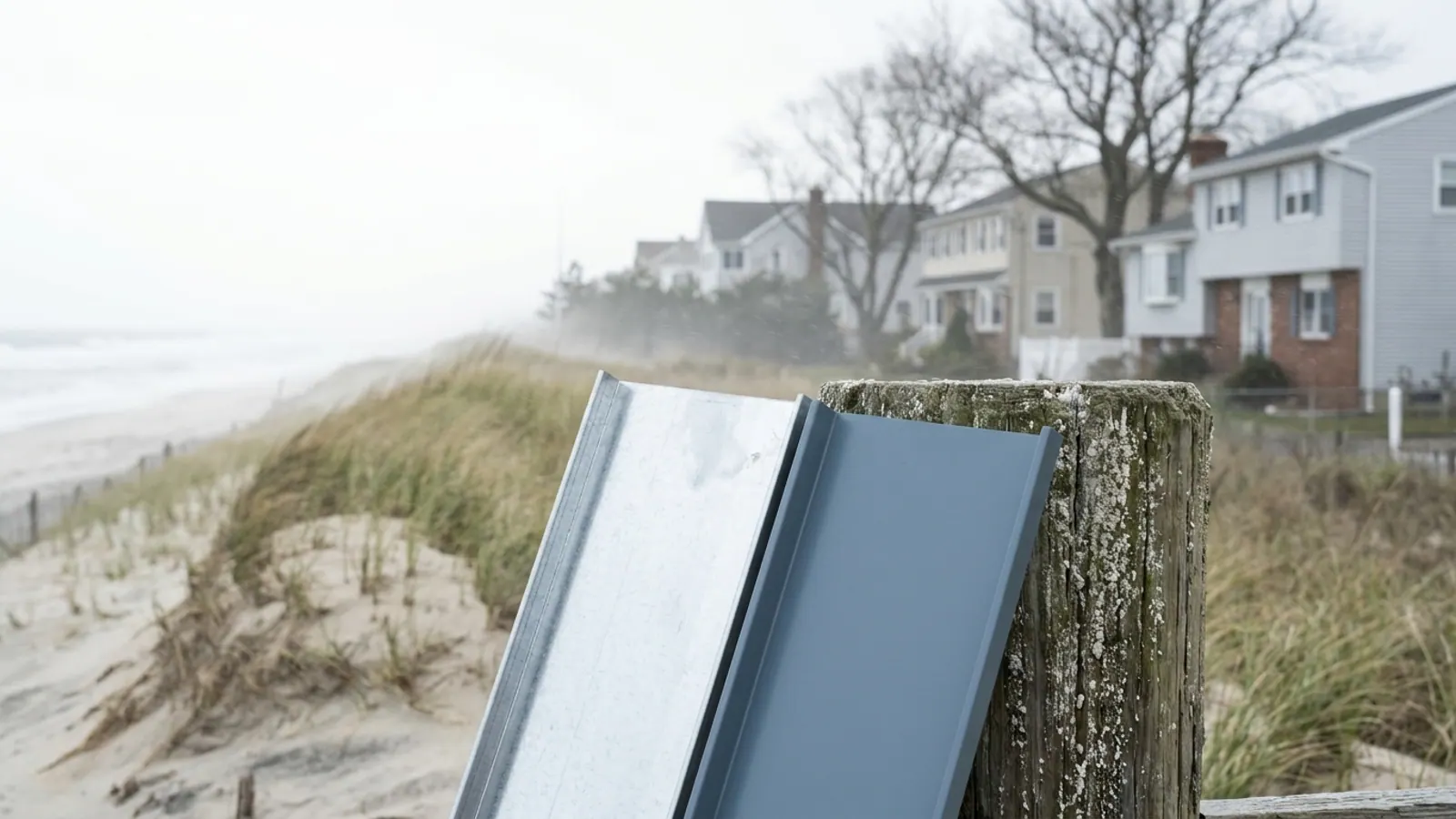
Galvalume is steel coated with an aluminum-zinc alloy, and aluminum is solid metal with no steel core underneath the coating. Close to the ocean and the back bays, aluminum is the safer panel because it does not rust where the metal is cut, scratched or drilled. Farther inland, Galvalume is stronger and more dent-resistant, and it is the usual choice on a New Jersey house.
On this page
Galvalume is steel with an aluminum-zinc coating over it. Aluminum is aluminum all the way through. That one difference decides which panel belongs on your roof, and in New Jersey the deciding factor is how much salt air the house takes.
If you are within about a mile of the ocean or a back bay, and especially if your roof faces open water with nothing between it and the wind, aluminum is the safer material. Inland, Galvalume is stronger, holds a flat plane better, and is the panel most New Jersey metal roofs are made from. Here is what actually separates them, and what to make the contractor put in writing before you sign.
What Galvalume and aluminum actually are
Galvalume is a coated steel product. The steel core is the structure. Over it sits a metallic coating of aluminum and zinc, and over that, on a painted panel, a primer and a finish coat. The aluminum in the coating resists corrosion, the zinc gives some sacrificial protection at scratches, and the steel underneath does the work of being stiff and strong.
Aluminum panels have no steel core. The corrosion resistance is not a coating that can be scratched through, because the metal itself does not rust. Aluminum forms a thin oxide layer that stops the reaction. Cut it, drill it, scratch it, and the fresh metal behaves the same way the rest of the panel does.
That is the whole argument. Everything else follows from it.
Why salt air changes the answer
Salt is what makes a coastal roof different, and it does not stay on the beach. Onshore wind carries salt aerosol inland and deposits it on every horizontal and vertical surface it reaches. Rain washes some of it off. On the underside of a panel, on a hem, on the inside of a drip edge, on the shaded north face where the roof stays damp longer, it sits there.
On a Galvalume panel, salt attacks anywhere the steel is exposed. Every panel gets cut to length. Every hole for a pipe boot has an edge. Every scratch from a dropped tool has an edge. The zinc in the coating protects a small cut for a while, but chloride shortens how long that protection lasts. Panel manufacturers know this, which is why Galvalume warranties commonly carry an exclusion or a reduced term within a set distance of salt water. Read the actual warranty document for the product on your estimate. The distance is written in it.
Aluminum has no exposed steel to attack, so a cut end near the water is not a countdown. That is the reason coastal specifiers reach for it.
Side by side
| Galvalume steel | Aluminum | |
|---|---|---|
| Composition | Galvalume steelSteel core with aluminum-zinc metallic coating | AluminumSolid aluminum, no steel core |
| Behavior at cut edges and scratches | Galvalume steelSteel can corrode where exposed; salt accelerates it | AluminumNo steel to corrode; edge behaves like the rest of the panel |
| Salt-water warranty | Galvalume steelCommonly excluded or shortened near the coast | AluminumNormally covered at the coast |
| Stiffness and dent resistance | Galvalume steelHigher; holds a flat plane well | AluminumLower; specified in a heavier thickness to compensate |
| Thermal movement | Galvalume steelLess expansion and contraction | AluminumMoves more, so clips and seam details matter more |
| Relative material cost | Galvalume steelLower | AluminumHigher |
| Where it belongs in New Jersey | Galvalume steelInland counties and sheltered sites | AluminumOcean-facing and bayfront homes |
Cut edges, fasteners and mixing metals
The panel is only part of the assembly. A coastal metal roof fails at the details long before it fails in the middle of a panel.
Dissimilar metals in contact, with salt moisture between them, corrode faster than either would alone. Put a steel fastener through an aluminum panel at the shore and the connection is the weak point. The clips, fasteners, drip edge, valley metal, ridge and pipe flashings all need to be compatible with the panel, specified together as one system by the manufacturer. This is not an upgrade to negotiate; it is the difference between a fifty-year roof and a twelve-year roof.
Ask specifically about these:
- The metal and coating on every clip and fastener touching the panel.
- What the drip edge and rake trim are made of.
- How cut ends are treated, hemmed or finished.
- Whether the underlayment is rated for the temperatures under a metal roof.
The standing-seam metal roofing guide covers how the system goes together from deck to ridge, and it is worth reading before you compare two quotes.
Wind, not just salt, at the shore
Salt is the slow problem. Wind is the fast one. A shore roof gets nor'easters every winter and the edge of tropical systems most summers, and uplift is highest at the eaves, the rakes and the ridge.
Standing seam earns its price here because the fasteners are hidden under the seam and hold the panel through concealed clips, so there is no gasket sitting in the sun waiting to fail. What matters on the estimate is the clip spacing, the perimeter attachment, and whether the assembly has a tested uplift rating for the panel and substrate being used. Ask which tested assembly your roof is being built to. A contractor who cannot answer that has not specified a coastal roof.
Salt, wind and the way shore houses are framed are covered in more depth in the Jersey Shore roofing guide.
What a metal roof costs in New Jersey
Metal roofing runs $18,000 to $35,000 in standard-value towns, $28,000 to $55,000 in higher-value towns, and $45,000 to $120,000 for large or luxury homes. The band comes from the median home value of the municipality, using ACS 2024 five-year estimates, not from the material you pick.
Aluminum costs more per pound than coated steel, and it is normally specified thicker, so an aluminum roof sits higher within its band than a Galvalume roof on the same house. It does not jump you into a different band. Roof size, pitch, the number of valleys, dormers and penetrations, and the condition of the decking move the number far more than the panel metal does.
Do not accept a per-square-foot figure over the phone as a price. A metal roof is priced off a measured roof and a specified system.
Which one to put on your house
Work through it in this order.
- Find your distance from salt water, ocean or bay, and check it against the warranty exclusion distance printed in the panel manufacturer's document.
- Look at exposure. A roof facing open water across a marsh takes more salt than one four streets back behind mature trees, even at the same distance.
- If you are inside the exclusion zone, or right at its edge on an exposed lot, specify aluminum and keep every touching metal compatible with it.
- If you are clearly outside it, Galvalume is the stronger, stiffer, less expensive panel and there is no reason to pay for aluminum.
- Either way, get the panel product, the metal thickness, the finish system, the clip and fastener metals and the trim metals listed by name on the written estimate.
That last step is the one homeowners skip. Two quotes that both say "standing seam metal roof" can be entirely different roofs at the shore.
What happens when Lightning quotes it
The inspection and the written estimate are free with no obligation, and a salesperson comes to the house. The roof gets measured, the decking gets checked, and the conditions that normally turn into a change order later, extra layers, rotted sheathing, flashing that cannot be reused, are found then and priced into the quote. There are no change orders, and there is no deposit; nothing is due until the work is finished and you have inspected it. Lightning pulls the permit from your municipality's construction office under the New Jersey Uniform Construction Code and attends the inspection. Standing-seam metal takes two to four days on site.
Lightning Construction is veteran-owned and family-operated, licensed and insured, New Jersey Home Improvement Contractor registration 13VH12437000, and GAF Certified, rated 4.9 out of 5 from 264 Google reviews.
If you are weighing metal against asphalt in the first place, read asphalt vs. metal roofing in New Jersey first, because that decision comes before this one. If metal is already settled, see what the system involves on the metal roofing page, or, for a bayfront or ocean-block house in Ocean County, the Brick metal roofing page. When you want it measured, request a free estimate.