Short answer
If the panels are still sound and only the paint has dulled or chalked, a proper recoat is usually the right call and costs far less than new metal. Replace the panels when the metal itself is perforated, rusting through from the back, or when the fastener holes and seams no longer hold water out. Chalking by itself is a coating problem, not a roof failure.
On this page
If the metal is sound and only the finish has gone dull, recoat it. If the panels are perforated, rusting from the underside, or held down by hundreds of fasteners whose gaskets have cracked, paint is money spent on a roof that is already leaking. Chalking is a coating problem. Perforation is a roof problem. They get confused constantly because they look similar from the driveway.
Here is how to tell which one you have, and what each path actually involves on a New Jersey house.
What chalking is, and why metal roofs do it
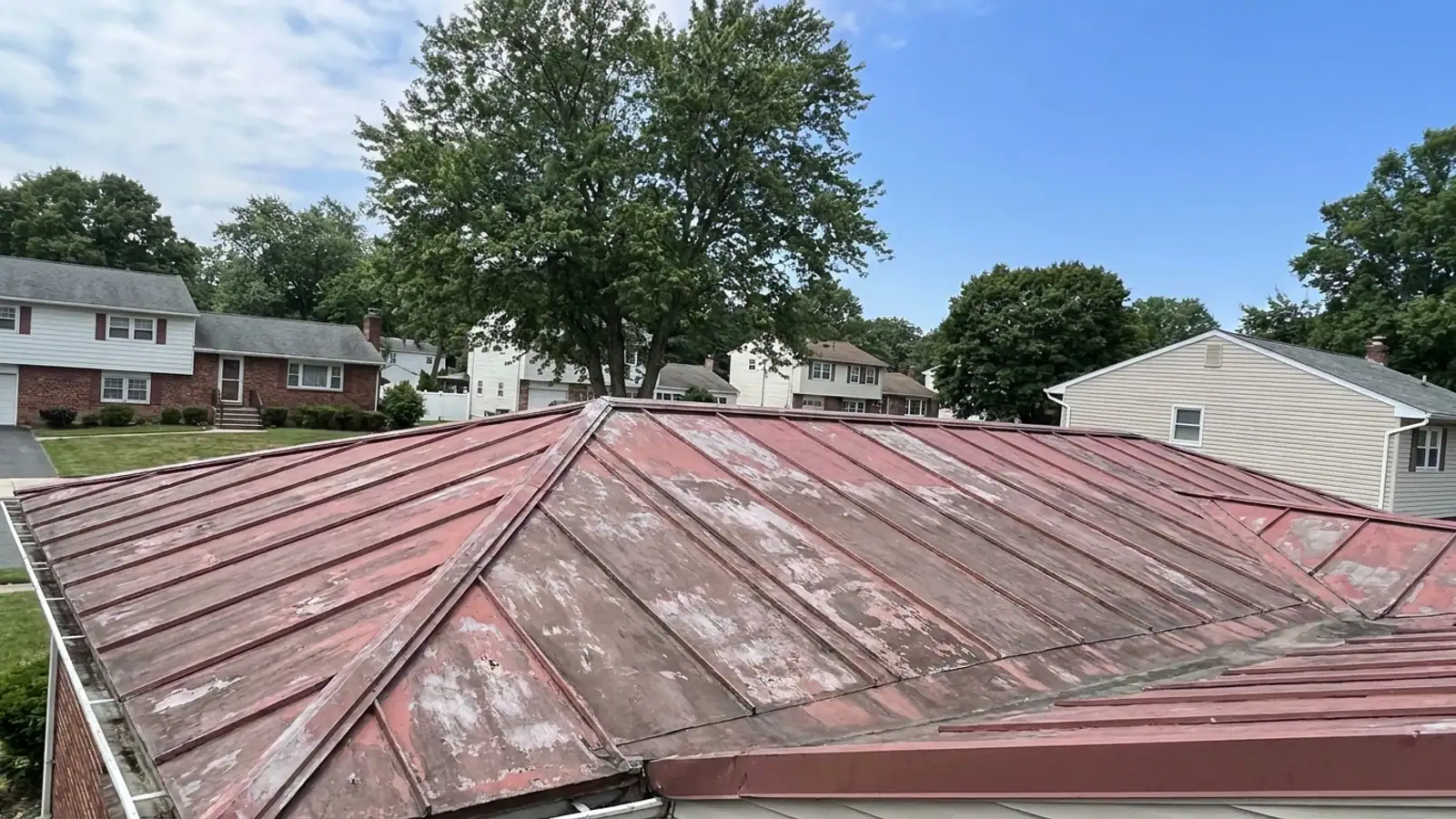
Chalking is the paint binder breaking down under ultraviolet light. The resin that holds the pigment together degrades at the surface, pigment particles are left loose, and they come off as a fine powder when you touch the panel. Rain carries that powder down the slope, which is why chalking roofs often show pale streaks running onto the fascia or the siding below.
Fading is a separate thing. Fading is pigment itself losing color. A roof can fade without chalking, chalk without obvious fading, or do both at once. Reds and dark blues typically show fade first because those pigments are the least UV stable. North slopes usually look better than south and west slopes on the same house, which is the clearest sign that sun exposure and not a manufacturing defect is doing the work.
The resin system is what decides how fast this happens. A PVDF finish, often sold under the Kynar name, holds color and gloss far longer than a silicone-modified polyester. Many older residential metal roofs, especially exposed-fastener agricultural panels put on houses and garages, were coated with polyester-based paint that was never going to hold up for decades of New Jersey sun.
The five-minute test to run before anyone quotes you
Do this from a ladder at the eave, on a dry day, on a slope that gets full afternoon sun. Do not walk the roof.
- Wipe a dark, dry cloth hard across the panel. Heavy colored powder means the finish is chalking.
- Look at the cut edges and the panel ends at the eave. Red rust bleeding out of an edge means the steel substrate is exposed and corroding.
- Check the fasteners if it is an exposed-fastener roof. Cracked or flattened neoprene washers, screws backed out above the panel, or rust rings around the heads are a system problem that paint will not touch.
- Press a screwdriver handle gently near any rust bloom. If the metal flexes like foil or the rust flakes off in sheets, the panel is thinning.
- Go in the attic with a flashlight on a bright day. Pinholes of daylight, rusty nail or screw tips, and stained sheathing tell you the roof is losing water now.
If tests one and two are the only ones that show anything, you have a paint question. If three, four or five show up, you have a replacement conversation.
Repaint or replace: how the decision usually breaks
| Condition on the roof | Recoat | Replace panels |
|---|---|---|
| Condition on the roofDull, chalky, uneven color, metal sound | RecoatYes | Replace panelsNo |
| Condition on the roofFaded badly but no rust, standing seam | RecoatYes | Replace panelsNo |
| Condition on the roofRed rust at a few cut edges only | RecoatYes, after spot prep | Replace panelsNo |
| Condition on the roofRust blooming across whole panels | RecoatNo | Replace panelsYes |
| Condition on the roofPinholes or daylight visible from the attic | RecoatNo | Replace panelsYes |
| Condition on the roofExposed-fastener roof, gaskets failed throughout | RecoatNo | Replace panelsYes |
| Condition on the roofSeams opened, sealant failed at ridge and penetrations | RecoatDepends on extent | Replace panelsOften yes |
| Condition on the roofPanels sound but you want a different profile | RecoatNo | Replace panelsYes, by choice |
What a real metal roof recoat involves
A recoat is not a paint job in the way a fence is a paint job. The sequence matters more than the product.
- Wash the entire roof to remove chalk, dirt, pollen and any organic growth. Loose chalk left on the panel is a bond breaker, and coating over it is the single most common reason a recoat peels.
- Rinse thoroughly and let it dry. Residual cleaner is also a bond breaker.
- Treat rust. Cut edges, scratches and screw heads get mechanically cleaned and primed with a metal primer rated for the substrate.
- Address the sealant and fasteners. Old butyl at the ridge, at sidewalls and around pipe penetrations gets cut out and replaced. Worn screws get upsized or swapped for ones with new washers.
- Apply the coating in the manufacturer's film thickness, usually two coats, within the stated temperature and dew point window. In New Jersey that realistically means late spring through early fall.
Be honest with yourself about what you get. A factory finish is roll-applied to coil and oven-cured. Nothing applied on a ladder matches that. Treat a recoat as a maintenance cycle that buys years of appearance, not as a permanent reset.
When replacing the panels is the cheaper answer
Three situations where paint is the wrong spend.
The roof is an exposed-fastener panel system past its service life. Those roofs rely on a rubber washer under every screw head, and there are hundreds of them. When the washers go, every one is a potential leak, and no coating fixes a compressed gasket. Replacing with a concealed-fastener standing seam removes the whole failure mode.
The corrosion is coming from the back. Panels installed over a wet or unvented assembly rust from the underside, and the first visible sign is often a bubble in the paint rather than a stain. Coating over that traps the problem.
The roof is on the coast and the fasteners and flashings are the wrong metal. Salt air finds dissimilar metal contact fast. Our Jersey Shore roofing guide covers what salt exposure does to a roof assembly and what has to be specified to survive it.
New metal roofing in New Jersey runs $18,000 to $35,000 in standard-value towns, $28,000 to $55,000 in higher-value towns, and $45,000 to $120,000 for large or luxury homes. The band comes from the municipality's median home value in the ACS 2024 five-year estimates, not from the condition of your old paint. Standing seam takes two to four days to install, unlike an asphalt replacement, which is usually done in a single day.
Picking a replacement color so this does not repeat
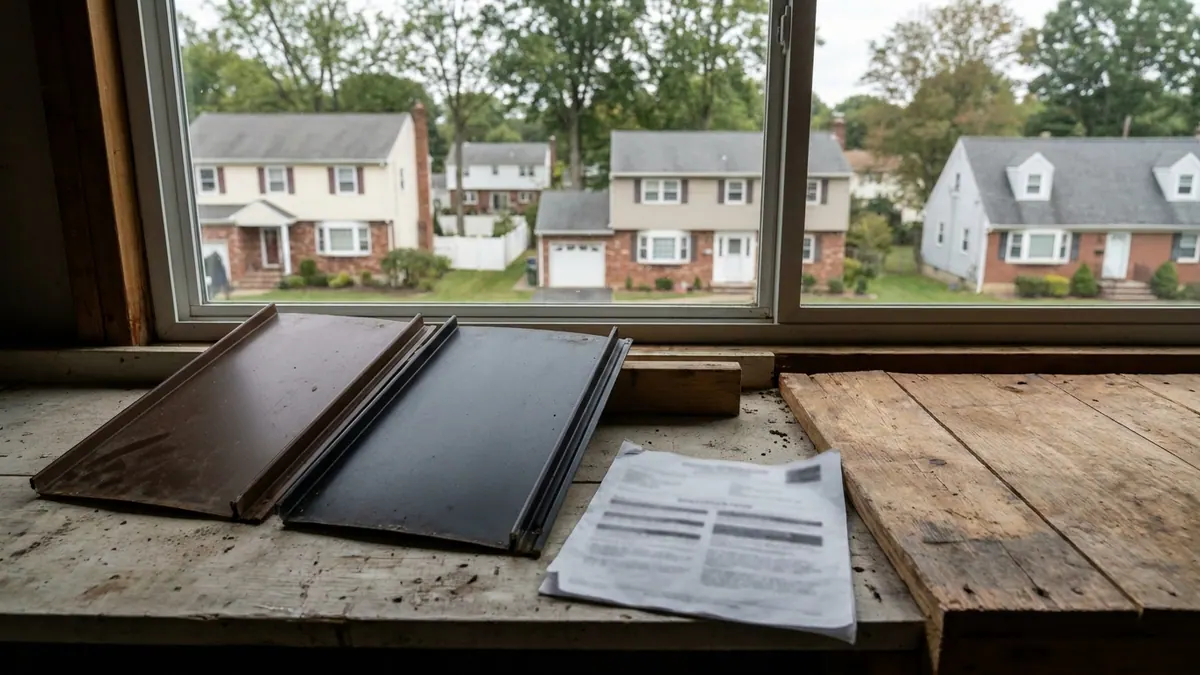
If you do replace, the finish system is the specification that matters most. Ask for the resin type in writing, not just the color name. Ask what the finish warranty says about chalk and fade, because those are normally measured separately from film adhesion and are often covered to different limits. Hold large samples against your brick, stone and the trim you are not replacing, outdoors, at two different times of day.
The standing-seam metal roofing guide walks through panel profiles, seam heights and substrate choices in detail. Read it before you sit down with anyone.
What to do next
Get the roof looked at before you decide. Chalk, fade, edge rust and backside corrosion all read the same from the ground, and the difference between them is the difference between a maintenance coating and a five-figure project.
At Lightning Construction the inspection and the written estimate are free with no obligation, and a salesperson does come to the house. There is no deposit on any job, nothing is due until the work is finished and you have inspected it, and there are no change orders, because the conditions that normally trigger one are found at the inspection and priced into the quote. We pull the permit from your municipality's construction office under the New Jersey Uniform Construction Code and attend the inspection. You file nothing.
See what is involved on the metal roofing page, or request a free estimate and we will tell you straight whether your panels still have life in them.