Short answer
Vinyl costs less to install and needs nothing but washing, while engineered wood costs more and has to be repainted on a cycle. Engineered wood buys you a deeper grain, crisp painted trim and a board that actually holds a fastener, which matters on older New Jersey houses. If you do not want to paint your house again, buy vinyl and buy a thick one.
On this page
Vinyl costs less to install and asks for nothing but a wash. Engineered wood costs more up front and has to be repainted on a cycle for as long as you own the house. That is the trade, and everything else is detail.
What you get for the extra money is a solid board with real depth to the grain, paint color instead of molded-in color, and sheathing-grade fastening that does not rely on a nail hem hooked over a strip. What you give up is a maintenance-free wall. Here is how the two actually differ on a New Jersey house.
What engineered wood siding actually is
Engineered wood siding is wood strands or fibers bonded with resins and waxes, pressed into lap boards, panels and trim, and finished at the factory with a primer or a full prefinish. The grain is embossed into the face. It is treated against fungal decay and termites as part of the manufacturing process, not brushed on after.
It is not plywood siding and it is not cedar. It installs like a wood board: nailed tight through the sheathing into framing, butt joints landing over a stud with joint flashing behind, cut ends sealed before the board goes up. That last step is the one that separates a good engineered wood job from a bad one. A field-cut end that never got sealed is an open edge, and open edges are where this product swells.
Vinyl is a different animal entirely. It is an extruded PVC panel that hangs on nails driven loose so the panel can slide as it expands and contracts. The color goes all the way through the panel on solid-color products, or it is a cap layer on darker colors. Nothing is painted, nothing is caulked at the panel joints, and the whole wall is designed to move.
Cost in New Jersey, and what actually moves the number
Siding in New Jersey runs $10,000 to $22,000 in standard-value towns, $16,000 to $38,000 in higher-value towns, and $30,000 to $70,000 for large or luxury homes. The band is set by the median home value of your municipality, from ACS 2024 five-year estimates, not by which product you pick.
Inside that band, engineered wood lands higher than vinyl for two reasons. The material costs more per square, and the labor costs more because the installation is slower. Boards get cut, sealed, blind-nailed and then caulked at trim intersections. Vinyl panels snap together and run.
The things that move the total more than the product choice are the same for both: how many squares of wall you have, how many stories, how many corners and gables, whether there is rot behind the old siding, and how much trim, soffit and fascia is going back on. A simple two-story colonial with four flat walls is cheaper per square than a split level with three roof lines crossing the wall.
Side by side
| Engineered wood | Vinyl | |
|---|---|---|
| Installed cost | Engineered woodHigher within the band | VinylLower within the band |
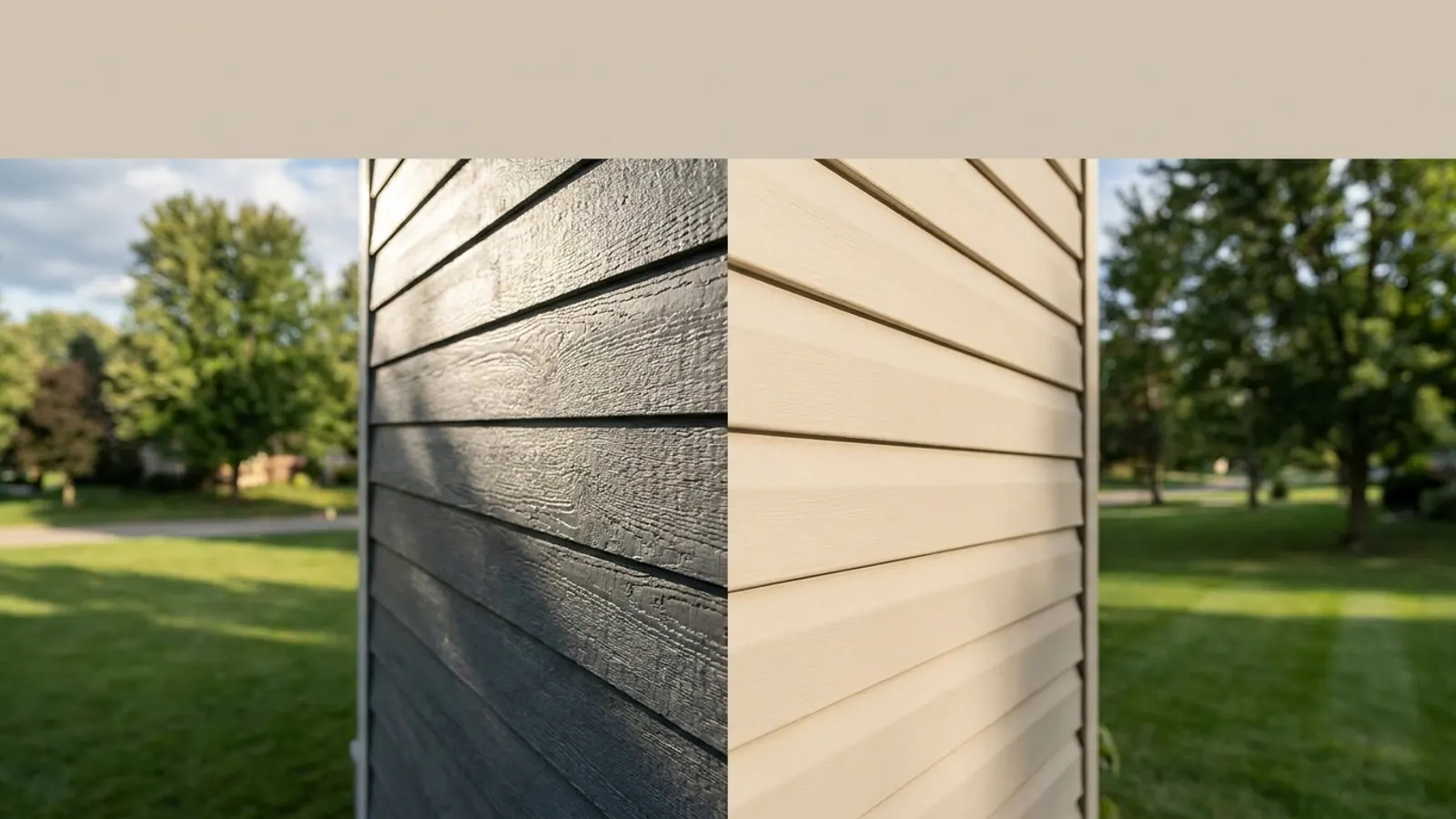
| Finish | Engineered woodFactory primed or prefinished paint | VinylMolded-in color, never painted |
| Repainting | Engineered woodRequired on a cycle | VinylNever |
| Texture depth | Engineered woodDeep embossed grain, reads solid from the curb | VinylShallower, flatter, improves with thicker panels and insulated backing |
| Impact resistance | Engineered woodGood, solid board | VinylFair on standard panels, better on thicker and insulated panels |
| Fastener holding | Engineered woodHolds a screw for shutters, lights, hose reels | VinylNothing fastens to the panel itself, mounting blocks required |
| Repair of one damaged board | Engineered woodReplace and paint the board | VinylUnzip and swap the panel if the color is still made |
| Expansion behavior | Engineered woodMinimal, nailed tight | VinylSignificant, must be hung loose |
| What kills it | Engineered woodWater at unsealed cuts and ground contact | VinylHeat distortion, cold-weather impact cracks, fading on dark colors |
What upkeep looks like on each
Vinyl upkeep is washing. Mildew on the north wall and road grime at the bottom course come off with a soft brush and a mild cleaner. Pressure washing is a real risk because water driven upward behind the panels gets in. Beyond that, you look for cracked panels after a hailstorm and loose panels after a windstorm, and you leave it alone.
Engineered wood upkeep is a short list you do on a schedule:
- Walk the walls once a year and look at the bottom course, the butt joints and any cut end at a window or a roof line. Those are the three places water finds first.
- Re-caulk where trim meets siding when the bead has pulled or cracked. Do not caulk the horizontal lap lines, which are supposed to breathe.
- Keep the bottom of the siding clear of grade, mulch and anything stacked against the wall. Soil contact ends an engineered wood wall faster than weather does.
- Repaint before the existing finish chalks through to the primer. Repainting early is cheap. Repainting after the face has opened up is a board replacement.
- After any impact, a ladder bump or a trimmer strike, prime and paint the gouge the same week.
The repaint interval depends on the product, the color and how much sun that elevation takes. South and west walls in New Jersey go first. Get the manufacturer's finish warranty in writing with the estimate and read what it actually covers, because prefinished and field-painted products are not covered the same way.
How each handles New Jersey weather
New Jersey gives siding a hard year: freeze and thaw cycles all winter, summer heat on the sunny walls, nor'easters and the tail ends of tropical systems driving rain sideways at the joints.
Vinyl handles the rain and the cold well and handles heat poorly. Standard panels get brittle in deep cold, so a ladder dropped against a wall in January cracks something that would have flexed in July. Vinyl also distorts from reflected heat, which is why a low-E window on a neighboring house or a grill parked too close can warp a section.
Engineered wood handles cold and impact better and depends completely on its finish for the rain. Intact paint, sealed cuts and a drainage plane behind the boards and it performs. A failed caulk joint above a window feeding water behind the board for two winters and it swells at the edge.
Both products are only as good as what is behind them. House wrap, flashing at every penetration and kickout flashing where a roof edge dies into a wall matter more than the siding choice. If your old siding is coming off and the sheathing is wet, that is the real job.
Which one belongs on your house
Buy vinyl if you want the lowest installed cost, you do not want to paint again, and the house is a straightforward shape where the flatter texture is not going to bother you. Buy a thicker panel and consider insulated vinyl if the walls are uneven, because the foam backing makes the wall read much flatter and more solid.
Buy engineered wood if you want deep texture and a specific paint color, if you are putting back a board-and-batten or a wide lap look that vinyl does not copy well, or if the house is detailed enough that painted trim and siding need to match exactly. It is also the better answer when you want to hang shutters, light fixtures and brackets directly on the wall.
If you are still deciding between materials at a broader level, the siding options guide for New Jersey homes covers vinyl against fiber cement, which is the other comparison most homeowners are running at the same time. The full set of homeowner guides covers the exterior work that usually gets sequenced with siding.
What to get in writing before you sign
Ask for the product name and series, not just "engineered wood" or "vinyl." Ask for the finish warranty document. Ask what happens at butt joints, whether joint flashing is included, and whether cut ends get sealed. Ask whether trim, soffit and fascia are in the number or priced separately, and whether the gutters come off and go back on.
Ask what happens if there is rot behind the old siding. With Lightning Construction that question is settled before the job starts: the free inspection finds it, it is priced into the written estimate, and there are no change orders. There is no deposit either, so nothing is due until the work is finished and you have inspected it. Lightning pulls the permit from your municipality's construction office under the New Jersey Uniform Construction Code and attends the inspection, in every municipality served.
The estimate appointment is free and genuinely no obligation, and a salesperson does come to the house. See what is included on the siding page, then book the free inspection and written estimate.