Short answer
A 2x3-inch downspout has about six square inches of opening and a 3x4-inch has about twelve, so the larger one moves roughly twice the water and clogs far less often. Most New Jersey houses with 5-inch seamless gutters and a normal number of outlets run fine on 2x3. Go to 3x4 when one downspout drains a large or steep section of roof, when the gutter overflows at the outlet in heavy rain, or when the line runs underground.
On this page
A 3x4-inch downspout has about twelve square inches of opening. A 2x3 has about six. That single fact drives everything else: the larger downspout carries roughly twice the water, and because the narrowest point of the opening is four inches instead of two, it takes a much bigger clump of leaves or shingle grit to plug it.
On most New Jersey houses with 5-inch seamless gutters, properly placed 2x3 downspouts handle the rain. The trouble starts when a house has too few outlets, when one run drains an oversized section of roof, or when heavy tree debris meets a two-inch throat. That is when the size of the downspout stops being a detail and starts being the reason your basement wall is damp.
What a downspout actually has to move
The gutter collects. The downspout evacuates. A gutter can only carry water as fast as its outlets can take it away, so the trough is almost never the limiting part of the system.
What matters is the roof area feeding each individual downspout, not the total square footage of the house. A 2,400 square foot roof with six well-placed outlets is easy. The same roof with two outlets, both at one corner, will overflow every time a real summer thunderstorm comes through. New Jersey gets short, intense downpours in July and August, and a system sized for a steady drizzle fails in exactly those storms.
Pitch matters too. Water coming off a steep roof arrives at the gutter with speed behind it, and it stacks up at the outlet faster than it does on a low-slope ranch. Steep roofs are a common reason a house that looks like it should be fine on 2x3 is not.
Where 2x3 downspouts fail on New Jersey houses
Four patterns come up over and over on inspections.
A long run with one outlet. Forty feet of gutter draining to a single 2x3 at one end. The far end floods, the water runs behind the gutter, and the fascia rots.
A valley dumping onto one spot. Two roof planes meeting in a valley concentrate a wide area of roof into a few feet of gutter. Every gallon from both slopes hits the same short section. If the nearest outlet is a 2x3, it backs up.
A porch or garage roof draining onto a main roof. Upper roof water is added to the lower roof's load, and nobody counted it when the gutters were hung.
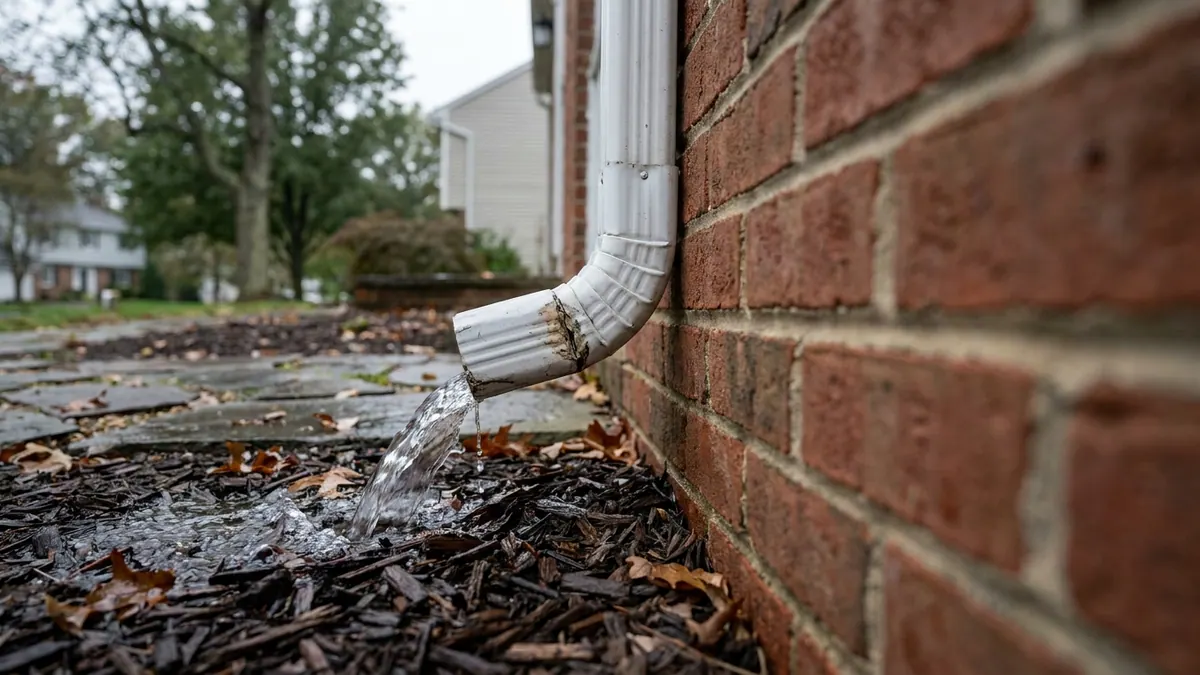
Heavy tree cover. Oaks and maples drop more than leaves. Seed pods, twigs and years of shingle granules collect at the outlet. A 2x3 elbow packs solid; a 3x4 keeps passing water with the same debris in it.
If you see water sheeting over the front lip of the gutter within a minute of a hard rain starting, the outlet is the suspect. If it overflows only at the very end of a long run, the pitch is the suspect. The gutter maintenance guide covers how to check the trough itself season by season.
2x3 vs. 3x4 downspouts side by side
| 2x3 | 3x4 | |
|---|---|---|
| Opening area | 2x3About 6 square inches | 3x4About 12 square inches |
| Narrowest dimension | 2x32 inches | 3x43 inches |
| Typical pairing | 2x35-inch K-style gutter | 3x45-inch or 6-inch K-style gutter |
| Clog resistance | 2x3Low where trees overhang | 3x4High |
| Appearance on the wall | 2x3Slimmer, less noticeable | 3x4Wider, more visible on narrow trim boards |
| Best use | 2x3Short runs, modest roof areas, low-debris sites | 3x4Long runs, valleys, steep roofs, underground lines |
| Underground connection | 2x3Restricts easily at the transition | 3x4Preferred |
Both sizes come in the same seamless aluminum and the same baked-on color range, so this is not an appearance compromise in most cases. The one place it shows is on a house with narrow corner boards, where a 3x4 can look wide against the trim.
How many downspouts your roof needs, not just what size
Sizing up a downspout does not fix a system with too few of them. Work through it in this order:
- Walk the perimeter during or right after a hard rain and mark every spot where water comes over the front or back edge of the gutter.
- For each overflow, look at where the nearest outlet is and how much roof drains into that run.
- Check whether the gutter is clean and correctly pitched before blaming the downspout at all.
- Add an outlet where a run is long or where a valley concentrates flow, rather than only widening the one that exists.
- Move to 3x4 on the runs carrying the most roof, and on any run that ties into a buried drain line.
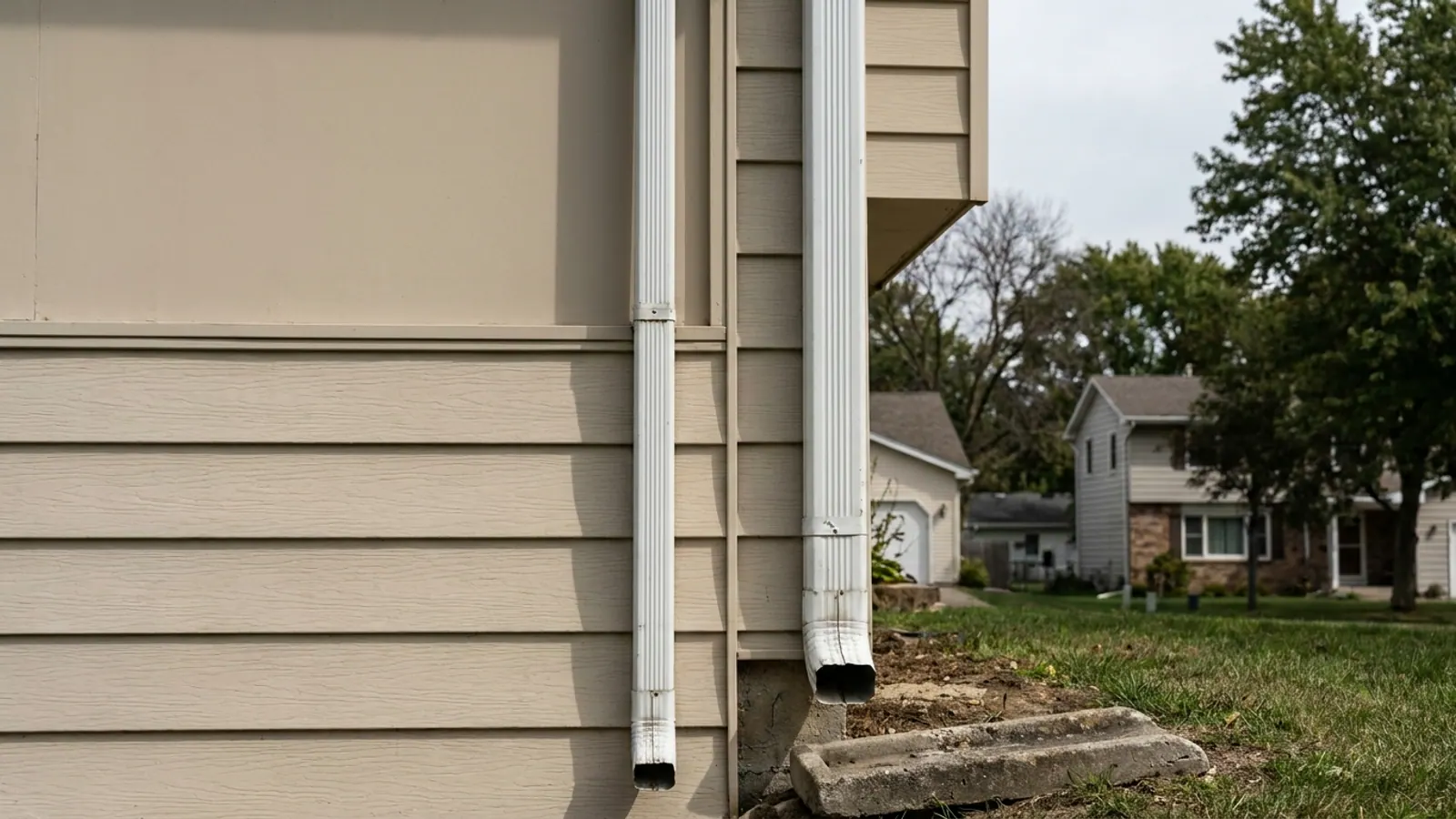
Mixing sizes on one house is normal and correct. The front elevation over the entry may be a short run that a 2x3 handles cleanly, while the back of the house takes two valleys and needs 3x4. A contractor who quotes one size for the whole house without looking at the roof planes has not sized anything.
Outlets, elbows and the underground line
The downspout is only as open as its tightest point, and that point is usually not the tube.
The outlet is the hole cut in the gutter floor. A 3x4 downspout fed by a partly blocked or undersized outlet drains like a 2x3. Ask that the outlet be cut to match the downspout, not the other way around.
Elbows are the next restriction. Every turn slows water and gives debris a ledge to sit on. Two elbows at the top and one at the bottom is common; adding more turns to route around a bay or a deck costs capacity every time.
Underground drain lines are the strongest argument for 3x4. A buried line you cannot see, cannot easily snake and will not notice failing is the worst place to accept a two-inch bottleneck. If your downspouts tie into pipe that runs out to the yard or the street, put the larger size above it.
What this costs and what to ask for in writing
Seamless gutter work in New Jersey runs $1,200 to $3,500 in standard-value towns, $2,500 to $6,500 in higher-value towns, and $4,000 to $12,000 on large or luxury homes. The band is set by the municipality's median home value from ACS 2024 five-year estimates. Going from 2x3 to 3x4 on some or all runs moves the number within that range rather than into a new one, and the added outlets usually matter more to the price than the tube size does.
Ask the estimate to state, in writing: the gutter size, the downspout size on each elevation, the number of outlets, and where each downspout discharges. Vague line items are where capacity quietly disappears. Lightning Construction writes the price as final, with no change orders and no deposit, so what is listed is what gets installed and nothing is due until you have inspected the finished work.
For how seamless aluminum is formed on site, and where guards do and do not earn their money, read the seamless gutters guide before you decide on add-ons.
What to do next
If your gutters overflow in every real storm and you have already cleaned them, the outlets are almost certainly undersized, too few, or both. Have someone look at the roof planes and count the drainage areas rather than guessing at the tube.
Lightning Construction installs seamless aluminum gutters, guards, downspouts and re-pitching across all 21 New Jersey counties, and the inspection and written estimate are free with no obligation, though a salesperson does come to the house. Book the free estimate and ask specifically what size downspouts your roof needs and how many.