Short answer
Downspouts should discharge at least four to six feet away from the foundation, onto ground that slopes away from the house. Anything shorter drops the entire roof's water into the backfill soil right against the basement wall, which is the most common cause of a wet basement that gets blamed on the roof. Extensions, splash blocks and buried lines all work, but only if the grade at the discharge point carries water away instead of back.
On this page
A downspout should put water on the ground at least four to six feet from the foundation, and that ground should slope away from the house. Everything else about downspout drainage is a variation on those two rules.
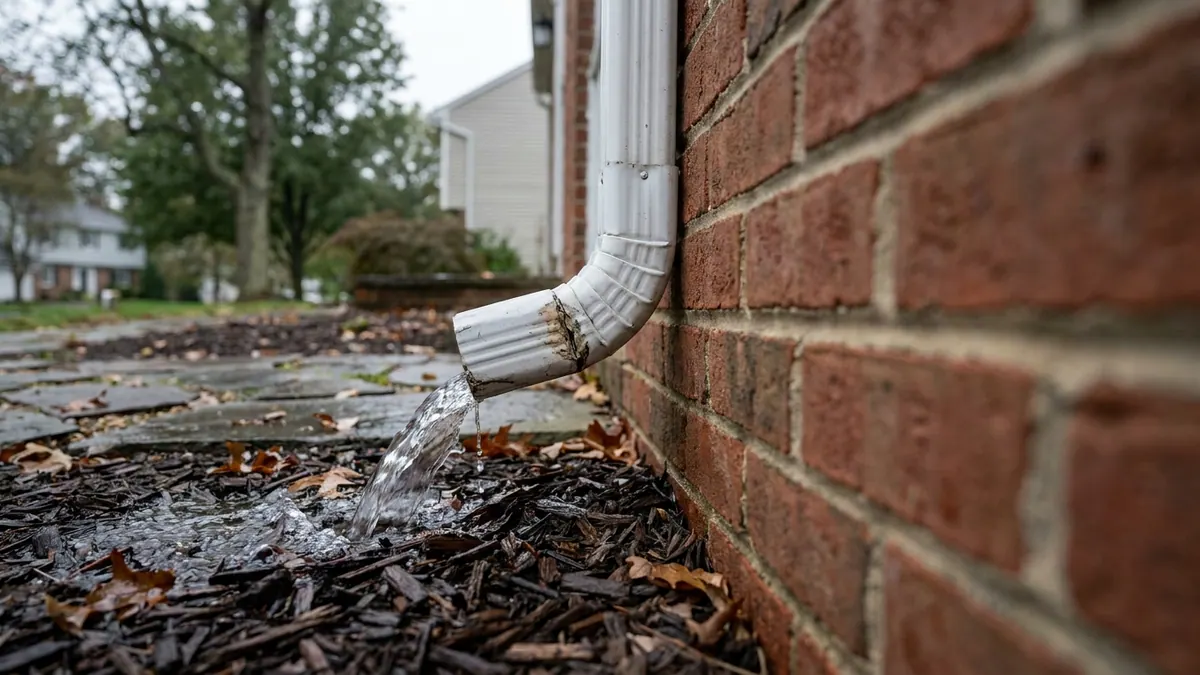
The reason it matters is volume. A hard New Jersey summer storm dumps hundreds of gallons on an average roof in under an hour, and the gutters collect all of it and hand it to two, three or four discharge points. If one of those points is a downspout elbow ending six inches from the basement wall, that is where hundreds of gallons go, into the loosest soil on the property.
Why the soil right next to your foundation is the problem
When your house was built, a trench was dug for the foundation, the walls went up, and the trench was backfilled. That backfilled soil never packs down as tightly as the undisturbed ground around it. It stays looser and more permeable for the life of the house.
So water landing in that band does not run off. It sinks, follows the outside of the foundation wall down, and collects at the footing. From there it finds the cold joint where the wall meets the slab, a tie-rod hole, or a hairline crack. That is the seepage a homeowner sees on the basement floor after every downpour and blames on the roof.
The fix is almost never a roof repair. It is getting the discharge point past the backfill zone and onto ground that carries water away.
How far is far enough
Four feet is the practical floor. Six feet is better. On a house with flat grading, a walk-out basement, or a finished lower level, further still.
Two conditions change the answer:
- Grading. A downspout that discharges ten feet out onto ground that slopes back toward the house has accomplished nothing. The water walks straight back. Grade beats distance every time.
- Roof area feeding that leader. A downspout that drains one small dormer moves a fraction of what a downspout at the bottom of two long roof planes moves. The heavy ones need more distance and a bigger outlet.
Walk the house during the next real rain, not on a dry day. You will see immediately which downspouts are gushing and which are trickling, and where the water goes after it lands.
The four ways to get water away from the house
| Method | What it does | Where it works | What goes wrong |
|---|---|---|---|
| MethodSplash block | What it doesSpreads impact, moves discharge about 18 inches | Where it worksCombined with an extension, on ground that already slopes | What goes wrongUsed alone, it drops everything in the backfill zone |
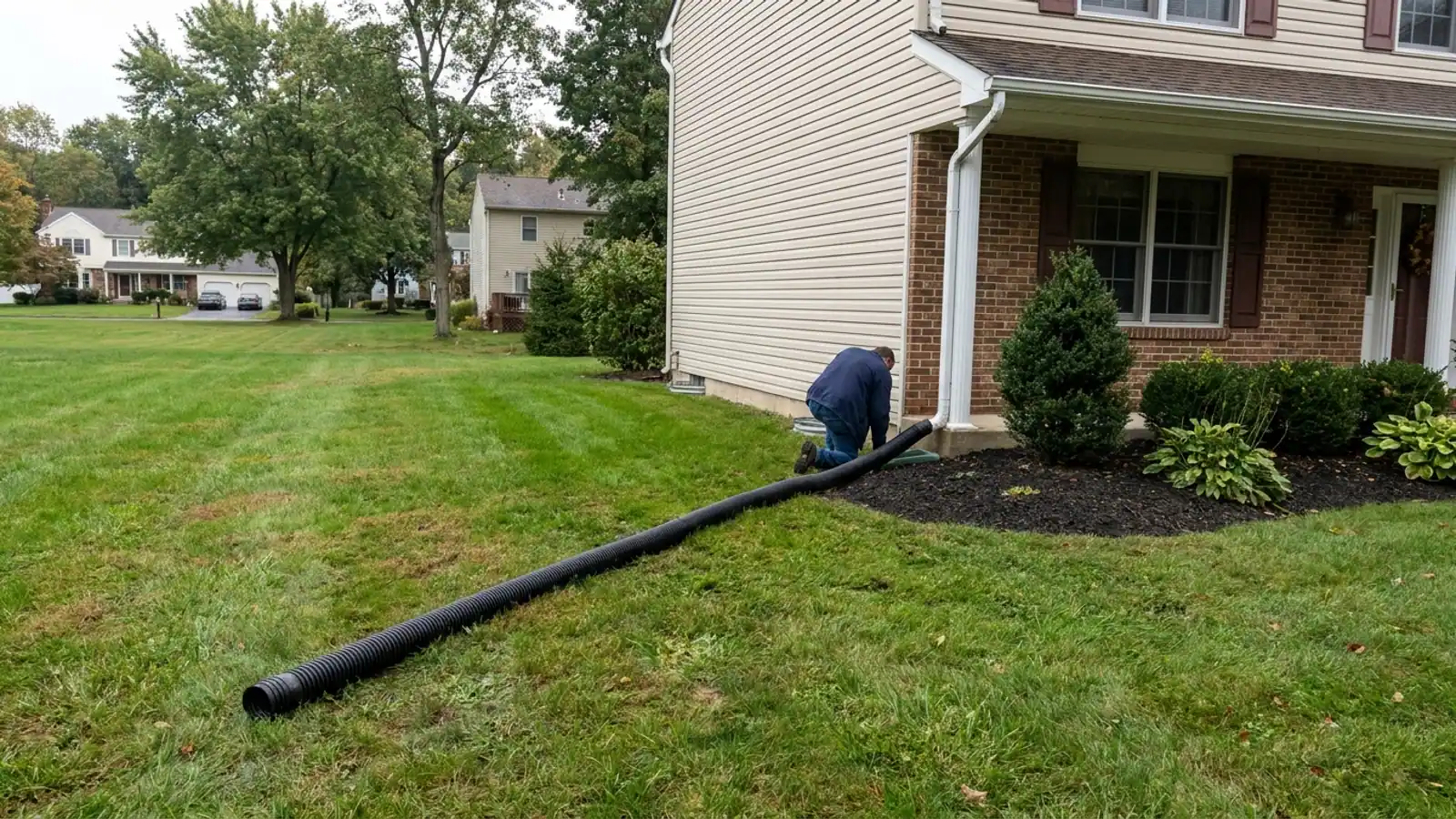
| MethodAbove-grade extension | What it doesCarries water four to ten feet out on the surface | Where it worksMost New Jersey lots with usable slope | What goes wrongGets knocked loose by mowers, kicked off, left disconnected |
| MethodHinged or roll-out extension | What it doesFlips up for mowing, drops back down | Where it worksLawns that get cut weekly | What goes wrongStays flipped up all summer because nobody puts it back |
| MethodBuried solid pipe to daylight | What it doesMoves water 15 feet or more, out of sight | Where it worksYards that fall away from the house | What goes wrongClogs, freezes, or was never sloped enough; no cleanout to check |
A buried line is the best-looking answer and the one with the most hidden failure modes. If you run one, use solid pipe rather than perforated, keep a consistent fall to the outlet, and put a cleanout at the top so it can be cleared. A perforated pipe in a gravel bed near the house is a way of injecting roof water into the ground you were trying to keep dry.
Grading: the part nobody looks at
The ground within the first ten feet of the house should fall away from the wall. Over years, mulch beds get topped up, patios settle, and a flower bed gets built up against the siding until the grade runs the wrong way.
Check three things:
- The first six feet out from the wall. Stand back and look along the ground line. If soil or mulch is higher at the edge of a bed than it is against the foundation, water pools at the wall.
- Where downspouts land. Look for a dug-out hole, a bare patch, or a channel cut through mulch. That is erosion telling you the water is concentrated and going nowhere.
- Hardscape. Walkways, patios and driveway aprons that have settled toward the house route roof water directly to the foundation, no matter how good the downspout extension is.
Fixing grade is dirt work, not gutter work, but it is often the cheaper half of the solution and there is no point extending a downspout onto ground that sends the water back.
Where downspouts should never drain
- Onto a walkway, driveway or stair. In January that becomes ice, and it is a liability at the front door.
- Straight at a neighbor's property line. Some New Jersey municipalities have their own stormwater rules about discharge across property lines and into public systems. Your construction office can tell you what applies on your street.
- Into a footing drain or a sump discharge line. Roof water volume overwhelms systems built to handle groundwater seepage, and it lands right back where you started.
- Into a window well. Obvious once you see it, and it happens on houses where a downspout was moved during a siding job.
The gutter side of the problem
Drainage only works if the water reaches the downspout in the first place. Three gutter faults create foundation water even when the extensions are perfect:
- Overflow at a valley. Where two roof planes meet, water arrives at one spot in a concentrated stream and jumps the front edge. It lands at the foundation without ever entering a downspout.
- Wrong pitch. A gutter hung level holds standing water and spills at the low point instead of draining to the outlet. Re-pitching an existing run is sometimes the entire fix.
- Too few downspouts. A long run with a single outlet at one end fills at the far end and spills there. Adding a second downspout is often cheaper and more effective than any other change.
Seasonal cleaning and what to check each spring and fall is covered in the gutter maintenance guide. The trade-offs between guards and open gutters, which matter a lot when you are running buried lines, are in the seamless gutters and gutter guards guide.
What to ask for in writing
When you get an estimate for gutter work, the drainage part is usually where the detail is thin. Get these on paper:
- How many downspouts, and where each one lands.
- Downspout size at each location, and whether any run is getting a second outlet.
- Whether extensions are included, what type, and how far they carry.
- If a buried line is part of it, the pipe type, where it daylights, and whether there is a cleanout.
A quote that says "gutters and downspouts" with no discharge detail is a quote you will be arguing about later.
Getting it looked at
Lightning Construction installs seamless aluminum gutters, guards, downspouts and re-pitching across all 21 New Jersey counties, and the inspection and written estimate are free with no obligation. A salesperson comes to the house, looks at the roof planes feeding each run and where the water is currently landing, and puts a number in writing. There is no deposit and no change orders, so the written estimate is the final price and nothing is due until the work is done and you have looked at it.
If your basement gets wet after storms, start at the downspouts before you spend money anywhere else. See the full scope of the work on the gutters page, or request a free estimate.