Short answer
Copper gutters commonly outlast the roof above them, while aluminum is generally expected to give a couple of decades of service when it is pitched right and kept clear. Copper is the most expensive common gutter material and its joints are soldered rather than sealed, so both the stock and the labor cost more. Seamless aluminum is the right answer on most New Jersey houses, and it is what Lightning Construction installs.
On this page
- The short version on cost and lifespan
- Copper vs. aluminum at a glance
- What you are actually buying with copper
- What aluminum does well
- How each metal handles New Jersey weather
- Galvanic corrosion: the mistake that ruins mixed systems
- Maintenance, repairs and the parts nobody mentions
- How to decide
- What to do next
Copper gutters commonly outlast the roof they hang on. Aluminum gutters do not, and they cost a fraction as much to buy, to fix and to replace. That is the entire trade, and on most New Jersey houses seamless aluminum is the correct answer.
Lightning Construction installs seamless aluminum gutters, guards, downspouts and re-pitching. This is not a pitch for copper. It is an explanation of what copper actually buys you, what it does badly, and why the aluminum gutters on your house are probably failing for a reason that has nothing to do with the metal itself.
The short version on cost and lifespan
Copper is the most expensive common gutter material, and the gap over aluminum is large rather than marginal. Two things drive it. The stock costs more, and the joints are soldered by hand instead of sealed with caulk, which is slower work and requires someone who solders for a living.
Aluminum is the volume material. Lightning's gutter work runs $1,200 to $3,500 in standard-value towns, $2,500 to $6,500 in higher-value towns and $4,000 to $12,000 on large or luxury homes. The band is set by the municipality's median home value from the ACS 2024 five-year estimates, not by a guess about your street. Those figures are for seamless aluminum systems.
On lifespan, installers generally expect a couple of decades out of a correctly hung aluminum system, and copper systems on older homes are frequently still working after fifty years or more. The honest caveat is that almost no aluminum gutter in New Jersey dies of old age. It dies because the fascia behind it rotted, because the hangers were spaced too far apart, because the pitch was wrong from day one, or because it spent ten winters full of maple seeds and ice.
Copper vs. aluminum at a glance
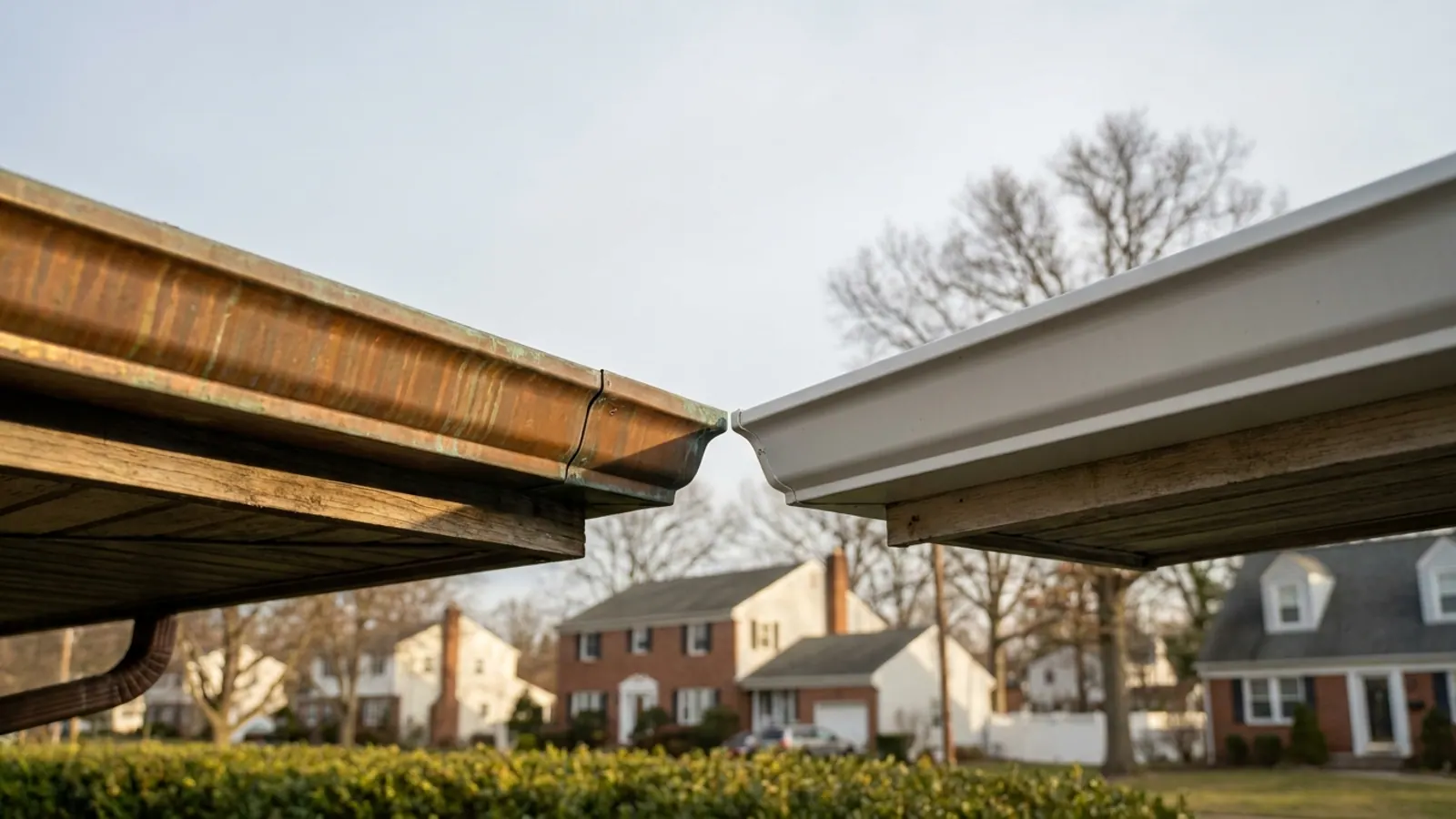
| Copper | Seamless aluminum | |
|---|---|---|
| Up-front cost | CopperHighest of the common materials | Seamless aluminumLowest of the common materials |
| Expected service life | CopperDecades; often outlives the roof | Seamless aluminumGenerally a couple of decades |
| Joints | CopperSoldered, permanent | Seamless aluminumSealed and riveted, or seamless runs |
| Seams on a long run | CopperSoldered sections | Seamless aluminumRolled on site in one continuous piece |
| Color | CopperChanges on its own from bright to brown to green | Seamless aluminumBaked finish, holds its color |
| Dents | CopperSoft, dents from ladders and ice | Seamless aluminumSoft, dents from ladders and ice |
| Repair | CopperNeeds a sheet metal worker who solders | Seamless aluminumAny competent gutter crew |
| Theft risk | CopperReal, because scrap copper has value | Seamless aluminumNegligible |
| Metal pairing | CopperMust be isolated from aluminum and steel | Seamless aluminumMust be isolated from copper |
What you are actually buying with copper
Appearance and permanence, in that order. Copper reads as a finished architectural detail on a house where the gutter is meant to be seen: deep exposed eaves, a slate or standing-seam roof, a stone or brick front, a historic district property where the trim details matter. On those houses copper looks correct and aluminum looks like a compromise.
The second thing is joint quality. A soldered copper seam is a solid metal connection, not a bead of sealant doing a job that sealant eventually stops doing. That is why copper conductor heads, valleys and half-round systems on century-old houses are still moving water. If you want a system nobody has to think about again for a very long time, copper delivers it.
What copper does not do is resist dents. It is a soft metal. A ladder leaned on a copper gutter marks it the same way it marks aluminum, and the mark on copper costs more to make go away.
What aluminum does well
Seamless aluminum is rolled on site from coil, so a 40-foot run of gutter is one continuous piece with no joint anywhere along it except at the corners and the outlets. That removes the single most common leak point in a gutter system. It comes in finish colors that stay the color you picked, it is light enough to hang without heavy structural work, and any crew in the state can repair or extend it next year.
The part that matters more than the metal is the sizing and the drainage. A 5-inch gutter with 2x3-inch downspouts covers most New Jersey roofs, and a 6-inch gutter with 3x4-inch downspouts is the fix for steep pitches and oversized roof planes. The seamless gutters and gutter guards guide walks through sizing, guard types and hanger spacing in detail.
How each metal handles New Jersey weather
Salt air along the coast
Salt is hard on aluminum finishes and on the steel fasteners holding anything to a house. Copper handles marine air well and simply patinas faster there. If you are within a mile or two of the water, the more useful upgrades on an aluminum system are stainless hangers and screws, and washing the gutters down with fresh water when you clean them. The Jersey Shore roofing guide covers what salt exposure does to the rest of the roof edge.
Freeze and thaw
Neither metal cares much about cold on its own. What breaks gutters in a New Jersey January is weight. A gutter packed with debris holds water, the water freezes, and the ice load pulls hangers out of the fascia. Copper is stiffer than aluminum and resists deformation better, but the hanger and the fascia board are what actually fail, and those are the same on both systems.
Ice forming at the eave is a ventilation and insulation problem, not a gutter problem. Replacing gutters does not stop it. The ice dams guide explains what does.
Galvanic corrosion: the mistake that ruins mixed systems
Copper and aluminum in direct contact, with water running across the joint, corrode. The aluminum loses. This shows up in two ways on real houses.
- Copper gutters hung with aluminum drip edge, aluminum hangers or ordinary steel screws. Everything in a copper system that touches the copper has to be copper or stainless.
- Aluminum gutters catching runoff from a copper roof, copper flashing or a copper chimney cap. The runoff carries copper ions into the aluminum trough and pits it from the inside, usually right under the discharge point.
If your house has copper flashing anywhere and you are replacing gutters, say so during the inspection. It changes the specification.
Maintenance, repairs and the parts nobody mentions
Both metals need the same cleaning schedule, and the schedule is set by your trees, not your budget. Debris, standing water and lost pitch cause far more damage in New Jersey than any material defect; the seasonal gutter maintenance guide lays out what to check and when.
Two practical differences. Copper repairs need a sheet metal worker who solders, and there are fewer of them than there are gutter crews, so a small repair takes longer to schedule. And copper has scrap value, which means low, reachable copper runs on an unoccupied property occasionally get stolen. Neither is a reason to avoid copper. Both are reasons to know what you are signing up for.
How to decide
- Look at whether the gutter is visible from the street as an architectural element or just as a line under the roof edge. That answers most of it.
- Check what other metals are already on the roof edge, especially copper flashing or a copper roof.
- Decide how long you intend to own the house. Copper's advantage is measured in decades.
- Price the aluminum system done correctly, with the right gutter and downspout size and proper pitch, before you price an upgrade in metal. A correctly sized aluminum system beats an oversized-price copper system that dumps water at the foundation.
- Get the fascia and soffit condition checked at the same time. Rotted wood behind a new gutter is a repeat job.
What to do next
Book a free inspection and written estimate. There is no deposit on any Lightning job, nothing is due until the work is finished and you have looked at it, and there are no change orders because the conditions that usually cause them are found at the inspection and priced into the quote. When gutters go on as part of a roof replacement, Lightning pulls the permit and attends the municipal inspection under the New Jersey Uniform Construction Code, and you file nothing.
See what a seamless aluminum system includes on the gutters page, or request a free estimate and have someone measure your roof planes and downspout runs instead of guessing at them. A salesperson comes to the house, the visit is free, and there is no obligation.