Short answer
Most chimney leaks in New Jersey start at the flashing where the roof meets the brick, not inside the chimney itself. The next most common sources are a cracked crown on top of the masonry and a missing or rusted cap over the flue. Where the water shows up inside the house tells you which of the three it is, and the fix is different for each.
On this page
Most chimney leaks in New Jersey start at the flashing, the metal that seals the joint where the roof plane meets the brick. The crown on top of the masonry and the cap over the flue are next, and the brick and mortar themselves come last. Those four things fail in different ways, show up differently inside the house, and cost very different amounts to fix, so guessing is expensive.
A chimney is the hardest penetration on a roof. It is wide, it interrupts water running down the slope, it is built of a material that absorbs water, and it moves at a different rate than the wood framing around it. Every one of those facts creates a way in.
Start with where the water shows up
Before anyone gets on the roof, look at the evidence you already have.
- Find the stain and note which side of the chimney it is on. Water on the up-slope side, above the chimney, points at the flashing or at snow and ice sitting behind the brick. Water on the down-slope side points at the flashing apron or the shingles below.
- Go into the attic with a flashlight on a dry day. Look at the chimney chase from the underside of the roof deck down to the ceiling. Dark streaks on the brick, white powdery deposits, rusted nail heads and stained framing all mark the path.
- Note when it leaks. Only in a hard, wind-driven rain means the water is being pushed in sideways. In any rain means an open path. Only during a January thaw means ice, not rain.
- Look for the leak with no rain at all. Water on the floor of a firebox in humid weather, or a musty smell with rust inside the flue, is usually condensation in an unlined or oversized flue, not a roof problem.
- Check the crown and cap from the ground with binoculars if you can see them. A missing cap and a crown broken into pieces are both visible from the driveway.
That is fifteen minutes of work and it narrows four possibilities down to one or two.
The four things that leak on a chimney
Step flashing and counterflashing
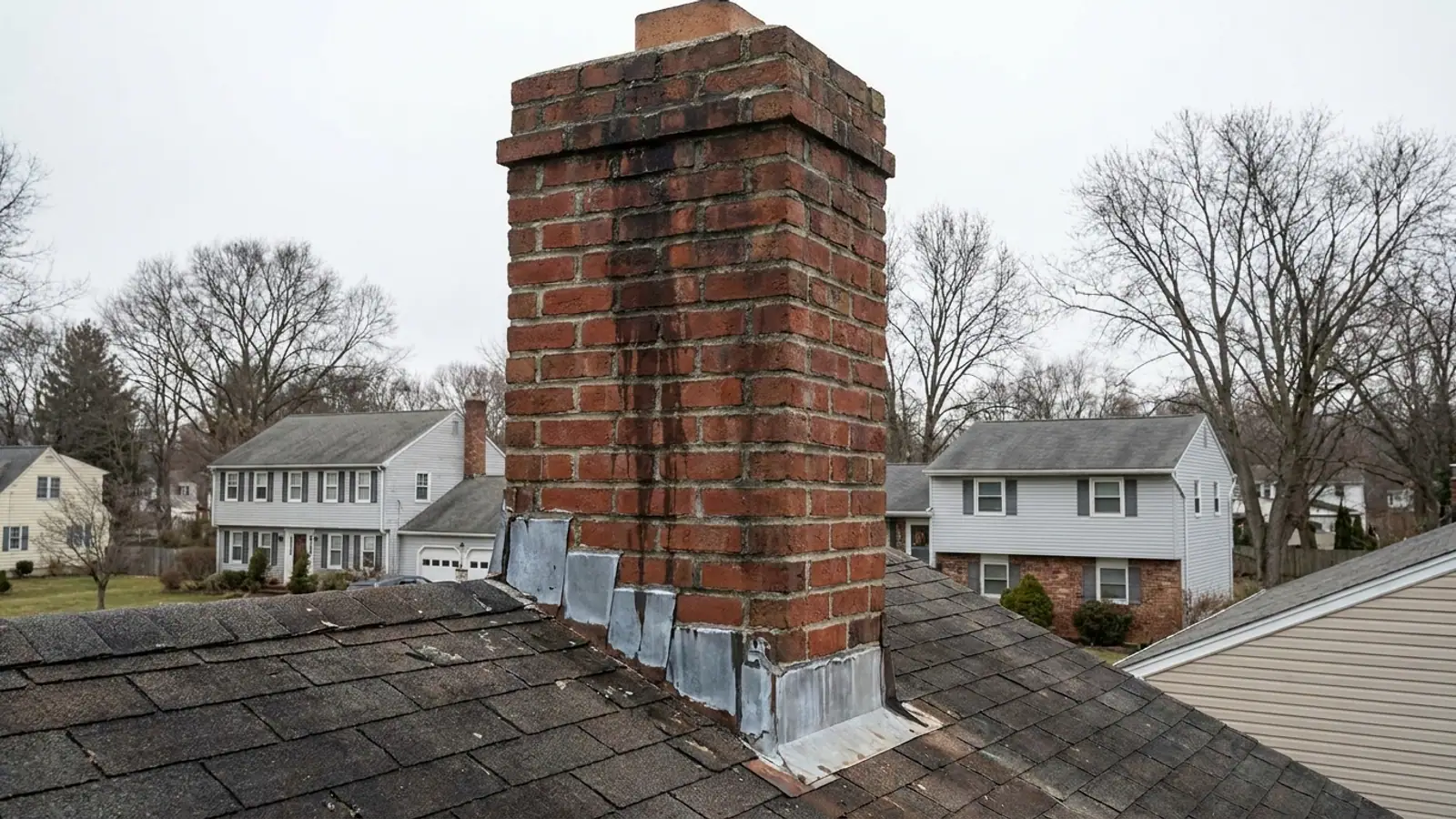
This is the most common failure by a wide margin. Step flashing is a series of bent metal pieces, one per shingle course, woven up each side of the chimney so every piece laps the one below it. Counterflashing is the second layer, cut or let into a mortar joint in the brick and bent down over the top of the step flashing so water running down the masonry cannot get behind it.
It fails when the metal is old and holed, when the counterflashing was surface-mounted with sealant instead of set into the joint, when someone reused bent flashing on a re-roof, or when the whole assembly was replaced with a bead of roof cement. Tar on a chimney is a repair with a shelf life. It dries, shrinks and cracks, usually within a couple of New Jersey winters.
The crown
The crown is the concrete slab on top of the chimney that sheds water off the masonry and away from the flue liner. A real crown is reinforced, several inches thick, and overhangs the brick with a drip edge. What sits on many older New Jersey chimneys is a thin mortar wash troweled flat on top of the last brick course, and that cracks. Once it does, rain soaks straight down into the chimney's core, comes out through the brick face, freezes, and starts pushing the masonry apart.
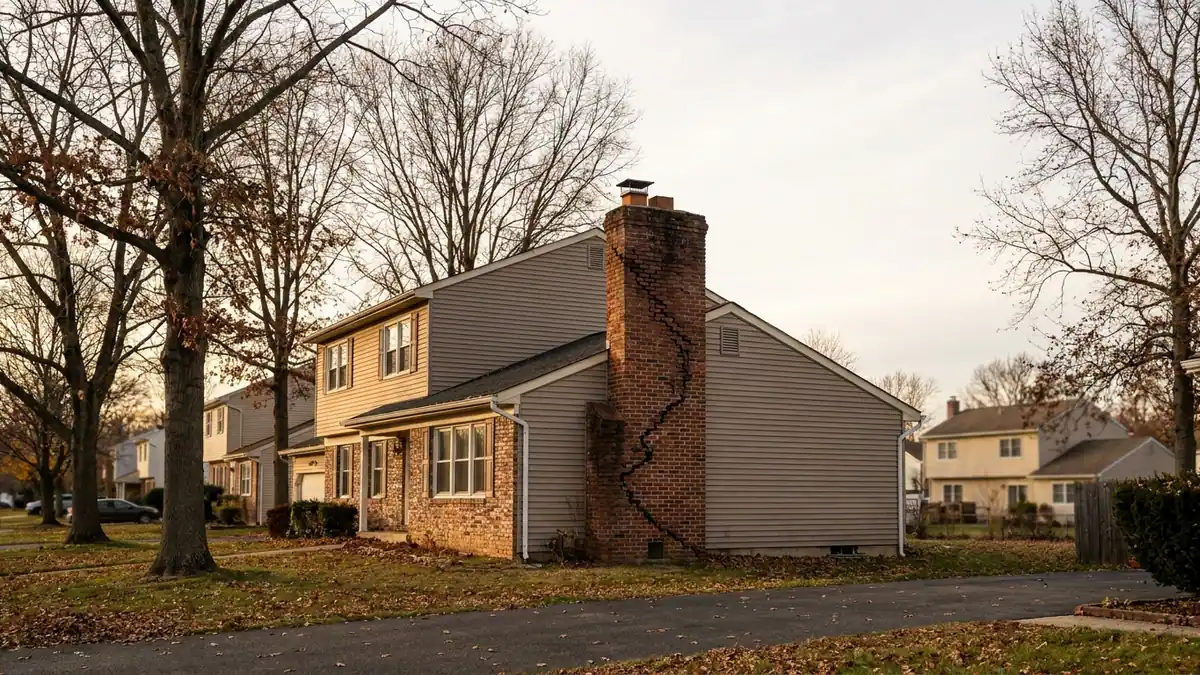
Crown damage often reads as a flashing leak because the water eventually appears at the roofline. The tell is staining and efflorescence on the brick well above the roof, not just at the flashing.
The cap and the chase cover
A masonry chimney should have a cap over the flue: a metal hood on legs that keeps rain, snow and animals out of the flue while letting smoke out. Framed chimneys with a metal chase have a chase cover instead, a large sheet-metal pan over the top. Galvanized chase covers rust through in the middle and dump water directly down the chase. If there is no cap at all, every inch of rain goes straight down the flue.
The brick and the mortar
Brick is porous and mortar joints open up over decades. On an exposed chimney, especially one on a windward wall, driving rain wets the masonry faster than it can dry, and it comes through. Freeze-thaw cycles then spall the brick faces. This is the slowest failure and the one most often blamed on the roof.
Matching the symptom to the source
| What you see | Most likely source | Who fixes it |
|---|---|---|
| What you seeStain on the ceiling beside the chimney after normal rain | Most likely sourceStep flashing or counterflashing | Who fixes itRoofer |
| What you seeLeak only in hard wind-driven rain | Most likely sourceCounterflashing top edge or open mortar joints | Who fixes itRoofer or mason |
| What you seeWet brick and white deposits above the roofline | Most likely sourceCracked crown soaking the masonry | Who fixes itMason |
| What you seeWater inside the firebox or damper, no rain needed | Most likely sourceCondensation in the flue, or no cap | Who fixes itChimney contractor |
| What you seeRust stains running down the outside of a metal chase | Most likely sourceFailed chase cover | Who fixes itRoofer or chimney contractor |
| What you seeStain appears in a January thaw, not in summer storms | Most likely sourceIce damming behind the chimney | Who fixes itRoofer |
| What you seeShingles below the chimney curled or granule-bare | Most likely sourceConstant runoff with no cricket | Who fixes itRoofer |
Ice is its own category. Snow piles up on the up-slope side of a chimney and melts unevenly, and a chimney is a natural place for an ice dam to start. If your leak is a winter-only leak, the ice dams guide explains what is actually happening in the roof assembly above the ceiling.
Why a chimney wider than 30 inches needs a cricket
A cricket is a small framed and flashed peak built on the up-slope side of a chimney to split water and send it around both sides. Without one, the entire flow from the roof above hits the flat back wall of the brick and sits there against the flashing, along with leaves, pine needles and snow. On wide chimneys that standing debris is the single best predictor of a future leak.
If your chimney is wide, on a low-slope roof, or far up the slope with a lot of roof draining into it, ask specifically whether the estimate includes a cricket. It is framing plus flashing plus shingles, it is not free, and it is the difference between a detail that lasts and one you revisit.
What a real chimney flashing repair includes
Ask for these items in writing, by name:
- Full removal of the old step flashing, not reuse.
- New step flashing, one piece per shingle course, each lapping the one below.
- New counterflashing cut into a mortar joint or a reglet, not surface-mounted on the brick face and caulked.
- New apron flashing at the down-slope face.
- Ice and water membrane at the chimney before the flashing goes on.
- A cricket where the chimney width calls for one.
- Sealant only as a secondary detail at the top edge of counterflashing.
When a replacement quote comes in unusually low, reused flashing is one of the most common reasons. New metal is cheap; the labor to weave it in properly is not, and that labor is what gets cut.
Repair the chimney or replace the roof
If the shingles around the chimney are sound and the rest of the roof has life left, flashing is a repair and should be quoted as one. If the roof is near the end of its service life, doing flashing alone means paying for the same access twice, because new flashing has to be woven into the shingle courses. The signs you need a new roof guide covers the conditions that decide this, including what you can only see from the attic.
One split worth being clear about: Lightning Construction is a roofing, metal roofing, siding and gutter contractor. Everything where the roof meets the chimney is roofing work. A cracked crown, spalled brick and repointing are masonry, and a lined or condensing flue is chimney work. An honest inspection tells you which of those you have so you are not paying a roofer to solve a mason's problem.
What to do next
Get the chimney looked at before the next stretch of driving rain, and get the finding in photographs. Lightning Construction's roofing service covers chimney flashing, crickets, decking repair and full replacement across all 21 New Jersey counties, and the inspection and written estimate are free with no obligation. A salesperson does come to the house, and that is a straight sales appointment with no cost attached.
The terms are worth knowing before you schedule. There is no deposit, so nothing is due until the work is finished and you have inspected it. There are no change orders, because the conditions that usually create them, extra shingle layers, rotted decking and unusable flashing, get identified at the inspection and priced into the estimate. Lightning pulls the permit from your municipality's construction office under the New Jersey Uniform Construction Code and attends the inspection, and most asphalt roof replacements are done in a single day. Book the free estimate and find out which of the four sources you are dealing with.