Short answer
Black streaks are algae feeding on the limestone filler in asphalt shingles, and on their own they are not a reason to replace a roof. If the shingles are still flexible, lying flat and holding their granules, a soft wash removes the stain and the roof keeps working. Replace when the streaking shows up alongside curling, bald spots or a roof already at the end of its service life.
On this page
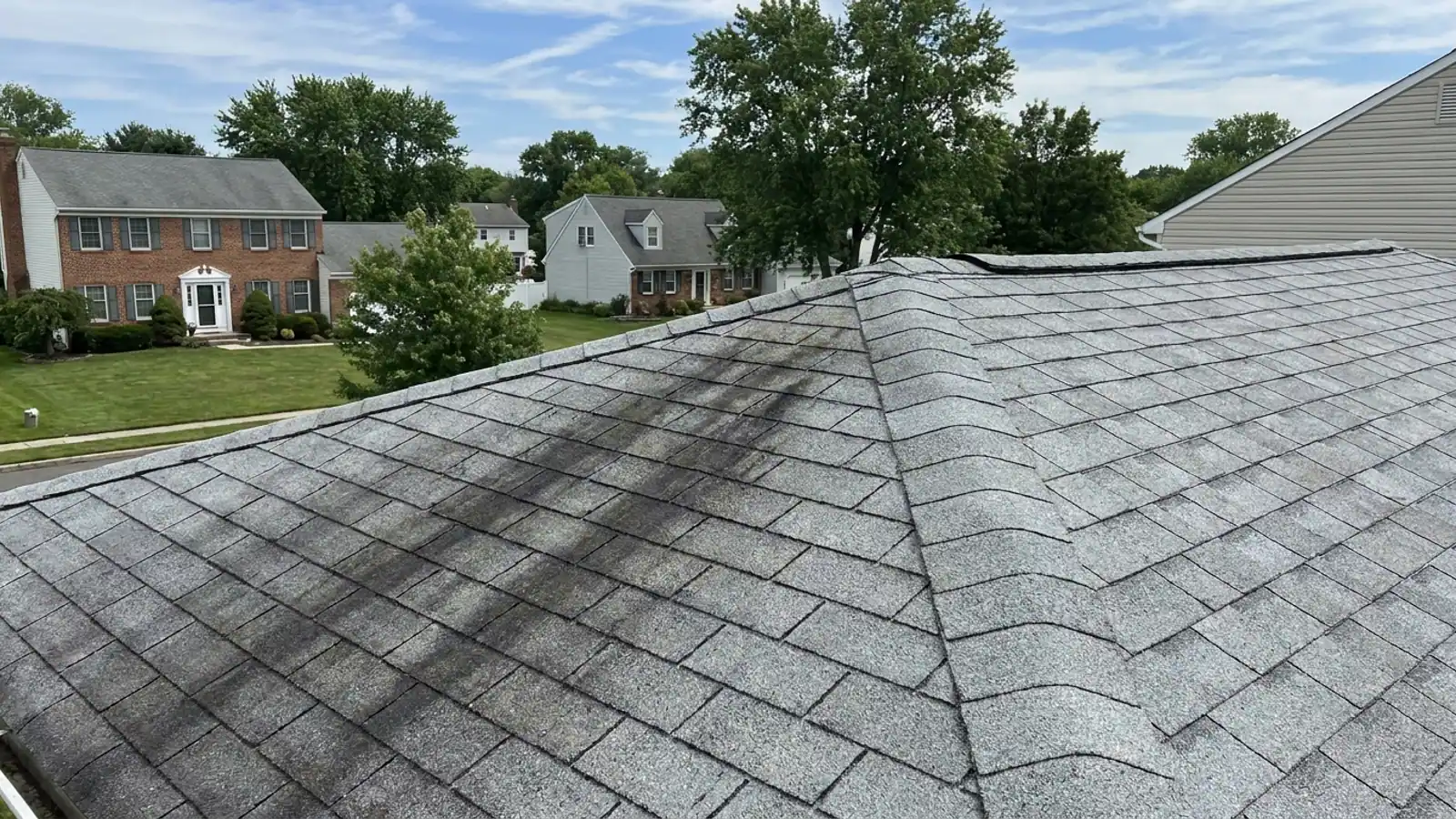
Black streaks are algae, not damage. On a New Jersey roof the streaks are almost always Gloeocapsa magma, an airborne algae that lands on the shingles, feeds on the limestone filler in them, and grows a dark pigmented coating to protect itself from ultraviolet light. That coating is the black you see from the driveway. It is a stain on the roof, not a hole in it.
So the honest answer to the question in the title is: clean it, unless the roof has other problems. The streaks are a cosmetic condition that gets mistaken for a structural one, and plenty of roofs get replaced years early because a homeowner looked up, saw black, and assumed the worst. What follows is how to tell the difference in about fifteen minutes without getting on a ladder.
Why the streaks run down and not across
Algae spores land everywhere, but they colonize where the surface stays damp the longest. Rain and dew carry them down the slope, so the growth spreads in vertical streaks from the ridge toward the eaves. That is also why you see it on one side of the house and not the other. North-facing slopes and any slope shaded by trees dry more slowly, hold moisture into the morning, and streak first.
New Jersey summers give the algae everything it wants: humidity, warm nights and long stretches where a shaded roof plane never fully dries. Houses with mature trees close to the roof, and houses where the surrounding lots are wooded, streak faster than an open lot in the same town.
One more pattern worth knowing. If the streaking stops in clean stripes below a chimney, a vent stack or a run of flashing, that is not a coincidence. Rain running off galvanized or copper metal picks up metal ions that kill the algae underneath. It is the same principle behind zinc strips, and it tells you the stain is biological rather than a manufacturing defect.
Does algae actually shorten shingle life?
A little, and slower than people fear. The dark coating absorbs more heat than the original granule color, which raises surface temperature on that slope. Over many years the growth also loosens its hold on granules as it works into the mat. Neither effect turns a healthy ten-year-old roof into a failing one. Untreated growth on a roof that is already at the end of its life will not help, but it is not the thing that ended it.
What does matter is moss, which is a different organism and a real problem. Moss grows in mounded green clumps, holds water against the shingle, and lifts shingle edges as it thickens. Ice gets into that lift in January and the shingle breaks. If what you have is mounded and green rather than flat and black, treat it as urgent instead of cosmetic.
Clean it or replace it: how to tell
Use the condition of the shingles, not the color of them.
| What you see | What it means | The call |
|---|---|---|
| What you seeFlat black streaks, shingles lying flat, edges tight | What it meansSurface algae on a sound roof | The callClean it |
| What you seeStreaks plus a roof under 15 years old with no leaks | What it meansCosmetic only | The callClean it, or leave it |
| What you seeStreaks plus curling or cupped shingle edges | What it meansShingles have dried out and lost flexibility | The callGet it inspected for replacement |
| What you seeStreaks plus bare black patches where granules are gone | What it meansThe asphalt mat is exposed to sunlight | The callReplacement territory |
| What you seeGranules filling the gutters every time it rains | What it meansThe surface layer is shedding | The callGet it inspected for replacement |
| What you seeGreen mounded growth, not black streaks | What it meansMoss holding water on the shingle | The callTreat now, inspect for damage underneath |
The signs you need a new roof guide goes through the failure conditions in more depth, including the ones you can only see from the attic. Read it before you spend money either way.
How roof cleaning is actually done
Soft wash, not pressure wash. This is the part homeowners get wrong most often, and the mistake is expensive. A pressure washer aimed at asphalt shingles blasts off the granules that shield the asphalt from ultraviolet light, and it can force water sideways under the shingle courses and into the underlayment. A roof cleaned with high pressure can look great and age five years in an afternoon.
Done correctly, the sequence looks like this:
- The plants and shrubs below the work area get soaked with plain water and covered, and downspout outlets get diverted away from beds and lawns.
- A cleaning solution, typically sodium hypochlorite diluted with water and a surfactant, gets applied at low pressure so it sits on the surface rather than blowing off it.
- The solution is left on the growth for the dwell time the applicator specifies. The chemistry kills the algae; the equipment does not scrub it.
- The roof and everything below it get rinsed at low pressure, and the landscaping gets rinsed again.
- Remaining discoloration fades over the following weeks as rain carries the dead growth off the slope.
Walking a roof is the other risk. Wet shingles with a cleaning solution on them are slick, and steep New Jersey roofs are not a place to learn that. Most of this work is done from ladders and extension equipment for a reason. If you are considering doing it yourself, price the fall, not the bleach.
Lightning Construction does not sell roof cleaning. What it does sell is a free inspection and a written estimate with no obligation, which is the piece that tells you whether the roof under the stain is worth cleaning at all. A salesperson does come to the house; that is a straight sales appointment, and there is no cost and no pressure to book work.
Keeping the streaks from coming back
Cleaning removes the stain. It does not change the conditions that grew it, so on a shaded slope in a humid county the growth returns on its own schedule. Three things slow it down.
Cut back what shades the roof
Trimming branches that overhang or shade a slope does more for algae than any product. More sun and better air movement means the surface dries faster, and a dry surface is a poor place for algae to establish. Trimming also keeps leaf litter out of the gutters, which is its own problem; the gutter maintenance guide covers that seasonal work.
Zinc or copper at the ridge
A metal strip installed near the ridge releases ions every time it rains, and the water carries them down the slope. It works, with limits. It only protects what the runoff reaches, so a wide roof plane can show clean bands under the strip and streaking between them, and the effect weakens the farther down the slope you go. It also does nothing to a stain that is already there.
Algae-resistant shingles when you do replace
When the roof is genuinely done, this is the moment to solve the problem permanently. Modern architectural shingles are available with copper-containing granules mixed into the surface, sold under manufacturer stain warranties, and they hold off visible streaking far longer than a standard shingle in the same location. Lightning is GAF Certified and installs GAF asphalt systems; the GAF shingles guide explains the lines, the colors and how the stain coverage is written. If your house sits under trees, specify it on the estimate rather than assuming.
What to do next
Start with an inspection rather than a cleaning quote. If the shingles are flat, flexible and holding granules, hire a soft wash contractor and keep the roof you have. If the inspection turns up curling, exposed mat, bad flashing or soft decking, the stain was never the issue.
If replacement is the answer, know the terms before you compare quotes. Lightning takes no deposit, so nothing is due until the work is finished and you have inspected it. There are no change orders, because the conditions that normally cause them, including extra shingle layers, rotted decking and unusable flashing, are found at the free inspection and priced into the written estimate. Lightning pulls the permit from your municipality's construction office under the New Jersey Uniform Construction Code and attends the inspection, so you file nothing. Most asphalt roof replacements are torn off and finished in a single day.
You can see what a full roof replacement in New Jersey includes, or book the free inspection and written estimate and get a straight answer on whether your roof needs a wash or a replacement.