Short answer
Usually yes. New siding can be installed over intact asbestos cement shingles, and leaving sound material undisturbed is generally safer and far less expensive than removing it. Once the shingles are broken, loose, or covering wet or rotted sheathing, covering them is the wrong call and the material has to come off through a licensed asbestos abatement contractor before any siding work starts.
On this page
Usually yes. Intact asbestos cement siding can be covered with new siding, and on most New Jersey houses that is the safer and cheaper path. Asbestos cement is only a hazard when it is disturbed, and covering it with furring strips and new panels disturbs very little compared to tearing it off shingle by shingle.
The answer flips when the old shingles are cracked, falling off, or hiding wet sheathing. Then you are not covering a stable wall, you are sealing in a problem you cannot see, and the material has to come off through a licensed abatement contractor first.
How to tell if your siding is asbestos cement
Only a lab test on a sample proves it. That said, the material has a look that is hard to mistake once you know it.
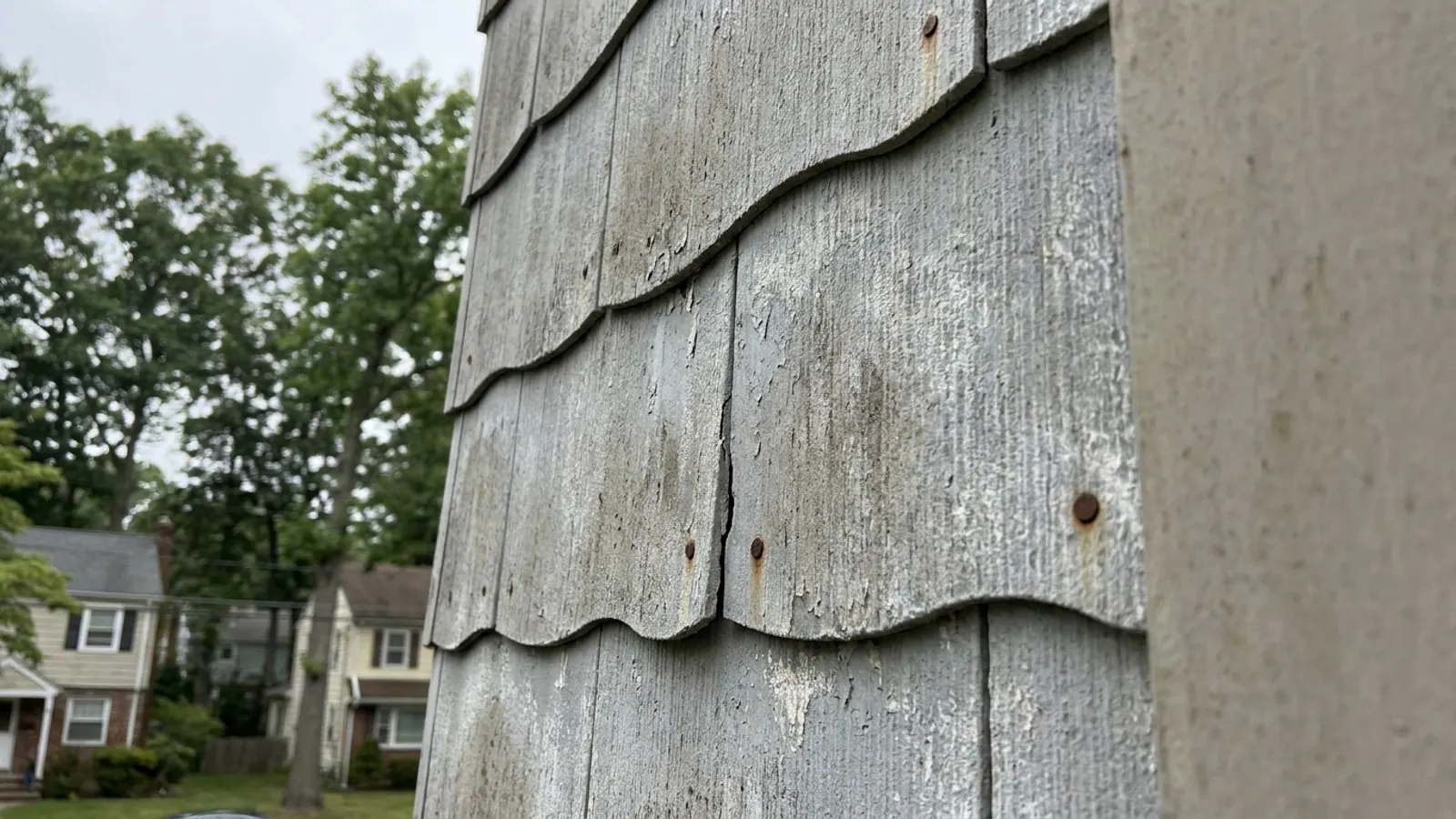
- Rigid shingles, commonly around 12 by 24 inches, that sound like stone when tapped rather than like plastic.
- A chalky gray, white or pastel surface that leaves residue on your hand.
- A wavy, notched or straight butt edge, often with a faint pressed wood grain.
- Two exposed nail heads near the top of each shingle, sometimes with a small metal clip at the bottom edge.
- Shingles that crack rather than bend, with spider cracks radiating from the nail heads.
It was installed on an enormous number of New Jersey houses built from the 1930s through the 1970s. Housing stock in older municipalities is right in that window: the median home in Passaic was built in 1938, in Camden 1950, in Clifton 1951, in Trenton 1953. If your house dates from that era and the walls are hard gray shingles, assume asbestos cement until a test says otherwise.
Do not snap a piece off to look at the edge. Breaking it is the exact activity that releases fiber. If you want a test, have a qualified sampler take it.
Why covering it is usually better than removing it
Removal means hundreds of brittle shingles pried off a wall, each one a chance to break. That work is regulated, it requires containment and disposal through a licensed abatement contractor, and it adds a cost and a schedule that have nothing to do with siding.
Covering it leaves the material where it has sat for fifty or sixty years. A furring strip fastened through a shingle into the stud behind it makes a small penetration. A pry bar across the whole wall does not.
That is the practical trade. Abatement is a specialty trade with its own license, not something a siding crew does on the side. Lightning installs siding. If your wall has to be stripped, you hire an abatement contractor for that step, and the new siding goes on after.
When you can cover it and when you cannot
| Condition of the wall | Cover it | Remove it first |
|---|---|---|
| Condition of the wallShingles intact, firmly nailed, no bulges | Cover itYes | Remove it firstNo |
| Condition of the wallA few cracked shingles, rest sound | Cover itUsually, cracked pieces stabilized in place | Remove it firstOnly if widespread |
| Condition of the wallShingles loose, missing, or crumbling at the edges | Cover itNo | Remove it firstYes |
| Condition of the wallSoft or stained sheathing behind the wall | Cover itNo | Remove it firstYes |
| Condition of the wallInterior water stains or a musty smell on an exterior wall | Cover itNo | Remove it firstYes, after the source is found |
| Condition of the wallWalls out of plane by more than furring can shim | Cover itDepends on the framing | Remove it firstOften yes |
| Condition of the wallYou are adding thick insulation board and losing window reveal | Cover itDepends on the trim detail | Remove it firstSometimes |
The row that matters most is the sheathing. Nobody can confirm what is behind the shingles from the ground. A contractor who tells you the wall is dry without opening anything is guessing. At a free inspection, that means pulling a small area in a low-visibility spot, or reading the interior evidence carefully, and saying out loud what was checked.
What a correct installation over cement shingles involves
- Inspection first. The walls are examined for loose or broken shingles, soft spots, and any sign of water entry at windows, at the roof edge and at the base of the wall.
- Broken shingles are stabilized rather than ripped out, so the wall stops shedding pieces.
- Furring strips, typically one by three, are fastened vertically into the studs through the shingles, then shimmed until the whole wall reads flat. This is the step cheap bids skip, and skipping it is why some re-sided houses look rippled from the street.
- House wrap is installed over the furring as a drainage plane, lapped correctly, shingle fashion, so water that gets behind a panel runs down and out.
- Flashing is detailed at every opening, at the roof to wall junctions, and at the bottom of the wall, with a starter strip set level.
- New siding goes on, nailed to the furring, not driven tight. Vinyl has to hang and move.
- Trim, soffit and fascia are completed, and the old wall is left sealed behind a drained, vented assembly.
Furring also creates an air space, which is why this detail performs better than siding fastened flat to the old shingles. Water that gets in has somewhere to go.
Choosing the siding that goes over it
Fiber cement and insulated vinyl both work over a furred wall. Fiber cement is heavier and needs a fastening plan that accounts for the furring depth. Insulated vinyl adds thickness, which changes how window and door trim lands, so the reveal has to be worked out before anything is ordered. Standard vinyl is the lightest load on the old wall and the most forgiving.
The siding options guide compares vinyl and fiber cement in depth, including maintenance and appearance. The one point specific to an asbestos cement wall is weight and fastener length. Everything has to reach solid framing through the furring and the old shingle, and that is a measurement, not an estimate.
What it costs in New Jersey
Siding in New Jersey runs $10,000 to $22,000 in standard-value towns, $16,000 to $38,000 in higher-value towns, and $30,000 to $70,000 for large or luxury homes. The band is set by the municipality's median home value from ACS 2024 five-year estimates. Wall area, the number of stories, trim complexity and the siding product move the number inside the band.
Abatement, if your wall needs it, is a separate contract with a separate licensed contractor and is not part of those ranges. Get that number before you commit to a siding date, because it changes the whole budget.
For a wall that can be covered, the furring and house wrap are part of the written estimate, not an extra discovered on the day. Lightning writes no change orders. The conditions that normally trigger one, including rotted sheathing and failed flashing, are found at the free inspection and priced into the quote. There is also no deposit, so nothing is due until the work is finished and you have inspected it.
What to ask before you sign
Ask these four questions and listen for specifics.
- Did you open a section of wall, or are you assuming the sheathing is dry?
- Is furring and shimming in the written scope, and what spacing?
- Is house wrap included, and how is it lapped at windows and at the roof to wall junction?
- If the old shingles have to come off, who does that, and is that price in this contract or someone else's?
A contractor who answers all four plainly is telling you how the wall will actually be built. One who says the panels go straight over the shingles is quoting a wall that will look wavy and drain nowhere.
What to do next
If your house has gray cement shingles and you are deciding what to do with them, start with an inspection of the wall, not a product catalog. Book a free, no-obligation siding estimate and a salesperson comes to the house, looks at the condition of the shingles and the sheathing behind them, and gives you a written price with the furring, wrap and flashing spelled out.
See the siding page for the materials Lightning installs, including fiber cement, insulated and standard vinyl, trim, soffit and fascia. Lightning pulls the permit and attends the municipal inspection under the New Jersey Uniform Construction Code, in all 21 counties and every one of the New Jersey municipalities served. You file nothing.