Short answer
Seamless aluminum belongs on nearly every New Jersey house. It is roll-formed in one continuous piece on site, so a long run has no joints to leak, and it holds its shape through freeze-thaw cycles and ice loads that crack and sag vinyl. Vinyl is cheaper and a homeowner can install it, which is its only real advantage on a short, low, sheltered run.
On this page
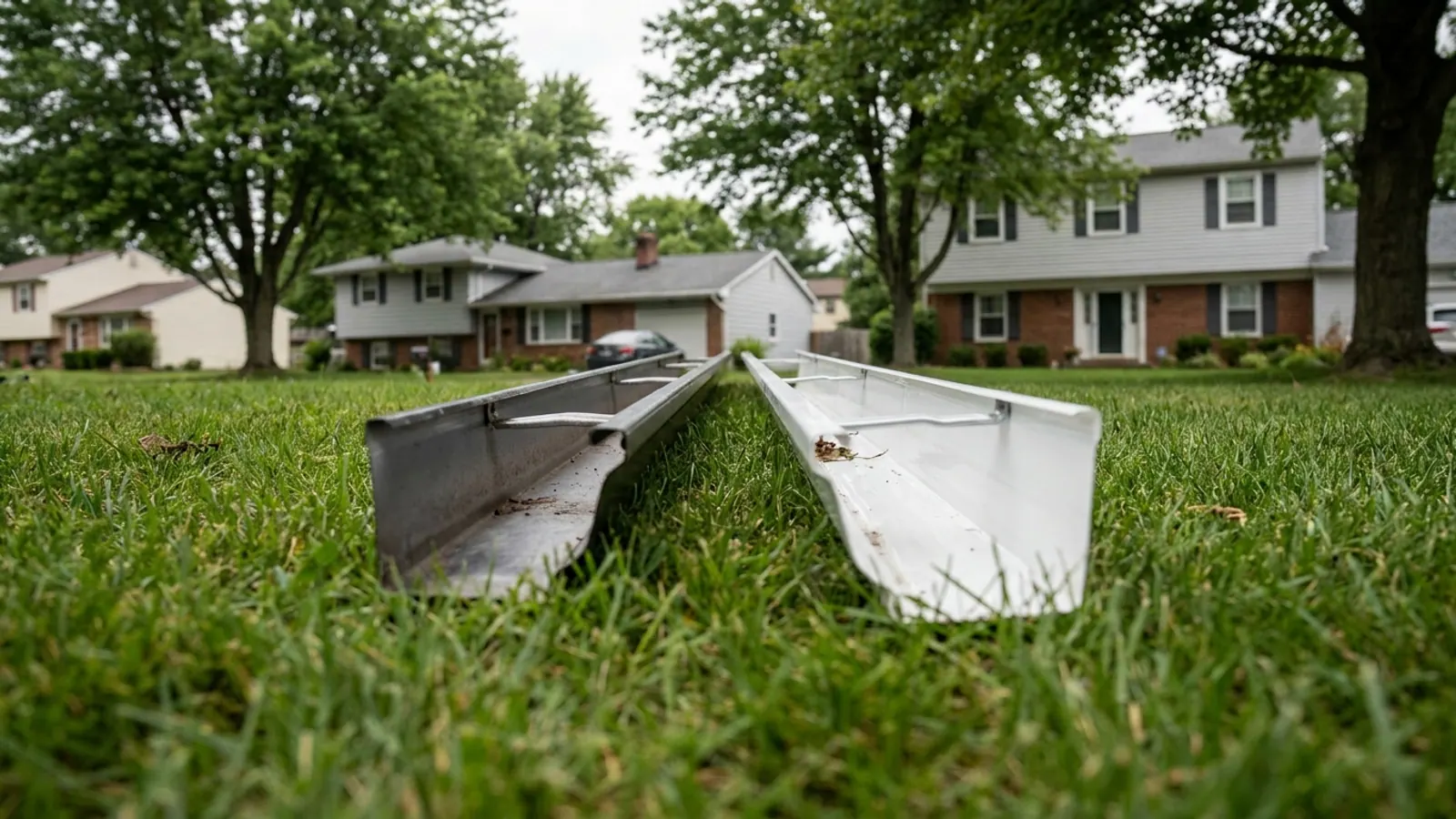
Put seamless aluminum on the house. On a New Jersey home, vinyl gutters are a short-run, low-stakes product sold in ten-foot sections at a home center, and they are joined every ten feet by a slip connector with a rubber gasket in it. Aluminum is rolled in one continuous length on your driveway, to the exact measurement of your fascia, with no joint anywhere along a straight run.
That single difference drives most of what follows. Here is what each material actually is, how they fail, and the narrow set of cases where vinyl is a defensible answer.
What vinyl gutters actually are
Vinyl gutter is extruded PVC, sold in fixed lengths with a catalog of matching parts: inside corners, outside corners, end caps, outlets, slip joints and brackets. You buy the pieces and snap them together. Each connection uses a gasket or a bead of sealant to stay watertight.
That is the appeal. No tools beyond a saw and a drill, no sheet-metal skill, no machine. For a detached garage with a sixteen-foot eave, it is a reasonable Saturday.
The problems are the joints and the material. PVC moves a lot with temperature, and a run of vinyl that was tight in March is working against its own connectors by July. The slip joints are built to allow that movement, which means they are built to not be rigid, which means they depend entirely on a gasket that is exposed to sun, grit and standing water for its whole life. Gaskets harden. Then the joint drips, usually right above a door or a walkway.
What seamless aluminum gutters actually are
Aluminum gutter starts as a coil of painted aluminum on a roll-forming machine. The crew measures the fascia, feeds the coil through, and the machine produces one continuous K-style gutter cut to that length. A forty-foot run comes off the machine as one piece. There is no joint in it at all.
The finish is baked on at the factory, not sprayed on site, and it is the same finish you see on the trim coil used for fascia wrap. Aluminum does not rust. It dents if you put a ladder against it or drop a branch on it, and a dented section can be cut out and replaced, but it does not get brittle at 20 degrees and it does not split when ice sits in it.
The seamless gutters guide covers the forming process and gutter guards in more depth. This post is about the material choice itself.
Aluminum vs. vinyl, side by side
| Vinyl (PVC) | Seamless aluminum | |
|---|---|---|
| How it is made | Vinyl (PVC)Extruded in ten-foot sections | Seamless aluminumRoll-formed on site from one coil |
| Joints on a 40-foot run | Vinyl (PVC)Three or four slip joints with gaskets | Seamless aluminumNone in the straight run |
| Cold-weather behavior | Vinyl (PVC)Gets brittle, cracks under ice load | Seamless aluminumStays ductile, dents rather than splits |
| Thermal movement | Vinyl (PVC)High; joints must be left loose to allow it | Seamless aluminumLow enough that continuous runs are standard |
| Color | Vinyl (PVC)Molded in, fades with UV, does not take paint well | Seamless aluminumBaked-on factory finish on the coil |
| Hanger support | Vinyl (PVC)Brackets, often spaced close and visible | Seamless aluminumHidden hangers screwed into the fascia or rafter tails |
| Repair | Vinyl (PVC)Swap a section, replace a gasket | Seamless aluminumCut and replace a length, re-pitch a run |
| Who installs it | Vinyl (PVC)Homeowner or handyman | Seamless aluminumContractor with a forming machine |
| Where it belongs | Vinyl (PVC)Shed, detached garage, short sheltered run | Seamless aluminumThe house |
What New Jersey weather does to each one
New Jersey runs the full cycle. Summer heat on a south-facing eave, winter nights in the teens, and a freeze-thaw pattern that happens dozens of times between December and March. Every one of those cycles is a small movement in the gutter and a small working of every joint.
Ice is the harder test. When a gutter fills with ice, the load is heavy and it is pushing outward on the walls of the trough. Aluminum deforms under that and usually comes back. PVC at low temperature does not deform much; it cracks. The crack shows up in spring as a vertical split on the outside face, or as a corner that has pulled apart.
Ice buildup at the eave is a roof and attic problem before it is a gutter problem, and replacing the gutter does not solve it. If your gutters freeze solid every winter, read the ice dams guide before you spend money at the eave.
Falling debris is the other one. Much of the state has mature oak and maple over the roofline. A branch that bounces off aluminum punches through vinyl.
How the two mount to the house
This gets overlooked and it matters as much as the trough material.
Vinyl systems hang on brackets that clip the gutter in place. The brackets are plastic, they are spaced per the manufacturer's instructions, and they are the weakest part of the run. A long vinyl gutter sags between brackets in summer heat, which creates a low spot, which holds water, which collects silt and grows mosquitoes.
Aluminum is hung with hidden hangers screwed through the back of the gutter into the fascia board or the rafter tail behind it. The hanger carries the load in metal, not plastic, and the screw gives it real pull-out strength. If the fascia itself is soft, the hanger has nothing to bite, and that is a fascia repair, not a gutter choice.
Pitch is the other install difference. An aluminum run is set with a deliberate slope toward the outlet, usually a small, consistent fall across the whole length. A sectional vinyl run gets whatever slope the brackets were set to, and the joints make it harder to keep consistent.
When vinyl is the honest answer
There are cases, and they are real:
- A shed or detached outbuilding where the run is short, the roof area is small and nobody will notice a drip.
- A low, sheltered porch with no trees over it and easy ladder access for a homeowner who wants to do it themselves.
- A temporary fix on a structure you plan to tear down or re-roof within a year or two.
What vinyl is not is a way to save money on the house. The gutter material is a modest share of a gutter job. Measuring, hanger spacing, pitch, corner fabrication, downspout placement and tying the run to the roof edge are where the labor is, and none of that gets cheaper because the trough is plastic.
What gutters cost in New Jersey
Lightning Construction's gutter work runs $1,200 to $3,500 in standard-value towns, $2,500 to $6,500 in higher-value towns, and $4,000 to $12,000 for large or luxury homes. The band comes from the municipality's median home value in the ACS 2024 five-year estimates, not from the material you pick. Total linear footage, the number of corners, the number of stories, downspout count and whether guards are included move the number far more than aluminum versus vinyl ever will.
The written estimate from Lightning is the final price. There is no deposit, and nothing is due until the work is finished and you have inspected it. The inspection and the written estimate are free with no obligation, and a salesperson does come to the house for it.
What to ask for in writing
Before you sign anything for gutters, get these on the page:
- Material and gauge of the aluminum coil, and the finish color.
- Total linear feet of gutter and the number of downspouts, with where each one discharges.
- Hanger type and spacing.
- Whether the existing fascia is being repaired or wrapped, and whether gutter apron or drip edge is included at the roof edge.
- Whether guards are included, and which type.
Once they are up, the maintenance is simple and seasonal; the gutter maintenance guide lays out what to check and when.
Next step
If your gutters are leaking at every joint, sagging between brackets or split from last winter, the material under them is usually the reason. See what Lightning Construction installs on the gutters page, or book a free estimate and get the run measured, the pitch checked and a written price for the whole thing.