Short answer
A partial approval means your carrier agreed to pay for storm damage it documented on some slopes and declined the rest, so the money on the table only covers part of the roof. You can accept it, ask for a supplement with better documentation, use the appraisal clause in your policy, or pay the difference yourself and replace the whole roof at once. Which choice makes sense depends on how old the shingles are and whether new shingles will visibly match what stays up there.
On this page
- Why an adjuster approves one slope and denies the others
- What a partial roof replacement looks like on the house
- Your four options after a partial approval
- Partial versus whole roof, side by side
- What actually gets a scope reopened
- If you decide to finish the whole roof
- What to get in writing before work starts
- What to do next
A partial approval means the adjuster wrote a scope for the damage he photographed and documented, and nothing else. If he was on the back slope and found hail bruising there but not on the front, your estimate covers the back slope. That is not a verdict on the condition of the rest of your roof. It is a record of what one person found on one visit, in whatever light and weather he had that day.
What happens next is your decision, and you have more than two options. Here is how partial approvals actually work in New Jersey and what each path costs you.
Why an adjuster approves one slope and denies the others
Storm damage really is directional. Wind comes from one side, hail comes in at an angle, and it is normal for a west-facing slope to be beaten up while the east slope looks untouched. A partial scope is often an honest reading of the roof.
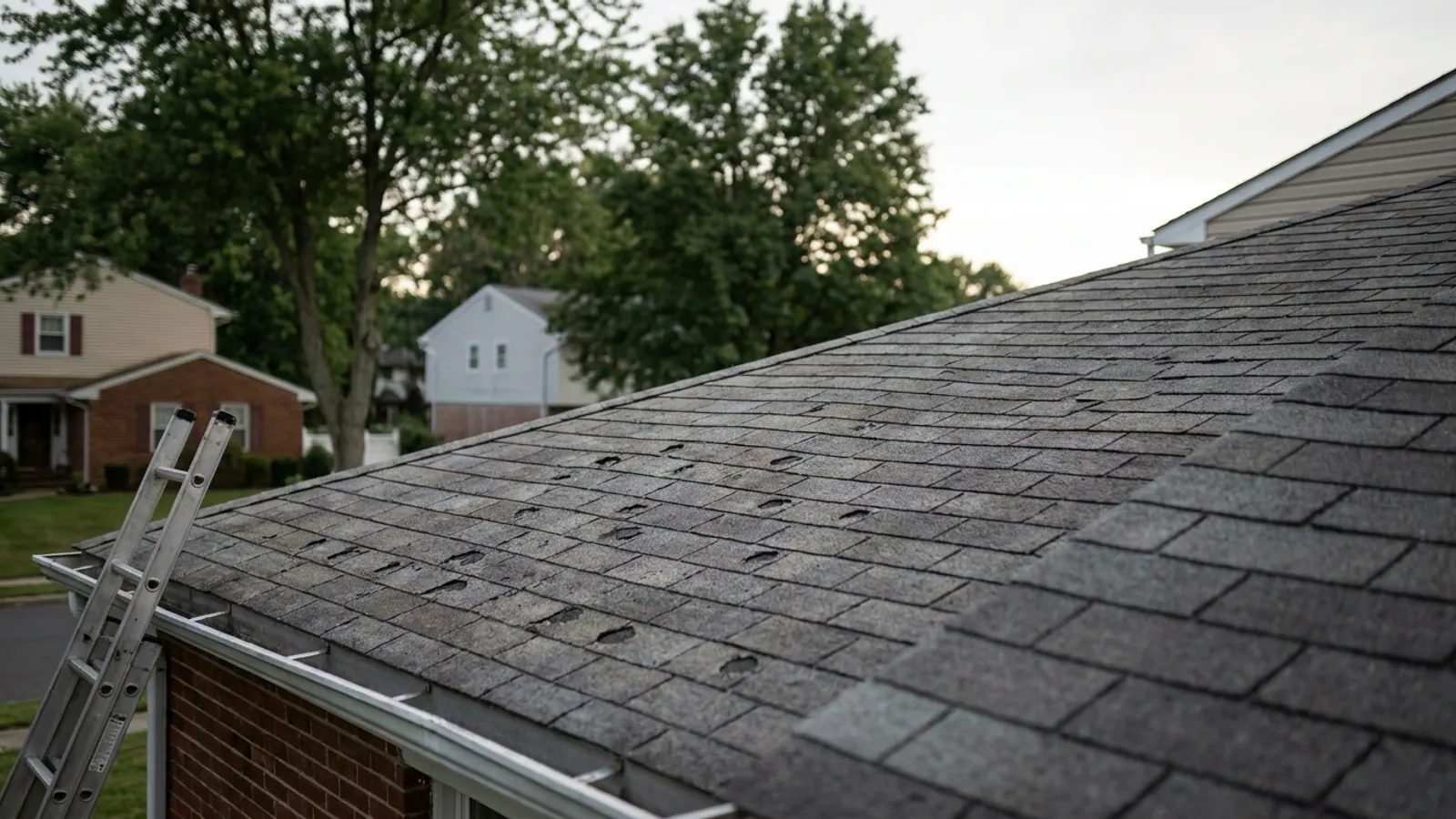
It can also be a documentation problem. Adjusters commonly test a 10-foot-by-10-foot square per slope and count hits inside it. Miss the concentrated area by a few feet and the slope fails the test. Soft metals like gutters, downspouts, vents and flashing get checked too, because dents there corroborate hail that is harder to see on asphalt. If the adjuster did not get on the roof at all, or only looked from a ladder at the eaves, the denial on the other slopes may simply reflect that nobody looked hard.
The other common reason is age. Carriers treat granule loss, curling and brittleness on an old roof as wear rather than storm damage, and they are often right. A 22-year-old roof with one damaged slope is a different conversation than an 8-year-old roof with one damaged slope.
What a partial roof replacement looks like on the house
This is the part homeowners underestimate. A partial replacement is a real construction sequence, not a patch.
The crew strips the approved slope to the decking, replaces anything soft or broken, installs new underlayment, new drip edge, new step flashing where that slope meets a wall or a chimney, and new shingles. Then it has to be tied into what stays. At the ridge, the new shingles have to be woven or capped into the old course. In a valley, the new slope meets an old slope inside the valley itself, which is the single most leak-prone junction on a roof and the reason flashing detail matters more on a partial than on a full tear-off.
The matching problem
New shingles will not match old ones. Color lines get discontinued. Production blends drift. Most of all, the existing roof has been weathering for years, so even the same product out of the same plant looks brighter and darker next to it. On a rear slope nobody sees from the road, that is fine. On a front-facing plane split down the middle, it is obvious for the life of the roof.
Whether your carrier owes anything for matching is a policy-language question, not a general rule. Pull your declarations page and your policy form, and ask the carrier in writing what the policy says about matching undamaged surfaces. Get the response in writing too.
The seam between new and old
A partial stops somewhere. The best place to stop is at a ridge, a hip or a valley, where there is already a natural break in the plane. The worst place is mid-slope, because the transition course sits over old shingles that have lost their seal and will not lay flat against the new ones. If your approved scope draws the line mid-slope, that is worth pushing back on before anyone orders material.
Your four options after a partial approval
- Accept the scope and do the partial. Reasonable when the damaged area is a separate plane, the roof is relatively young, and the new section will not be staring at the street.
- Request a supplement. Your contractor documents what the scope missed and submits photos, measurements and code items to the adjuster. This is normal claims practice, not a fight.
- Invoke appraisal. Most homeowner policies include an appraisal clause for disputes about the amount of loss. Each side hires an appraiser, the two pick an umpire, and their decision sets the number. Read your own policy for how it works and what it costs you.
- Pay the difference and replace the whole roof. The approved money goes toward the job and you cover the balance. One mobilization, one permit, one roof, one color.
Partial versus whole roof, side by side
| Partial replacement | Full replacement | |
|---|---|---|
| Out of pocket | Partial replacementDeductible only, in most cases | Full replacementDeductible plus the difference |
| Appearance | Partial replacementVisible color and wear mismatch | Full replacementUniform across every slope |
| Old flashing and decking | Partial replacementStays on the untouched slopes | Full replacementAll of it inspected and addressed |
| Manufacturer system coverage | Partial replacementGenerally does not qualify | Full replacementEligible when the full system is installed |
| Future claim on another slope | Partial replacementSeparate claim, separate deductible | Full replacementNot applicable |
| Time on site | Partial replacementUsually under a day | Full replacementMost asphalt roofs, a single day |
What actually gets a scope reopened
More photographs, taken closer, with something for scale, and tied to a specific slope and elevation. A chalk-free test square with hits circled. Soft-metal damage on gutters, vents and flashing on the slopes that were denied. Measurements that show the adjuster's square footage is short. Code items that apply to the work being done, like ice and water shield at the eaves and a proper starter course, which the scope sometimes omits.
What does not get a scope reopened is arguing over the phone. Submit documents. The New Jersey roof insurance claim guide walks through the filing sequence, and the storm damage guide covers what to photograph and when.
Be careful who you let handle this. A contractor who offers to cover your deductible is offering to commit insurance fraud with your name on the paperwork. Walk away from that.
If you decide to finish the whole roof
Get the full replacement priced as its own number so you can see exactly what you are adding. Most New Jersey asphalt roof replacements run $9,000 to $22,000 in standard-value towns, $14,000 to $35,000 in higher-value towns, and $25,000 to $60,000 on large or luxury homes. The band comes from the municipality's median home value in the ACS 2024 five-year estimates, not from your claim. Roof size, pitch, valleys, penetrations and how many shingle layers are already up there move the total far more than anything in the adjuster's report.
Financing is available through GreenSky and FTL, including 24 months at 0% interest and 120-month terms with no prepayment penalty, if the gap between the approved amount and the whole roof is the thing holding you up.
What to get in writing before work starts
The exact slopes and square footage being replaced. Where the new work stops and why. The shingle line and color. Whether flashing is new or reused. What happens if the deck under the approved slope turns out to be rotted.
At Lightning Construction, those last two are settled at the free inspection. Extra shingle layers, bad decking and unusable flashing are found and priced into the written estimate, so there is no change order on the day and no phone call from a foreman standing on your stripped roof. There is no deposit either. Nothing is due until the work is finished and you have inspected it. Lightning pulls the permit and attends the municipal inspection under the New Jersey Uniform Construction Code, on a partial slope or a whole roof, and the permit guide explains what that inspection covers.
What to do next
Get a second set of eyes on the roof before you sign the carrier's release. A free inspection and written estimate takes an hour, comes with photographs you can send to the adjuster, and costs you nothing — a salesperson does come to the house, and there is no obligation. Bring the adjuster's scope with you so the numbers can be compared line by line.
Schedule the free inspection and decide with real information instead of one photo set taken from a ladder.