Short answer
Two downspouts are not enough when a single outlet has to drain more roof than it can carry, which shows up as water spilling over the gutter front in heavy rain even though the gutter is clean. The common trade rule is one downspout for every 30 to 40 feet of gutter and roughly 600 square feet of roof for a 2x3-inch outlet. If your longest run is over 40 feet, or one run collects a valley or an upper roof discharge, add an outlet rather than replacing the whole gutter.
On this page
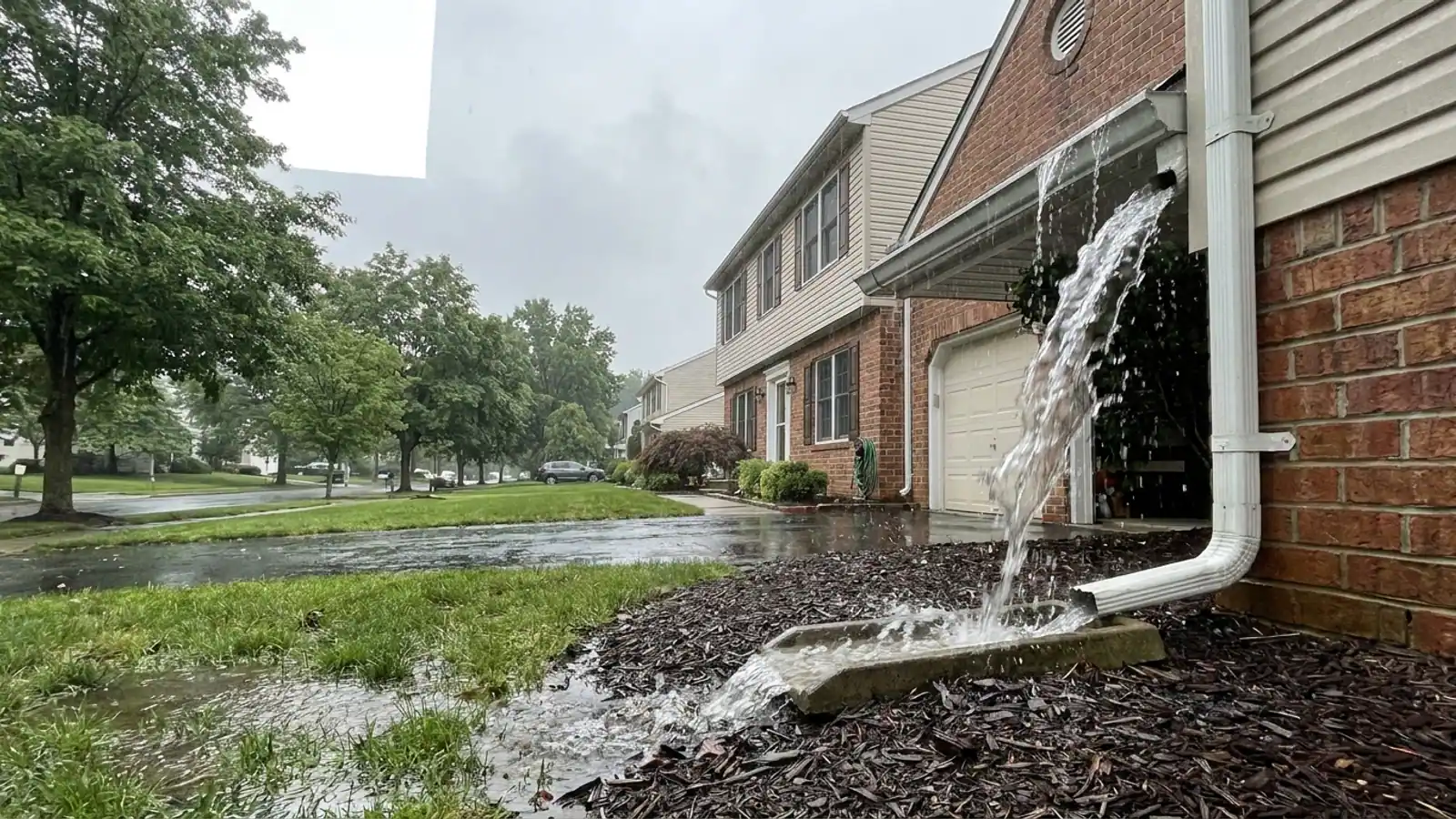
Two downspouts are not enough when one of them is draining more roof than it can physically carry. The sign is simple: the gutter is clean, the downspout is flowing hard, and water still pours over the front lip of the trough in a heavy rain. That is a capacity problem, and the fix is another outlet, not a bigger gutter and not a gutter guard.
Most New Jersey houses were built with the minimum number of downspouts the builder could get away with. A 1960s colonial with a 45-foot front run and one corner downspout looked fine on the plan and has been overflowing onto the mulch bed for sixty years.
How many downspouts a gutter run actually needs
The number comes from two things: the length of the gutter run and the square footage of roof draining into it.
The working rule in the trade is one downspout for every 30 to 40 feet of gutter. Past 40 feet, water at the far end of the run has to travel too far before it finds an exit, and the trough fills faster than the single outlet can empty it.
The second limit is roof area. An outlet only moves so much water per minute.
| Outlet size | Typical roof area served | Where it fits |
|---|---|---|
| Outlet size2x3-inch downspout | Typical roof area servedRoughly 600 square feet | Where it fitsStandard 5-inch K-style gutter on a simple run |
| Outlet size3x4-inch downspout | Typical roof area servedRoughly twice that | Where it fits6-inch gutter, steep roofs, long runs, valley discharge |
Use those as planning numbers, not as law. Roof pitch changes them. A steep roof throws water into the gutter faster than a low-slope roof of the same footprint, so a steep 10/12 plane behaves like a larger roof than its square footage suggests. Rainfall intensity matters too, and New Jersey summer downpours and tail-end tropical systems produce short bursts well above the average storm.
The runs that need an extra outlet most often
- Any gutter run longer than 40 feet with a downspout at one end only.
- A run that catches a roof valley. A valley funnels two planes into a few feet of gutter, and that section takes a disproportionate share of the water.
- A run below an upper roof that discharges onto it. The lower gutter is then draining its own roof plus everything the upper roof collects.
- Porch and addition roofs tied into a main run.
- Long back runs on a raised ranch or a split level, where the builder put outlets on the front elevation for looks and left the back short.
Signs two downspouts are not enough
Check these during rain, not on a dry day. A gutter tells you nothing when it is empty.
- Water sheets over the front edge of the gutter in the middle of a long run while both ends look fine.
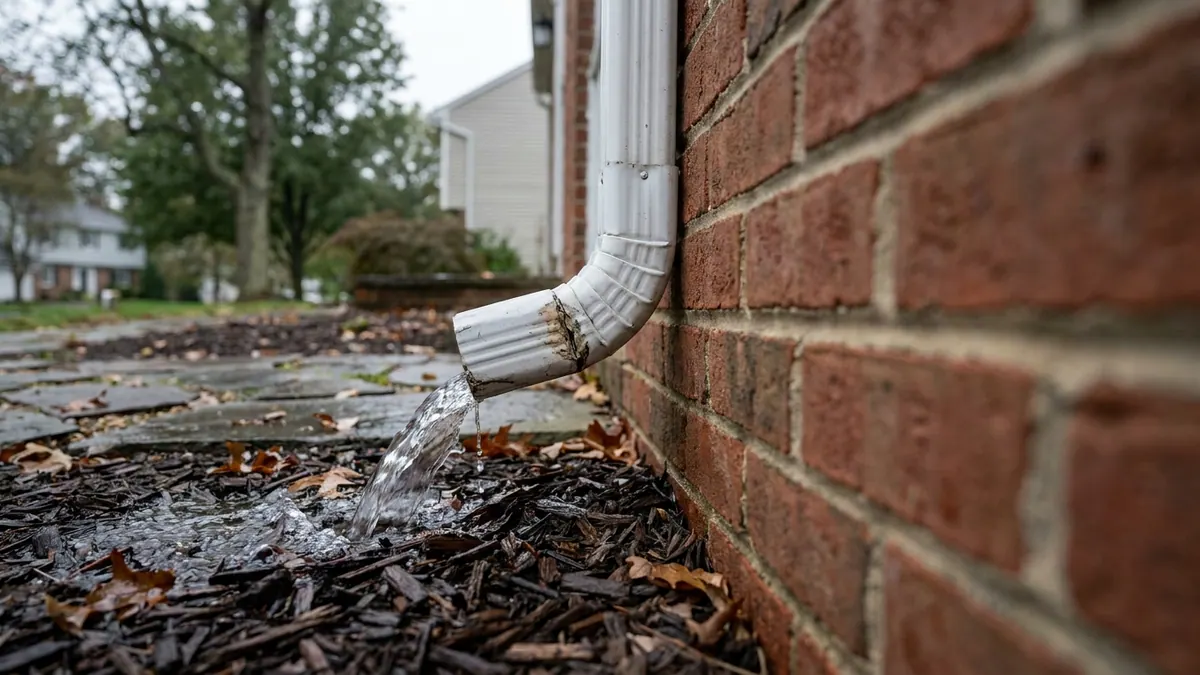
- A trench or a washed-out line in the mulch under one section of gutter.
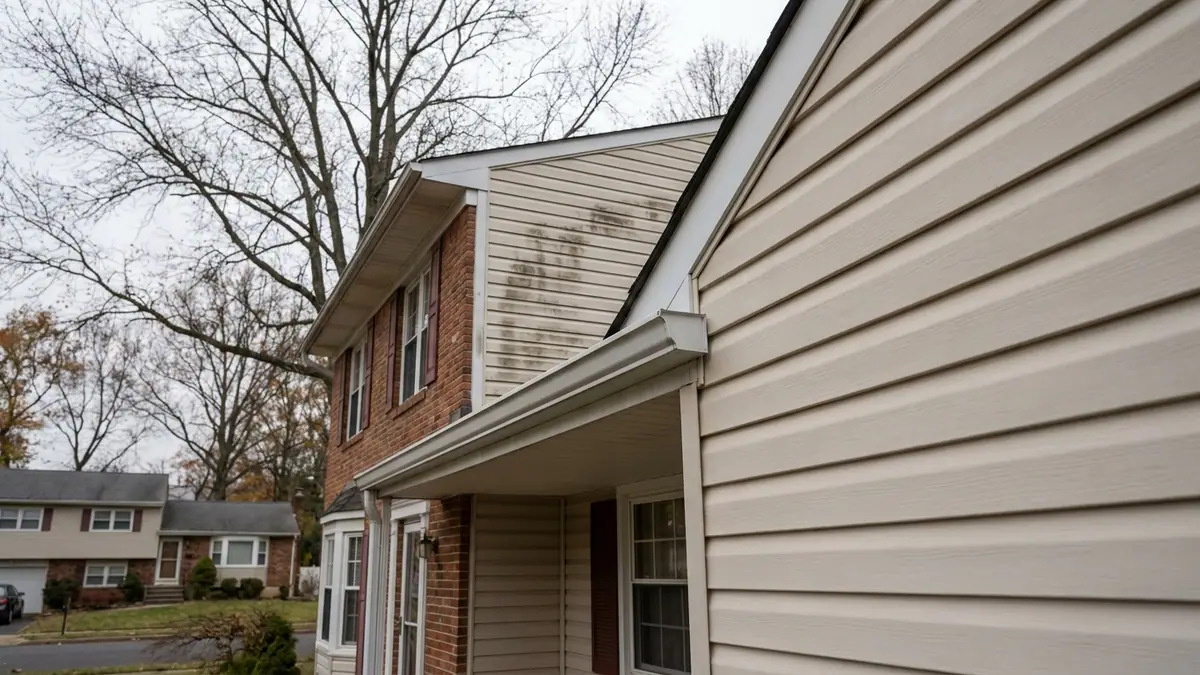
- Splash staining on siding below the gutter line, usually a dirty band a foot or two up from the ground.
- Soil pulled back from the foundation, or a basement that only takes water during heavy storms and not during steady rain.
- Fascia and soffit rot concentrated in one stretch of the roof edge, which is where overflow has been running behind the gutter for years.
- Ice buildup at one spot every winter, because slow drainage leaves standing water that freezes.
If you see overflow at the corners only, that is a pitch problem or a clogged outlet, not a capacity problem. Our gutter maintenance guide covers the seasonal side of that and is worth reading before you decide anything.
Where the new downspout should go
The new outlet goes at the high point of the excess, not wherever the wall is easiest.
On a long straight run with one downspout at the right corner, the second one goes at the left corner and the gutter gets re-pitched to crown in the middle, so each half drains its own way. That splits the run into two shorter sections and cuts the travel distance roughly in half.
Where a valley dumps into the middle of a run, the outlet goes close to the valley. Water leaving a valley moves fast and carries debris, and getting it out of the trough quickly keeps the rest of the run working.
A few practical limits on placement:
- Downspouts follow a corner board, a trim line or a window edge so they read as part of the house instead of a pipe stuck to a wall.
- They cannot cross a door head or land in a walkway where the discharge will ice over.
- They should not discharge onto a lower roof without a splash guard, because concentrated water strips granules off shingles in one spot.
- The discharge end needs a splash block or an extension carrying water well away from the foundation, and grade should fall away from the house.
Adding an outlet vs. replacing the gutter
Adding a downspout is the smaller job, and it is usually the right one. The crew cuts an outlet in the bottom of the existing trough, fits the outlet tube, runs elbows and pipe down the wall, and straps it to the siding. The existing gutter stays.
That only works if the gutter itself is worth keeping. If the trough is sectional with leaking seams, pitched wrong, hung on spikes that have backed out, or bent from a ladder or ice, a new outlet will not fix any of that. At that point seamless aluminum in the correct size is the honest answer, and the seamless gutters guide explains how those are rolled on site to the length of the run.
The same call comes up at a roof replacement. If the gutters are coming off anyway to install new drip edge, that is the moment to add outlets and correct the pitch, because the labor is already on the ladder.
What it costs and what to get in writing
Complete gutter work in New Jersey runs $1,200 to $3,500 in standard-value towns, $2,500 to $6,500 in higher-value towns, and $4,000 to $12,000 for large or luxury homes. The band is set by the municipality's median home value from ACS 2024 five-year estimates. Adding one or two downspouts to an existing system is a far smaller scope than a full replacement, and the number belongs on a written estimate rather than in a phone quote.
What should be on that estimate:
- The number of new downspouts and exactly which elevations they go on.
- Outlet and downspout size, 2x3 or 3x4.
- The color, and whether it matches the existing gutter.
- Whether the run is being re-pitched as part of the work.
- What happens at the discharge end, including splash blocks or extensions.
Lightning Construction takes no deposit, and nothing is due until the work is finished and you have inspected it. There are no change orders, because what the work actually requires is identified at the free inspection and priced into the quote. The inspection and the written estimate are free with no obligation, and a salesperson does come to the house.
As one customer put it: "One day to tear off, another to finish and add gutters. Highly recommend."
What to do next
Watch your gutters in the next real rain and note which section overflows. Measure the runs. If one is past 40 feet with a single outlet, or if one run is taking a valley or an upper roof discharge, you have your answer before anyone gets on a ladder.
Then book a free inspection. Lightning covers all 21 New Jersey counties and 544 municipalities, is licensed and insured under New Jersey Home Improvement Contractor registration 13VH12437000, and is rated 4.9 out of 5 from 264 Google reviews. See the gutters page for what the work includes, or request a free estimate and get the runs measured properly.