Short answer
Roof first, then siding, with gutters handled as part of the roof work. The order follows how the materials overlap: siding tucks under the roof edge and behind flashing, so replacing siding first means cutting into new work later. If everything is failing at once, doing it together costs less than doing it in sequence.
On this page
When a house needs a roof and siding and gutters, the sequence is not a matter of preference. These three systems physically overlap, and the overlaps only work in one direction.
The short version
Roof first. Gutters with the roof. Siding after.
If the budget allows all of it at once, do it at once. If it does not, follow that order and start with whatever is actively letting water in.
Why the roof goes first
At every point where siding meets the roof — a gable end, a dormer cheek, the wall a lower roof runs into — the siding stops short and something else takes over. Step flashing runs up the wall behind the siding and out over the shingles. Counterflashing laps over it. The siding covers the top of that assembly.
That stack only assembles in one order. To install step flashing correctly, the siding at that wall has to be off or lifted. So:
- Roof first, siding later means the flashing is installed properly and the new siding is then brought down over it. Clean, and the way the detail is designed to work.
- Siding first, roof later means the roofer arrives at a wall covered in new siding that has to be cut into, lifted or worked around to get flashing where it belongs. Best case the work is more awkward and more expensive. Common case the flashing gets surface-sealed instead of properly interlaced, which is precisely the shortcut that leaks in five years.
There is a second reason, and it is simpler. A roof tear-off is a demolition. Old shingles, nails and torn underlayment go over the edge into a dumpster, and material moves up and down ladders leaned near the walls. Doing that around new siding is asking for damage to something you just paid for.
Why gutters belong to the roof job
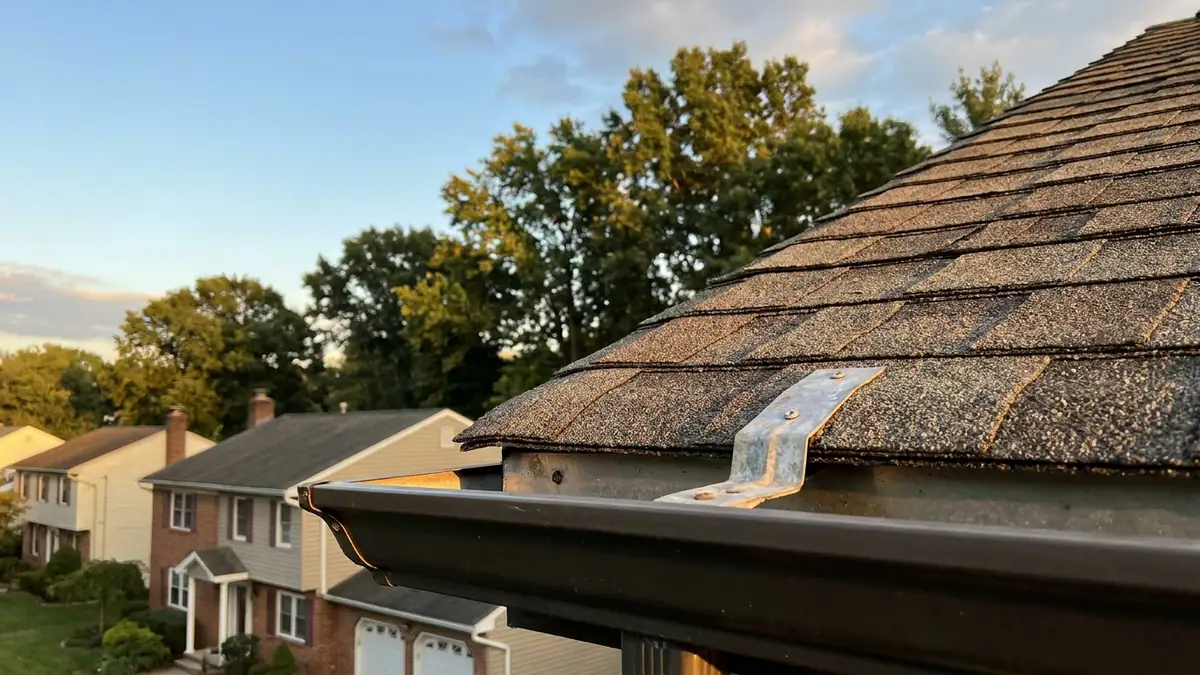
Gutters attach to the fascia, immediately below the roof edge, and they interact with the drip edge — the metal that runs along the eave and directs water off the deck and into the gutter rather than behind it.
Water getting behind a gutter, rather than over the front of it, is one of the most destructive things that can happen to a roof edge, and it usually traces back to a drip edge and gutter that were never installed as one detail. They can only be installed as one detail if the same crew does them at the same time, with the roof edge open.
There is also a practical argument. If the gutters are coming off anyway to do the roof, most of the labor of replacing them has already been spent. Doing it in one visit avoids paying for that setup twice, which is why gutters are frequently added to a roof job even when they had a couple of years left in them. One of the reviews on the site describes exactly that: one day to tear off, another to finish and add gutters.
Why siding goes last
Beyond the flashing, siding is the most vulnerable of the three to being damaged by the others. It covers the largest area, it sits where ladders lean, and both roof and gutter work happen directly above it.
It is also the one where you are most likely to notice damage. A scuffed shingle in the middle of a roof plane is invisible from the ground. A cracked panel at eye level next to the front door is not.
What "all at once" actually saves
If everything genuinely needs doing, doing it together is cheaper than doing it in sequence, for reasons that are all about setup rather than materials.
- One mobilization. Crew, equipment, dumpster, protection of the landscaping — paid for once instead of three times.
- One permit process rather than separate trips through the municipality's construction office.
- Transitions built as one detail. The roof-to-wall flashing, the drip edge and the gutter, and the siding termination all get built by people who are looking at each other's work.
- One disruption. Most asphalt roof replacements are finished in a single day; adding gutters and siding extends it, but far less than three separate projects would.
- One accountability. When one contractor did all three, there is no argument about whose work the leak came through.
When to break the order
The order assumes everything is equally urgent. It usually is not.
Active water entry wins. A roof that is leaking now gets fixed now, regardless of what else is on the list. Water in the structure gets more expensive every week.
Storm damage gets documented before anything. If a storm hit the house, photograph everything before any repair, including all three systems. Claims are settled on evidence, and work done first is hard to include afterward. The storm damage guide covers what to record and in what order, and the insurance claim guide covers the claim itself.
Rot gets chased to its source. A rotted fascia board is usually a gutter problem, and rotted sheathing behind siding is usually a flashing or window problem. Replacing the visible damaged part without fixing what wet it just resets the clock.
Paying for more than one at a time
The reason people sequence work over several years is normally money rather than sequencing theory. Lightning offers financing through GreenSky and FTL, including 24 months at 0% interest and 120-month terms with no prepayment penalty, which is what makes doing the whole envelope in one project realistic for a lot of households. How financing works on a project like this is covered in the financing guide.
There is no deposit on any Lightning job. Nothing is due until the work is finished and you have inspected it, and because there are no change orders, the written estimate is the final price — which matters a great deal more on a three-system project than on a single one.
Lightning Construction is a veteran-owned roofing, metal roofing, siding and gutter contractor working across all 21 New Jersey counties and 544 municipalities, rated 4.9 out of 5 from 264 Google reviews. If you are not sure how much of the list is actually urgent, that is a reasonable thing to have someone look at. The inspection and the written estimate are free with no obligation — request a free estimate.