
Short answer
After a New Jersey storm you can check most of what matters from the ground with a phone camera and no ladder. Walk the full perimeter and look at the gutters, the roof edge, the siding on the windward wall, and the ground for granules and torn shingle pieces. Anything you find down there is a reason to get someone on the roof, not a diagnosis by itself.
On this page
Do this the morning after, not during. Wind and wet decking are how people get hurt, and nothing you find at 11pm in a downpour changes what happens next. Wait for daylight, take your phone, and walk the whole perimeter of the house slowly. Every check below is done from the ground, from a window, or from inside your attic.
This is the walkaround, not the claim. If you already know you have damage and you are deciding what to do about insurance, the storm damage guide covers documentation, adjusters and sequencing in depth.
Start with the ground, not the roof
What falls off a roof tells you more than squinting at the roof does.
Walk the drip line all the way around the house and look down. You are checking for four things.
Shingle granules. A gritty black or gray sand collecting at the base of downspouts and along the driveway edge. Some granule loss is normal on any asphalt roof, especially a new one. Piles of it after one storm mean the mat underneath is getting exposed.
Shingle pieces. Tabs, corners, or whole shingles in the yard or the neighbor's. Pick them up and keep them. They tell an inspector the age and line of the shingle, and where on the roof it likely came from.
Metal. Bent aluminum, a length of drip edge, a piece of step flashing, a ridge vent cap. Loose metal in the yard is the single most useful thing you can find, because flashing that is off the roof is not keeping water out of anything.
Fasteners and wood. Nails, roofing nails with a washer of shingle still on them, or splintered fascia. Also note branches that came down and whether any of them hit the roof plane on the way.
Check the gutters and the roof edge from the ground
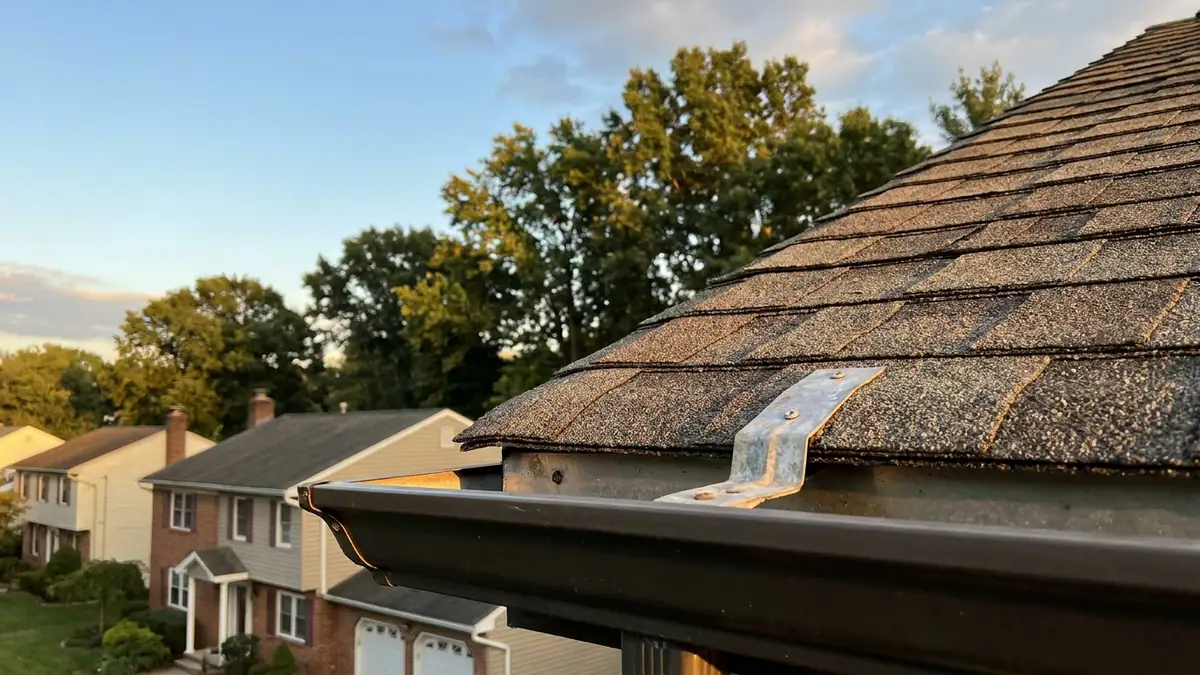
Stand back about thirty feet at each corner of the house and look along the gutter line with the sky behind it. You are looking for a line that is no longer straight.
- A gutter that sags in the middle is holding water, debris, or both.
- A gutter pulled away at one end has lost a hanger or has rotted fascia behind it.
- A downspout separated at an elbow is dumping the entire run next to your foundation.
- Water stains streaking down the fascia mean the gutter overflowed at that spot.
Then look at the very edge of the roof. Shingles at the eave should sit flat and overhang the gutter slightly. Curled, lifted, or dark-edged shingles at the rake and eave are the first place wind gets under a roof, because that is where the pressure is highest.
If the storm proved your drainage cannot keep up, the fix is usually capacity or pitch, not a bigger repair. Seamless aluminum, guards, downspouts and re-pitching are all handled under gutter work, and the seasonal cleaning routine is in the gutter maintenance guide.
Look hard at the wall the wind hit
One wall took most of the weather. In New Jersey that is usually the west or northwest elevation for a summer thunderstorm line, and the east or northeast wall for a coastal system. Start there.
On vinyl siding, run your eye across each course. Wind damage shows up as panels unzipped from the course above, panels cracked at a nail hem, or a whole run pushed out at one end. Hail shows up as small punctures or chalky bright spots, most visible in low sun.
On fiber cement, look for cracked butt joints and chipped edges where something struck it.
On any siding, press on the wall below a window and beside a door. Soft, spongy, or hollow-sounding sheathing means water is behind the siding and has been for a while. That is not a storm problem, but the storm is how you found it. Material options and what each one tolerates are covered in the siding guide.
Also check the soffit panels under the eave. Wind lifts soffit out of its channel regularly, and an open soffit lets the next storm blow rain directly into the attic and the wall cavity.
Go inside and look up
This is the part most people skip, and it is where a small roof problem gets caught before it becomes a decking problem.
Take a flashlight into the attic and look at the underside of the roof deck. You want to see clean, uniform wood. Dark streaks, damp plywood, matted insulation, or daylight where there should not be any all mean water came in. Look especially around chimneys, plumbing vents, skylights, and where a lower roof meets a wall.
Then walk the top floor and look at the ceilings, particularly in closets and corners where nobody looks. A fresh stain is soft and has a defined edge. Photograph it with the date visible on your phone.
What you found, and how fast it matters
| What you see | What it usually means | Urgency |
|---|---|---|
| What you seeGranule piles at downspouts | What it usually meansShingle surface wearing or aging | UrgencyInspect, not urgent |
| What you seeWhole shingles in the yard | What it usually meansWind uplift; the deck may be exposed | UrgencyCall within days |
| What you seeFlashing or drip edge on the ground | What it usually meansAn open seam at a wall, valley or chimney | UrgencyCall now |
| What you seeGutter sagging or pulled off | What it usually meansHanger failure or rotted fascia behind it | UrgencyCall within weeks |
| What you seeSoffit panel hanging loose | What it usually meansOpen path into the attic and wall | UrgencyCall now |
| What you seeWet attic sheathing or a fresh ceiling stain | What it usually meansActive leak | UrgencyCall now |
| What you seeCracked or unzipped siding panels | What it usually meansWind or impact damage | UrgencyCall within weeks |
| What you seeChalky spots and small punctures on siding | What it usually meansPossible hail | UrgencyDocument, then inspect |
The honest version of this list is that most of what a homeowner finds after one storm is a repair, not a replacement. A roof that lost six shingles in a straight line does not need to be torn off. A roof that lost shingles in four separate places, has granule piles at every downspout, and is at the back end of its life is a different conversation. The signs you need a new roof guide lays out where that line sits.
Do this before anyone climbs a ladder
- Photograph everything, wide first, then close. Include the whole elevation of the house in at least one shot per side, so the location of each close-up is obvious later.
- Bag the physical pieces you picked up. Shingle tabs, flashing, siding panels.
- Write down the date and roughly when the storm hit. Note hail if you saw or heard it.
- Tarp nothing yourself if it means getting on the roof. If water is actively coming in, put a bucket under it and move what is below out of the way.
- Get an inspection from a contractor who will photograph the roof and show you the pictures.
Be careful with anyone who knocks on the door the day after a storm and offers to get on the roof immediately. Ask for a New Jersey Home Improvement Contractor registration number and check that it is on the written estimate. Lightning's is 13VH12437000.
What happens when you call
A salesperson comes to the house. It is free, it is genuinely no-obligation, and it is also a sales appointment; all of that is true at the same time. The roof gets walked, the flashing points, the roof edge, the gutters and the attic all get looked at, and you see the photos.
If the answer is a repair, that is what you get told. If it is a replacement, the written estimate is the final price. Extra shingle layers, rotted decking and unusable flashing are found at that inspection and priced in, so there is no change order on the day. Lightning pulls the permit from your municipality's construction office under the New Jersey Uniform Construction Code and attends the inspection. Most asphalt roof replacements are torn off and finished in a single day; standing-seam metal takes two to four. Nothing is due until the work is done and you have inspected it, and emergency response is available around the clock.
When you have your photos and your list, book the free inspection. Bring the pieces you picked up off the lawn.