Short answer
Almost every bay window leak starts at the flashing where the small hood roof meets the house wall, not in the shingles on the hood itself. That joint is short, often low-slope, and on a lot of New Jersey houses it was finished with caulk or a surface-mounted strip instead of step flashing woven in behind the siding. A real fix means opening the siding above the roof, installing step and counter flashing correctly, and rebuilding the roof edge.
On this page
The roof over a bay window or a bump-out is the most leak-prone square footage on most New Jersey houses. It is small, it sits directly against a wall, and it has more flashing per square foot than any other part of the roof. When water shows up on the window trim or in a stain running down the drywall below it, the shingles on that little hood are almost never the problem. The joint where the hood dies into the siding is.
Here is what actually fails up there, how to tell it apart from the other things that stain a wall in the same place, and what a repair that lasts looks like.
Why bay window and bump-out roofs leak more than the main roof
The main roof is mostly field. Big planes of shingles, few interruptions, water running straight down into a gutter. A bay hood is almost all edges.
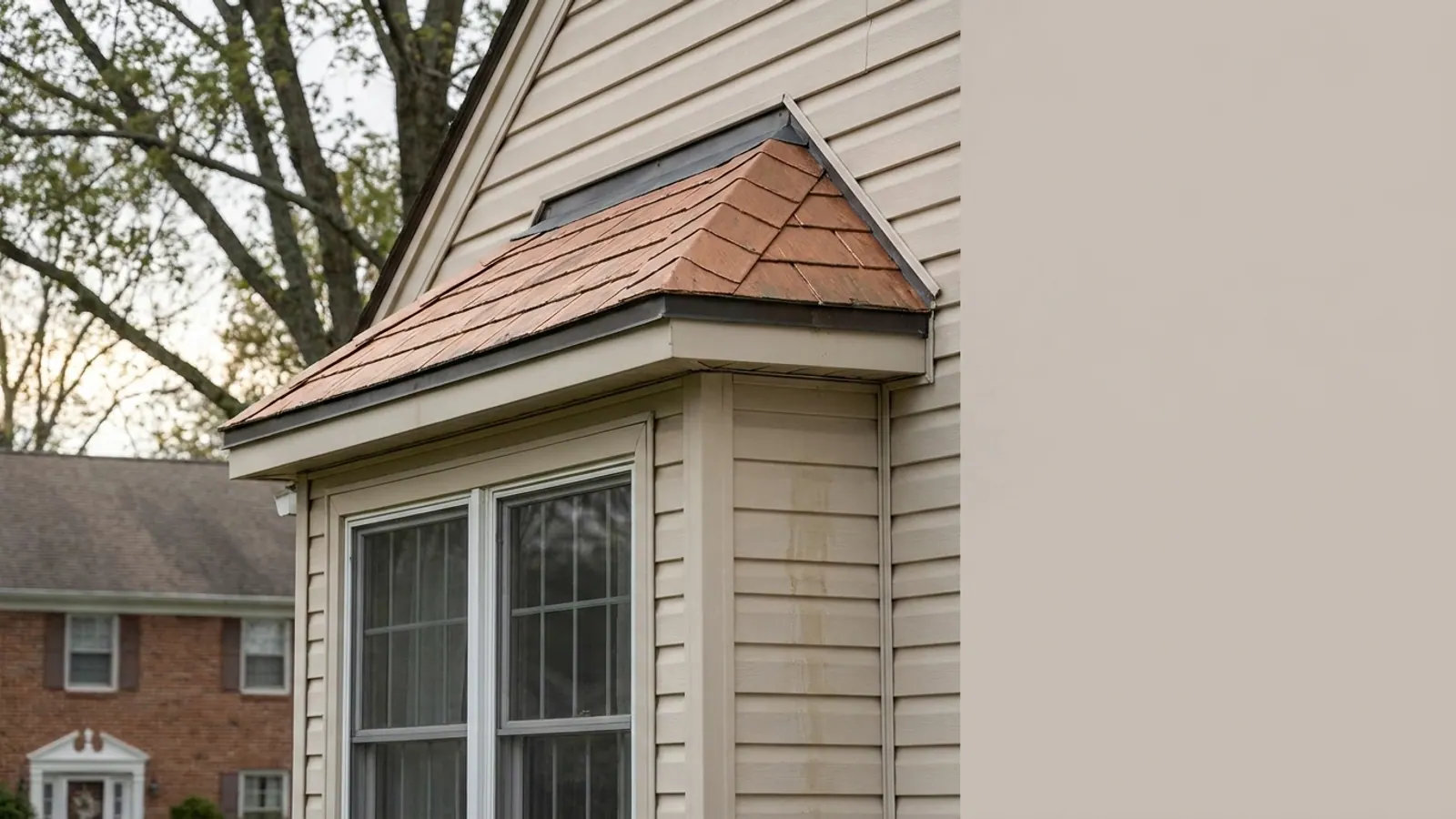
A typical bay roof has a headwall where the top of the hood meets the house, two sloped side returns running down to the corners, two or three short hips if it is an angled bay, a drip edge at the bottom, and a transition at each end where the roof meets siding on a different plane. That is six or seven detail points on a roof that might be twenty square feet. Every one of them depends on metal, not on shingles, and metal details depend on the order they were installed in.
The second problem is slope. Builders keep bay hoods shallow so they do not block the window above or stick out past the eave line. A shallow slope moves water slowly, holds debris and lets wind push rain back up under the courses. Combine a low slope with a wall above it, and you have a spot that gets wet and stays wet longer than anything else on the house.
The third is framing. A bump-out is frequently cantilevered off the floor joists with no foundation under it and no conditioned space wrapping it. Water that gets past the flashing lands on framing nobody has looked at since the house was built.
The five places water actually gets in
The headwall where the hood meets the siding
This is the number one failure. Water running down the wall above the bay has to be directed out on top of the hood roof, which means a continuous headwall flashing tucked up behind the house wrap and siding and lapped over the shingles below. On a lot of houses it is instead a strip of aluminum nailed on the face of the siding and sealed with caulk. Caulk has a service life. Siding and flashing do not move the same amount in New Jersey's temperature swings, the bead splits, and the wall above starts feeding the gap.
The side returns and the step flashing
Where the sloped sides of the hood run into the house wall, each shingle course needs its own piece of step flashing, woven in one piece per course and running up behind the siding. A single long strip of metal bent into the corner, which is what you find when a bay roof was redone cheaply, works for a couple of years and then leaks at every lap.
A low-slope or flat top on a wide bump-out
Some bump-outs are wide enough that the top of the hood is effectively flat. Asphalt shingles are not a flat-roof material and will not hold water that sits. The correct answer on a flat-topped bump-out is a membrane, and the flat and low-slope roofing guide covers how those systems are built and where the slope cutoff falls.
The drip edge and the bottom course
The front edge of the hood needs a drip edge so runoff leaves the metal instead of curling back under the sheathing. Without one, water wicks along the underside of the plywood and into the top of the window frame, which is why the stain often shows up inside the house at the window head rather than on the ceiling.
Ice at the roof edge
A bay roof catches the same snow the main roof does but has almost no mass behind it and often no insulation under it. Melt refreezes at the cold overhang, backs up under the shingles and finds every lap in the flashing. If you are seeing stains only in January and February, read the ice dams guide before you assume the roof covering failed.
How to tell whether it is the roof or something else
The same stain can come from four different sources. Match the pattern before anyone starts cutting.
| What you see | Most likely source |
|---|---|
| What you seeStain at the top of the window trim, worst in wind-driven rain | Most likely sourceHeadwall or step flashing above the hood |
| What you seeWater on the sill or the bottom corners, no stain above | Most likely sourceThe window unit or its own flashing, not the roof |
| What you seeStreaks on the siding below the hood, dry inside | Most likely sourceMissing drip edge or runoff splashing off the hood |
| What you seeDamp only during snowmelt | Most likely sourceIce backing up under the hood shingles |
| What you seeSoft, dark sheathing under the hood seen from outside | Most likely sourceLong-running flashing leak, rot already started |
If the water only arrives when rain comes sideways, that points at a vertical joint. Field leaks in shingles show up in any steady rain.
What a proper repair looks like
A bay hood repair that holds is not a tube of sealant. In order:
- Strip the hood shingles to the sheathing and probe for soft decking, especially at the headwall and at the front edge.
- Replace any sheathing that will not hold a nail.
- Open the siding above and alongside the hood far enough to get new flashing up behind the house wrap, not on top of the siding.
- Run ice and water shield across the whole hood, which is cheap on a surface that small and worth it at every one of those edges.
- Install new step flashing one piece per course on the side returns, a continuous headwall flashing lapped over the shingles, and a new drip edge at the front.
- Reshingle, then reinstall or replace the siding above so the flashing is covered but not sealed shut.
- Add a short gutter and downspout only if runoff is hitting siding or one spot of foundation.
If the plywood underneath has been wet for several seasons, expect rot in the hood framing too. That gets rebuilt before anything new goes on, because new flashing fastened to soft wood is temporary.
Is the bay roof included in a full replacement quote
It should be, and you should see it written down. When a full replacement is priced from the ground or off an aerial measurement, small hoods, dormer cheeks and bump-out roofs are exactly what gets missed, and then they turn into an extra on the day. Ask any contractor to state on the estimate that the bay or bump-out roof is included, that step and headwall flashing are new rather than reused, and what happens if decking under the hood is bad.
At Lightning Construction those answers are fixed before work starts. The free inspection is where extra shingle layers, bad decking and failed flashing get found, they get priced into the written estimate, and there are no change orders after that. There is no deposit either, so nothing is due until the job is finished and you have looked at it. Lightning pulls any required permit and attends the municipal inspection under the New Jersey Uniform Construction Code. Most asphalt roof replacements, bay hoods and all, are torn off and finished in a single day.
What it costs and what to ask for
A bay hood repair on its own is a small job and is priced as a repair, not as a roof. A full roof replacement in New Jersey runs $9,000 to $22,000 in standard-value towns and $14,000 to $35,000 in higher-value towns, with the band set by the municipality's median home value from ACS 2024 five-year estimates. Size, pitch, existing layers and the number of flashing details drive where you land inside that, and the roof cost guide breaks the drivers down.
Get photos. Any contractor working on a hood roof can stand on a ladder and shoot the headwall, the side returns and the sheathing once it is open. Photos before and after are the only way you will ever know whether the flashing went behind the siding or on top of it.
If you have a stain under a bay window and you are not sure what is feeding it, book a free inspection. It is genuinely no-obligation, a salesperson comes to the house, and you get the photos and a written price for either the small fix or the whole roof.